Abstract
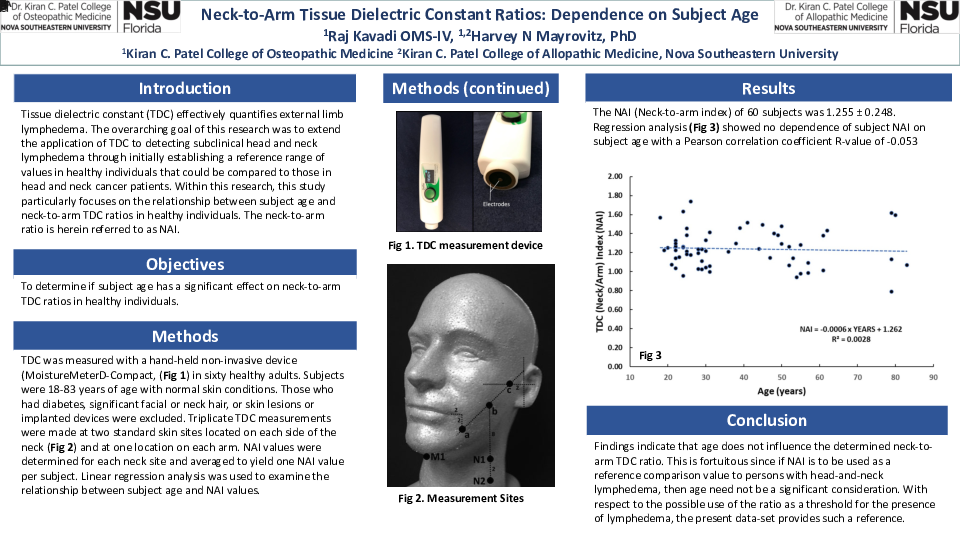
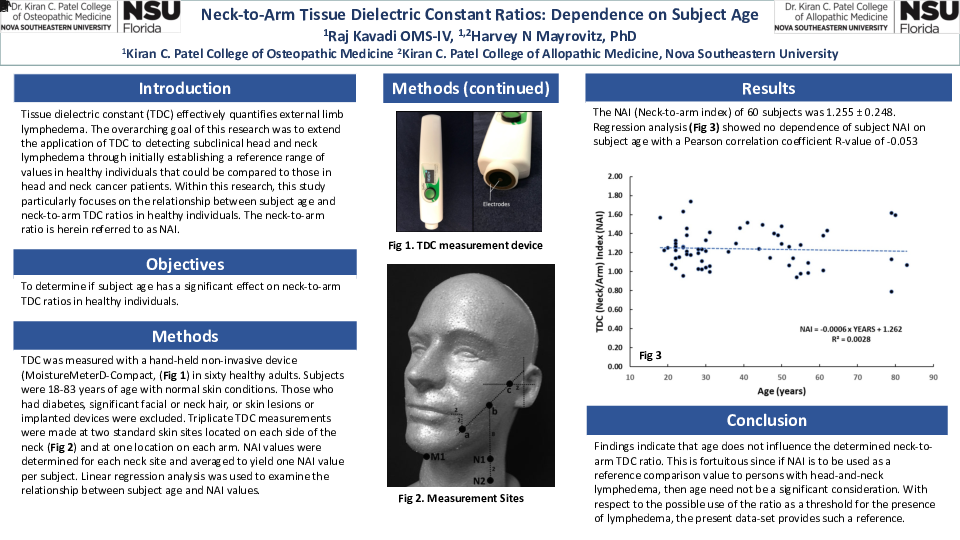
Background: In 2020, the incidence of cancer cases is expected to top 1.8 million and about 600,000 lives will be lost. Head and neck lymphedema, which is a common complication of head and neck cancer treatment, can be present in 90 percent of head and neck cancer patients within the first 18 months post treatment. This lymphedema may cause difficulties swallowing, breathing, body image dissatisfaction, abnormal head and neck mobility, and impaired nutrient intake. Lymphedema has been evaluated with a variety of scales, visual inspection, tape measurements, and palpation techniques, all with quantitative limitations. A new method using tissue dielectric constant (TDC) measurements stands out as a potentially effective way of measuring localized external limb lymphedema due to its sensitivity to skin-to-fat water content. However, its use in assessing head and neck lymphedema has not been investigated. The goal of this research was to create a reference range of TDC measurements in healthy individuals that could then be compared to those of cancer patients suffering from head and neck lymphedema.
Objective: Due to various age groups that can present with lymphedema, the specific aim of this study was to determine if subject age has a significant influence on neck-to-arm TDC ratios in healthy individuals. For convenience, this index is herein referred to as NAI.
Methods: This study was an IRB approved observational study that took place in a university setting. TDC was measured with a hand-held non-invasive device (MoistureMeterD-Compact) in sixty healthy adults after they signed an approved consent form. Subjects were 18-83 years of age, had normal skin conditions, and affirmed they had no history of lymphedema. Excluded were subjects that had diabetes, significant facial or neck hair, skin lesions or implanted devices. Triplicate TDC measurements were made at two standard skin sites located on each side of the neck and at one location on each arm. The TDC value depends on the interaction of a 300MHz signal reflected from the skin from which its water dependent TDC value is calculated. NAI values were determined for each neck site and averaged to yield one NAI value per subject. The dependence of this value on subject age was evaluated using linear regression analysis with subject age as the independent variable. Values are reported as mean ± SD.
Results: The overall NAI value of the 60 subjects was 1.255 ± 0.248. Regression analysis revealed no significant dependence of subject NAI on subject age based on a Pearson correlation coefficient R-value of -0.112 with a p-value of 0.395.
Conclusion: Based on the present findings it is concluded that age per se is a non-factor in the determined neck-to-arm TDC ratio. This is fortuitous since if NAI is to be used as a reference comparison value to persons with head-and-neck lymphedema, then age need not be a significant consideration. With respect to the possible use of the ratio as a threshold for the presence of lymphedema, the present dataset provides such a reference. It is suggested that this threshold should initially use the overall mean of the healthy population herein studied plus 2.5 SD which for the present data would be a threshold of 1.75. This potential threshold needs to be assessed in a clinical population of patients with head-and-neck lymphedema.