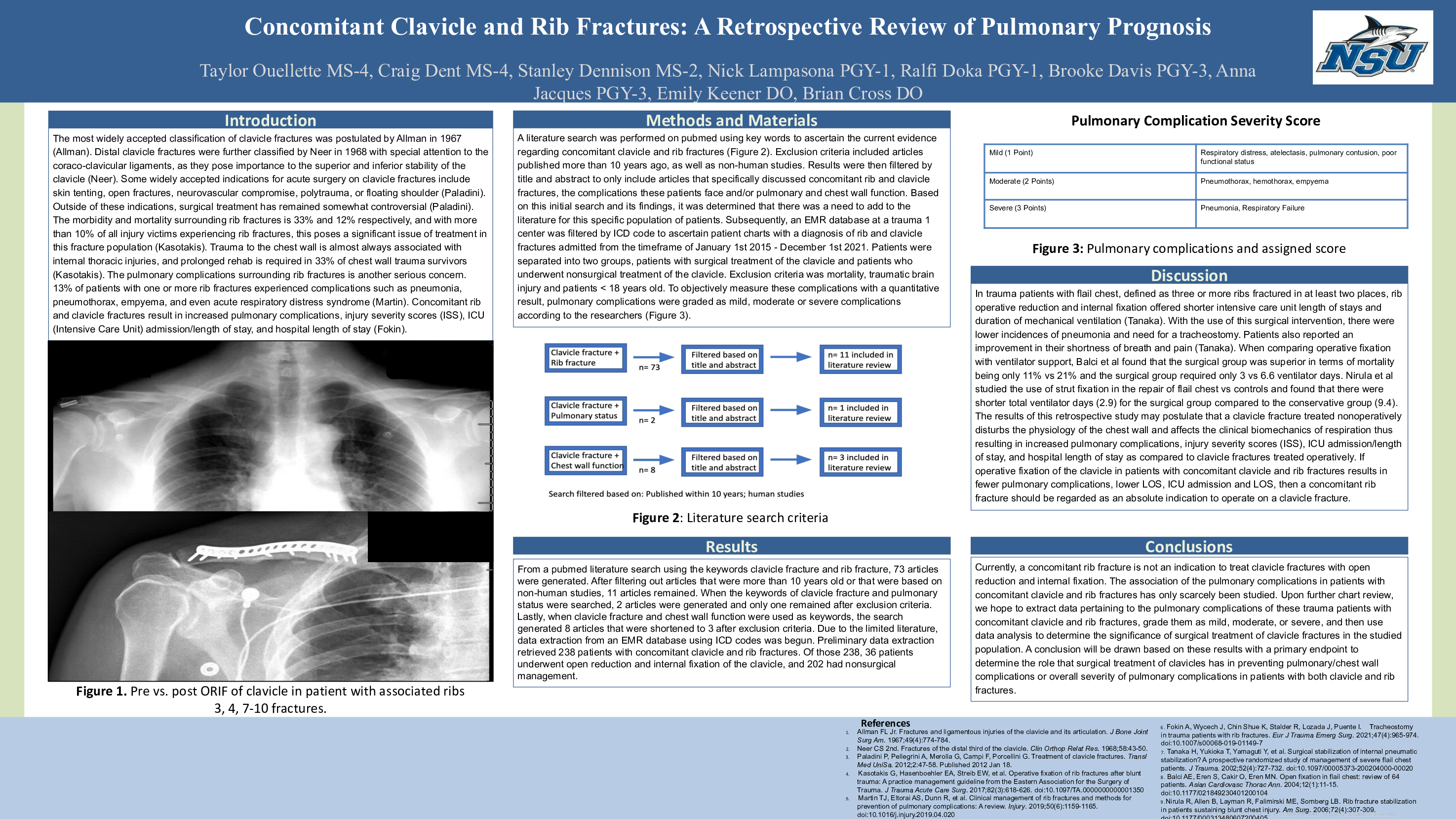
Abstract
Introduction: Indications for acute surgery on clavicle fractures include skin tenting, open fractures, neurovascular compromise, polytrauma, or floating shoulder (Paladini). Outside of these indications, surgical treatment has remained somewhat controversial (Paladini). The morbidity and mortality surrounding rib fractures is 33% and 12% respectively, and with more than 10% of all injury victims experiencing rib fractures, this poses a significant issue of treatment in this fracture population (Kasotakis).
Methods and Materials: A literature search was performed on pubmed using key words to ascertain the current evidence regarding concomitant clavicle and rib fractures. Exclusion criteria included articles published more than 10 years ago, as well as non-human studies. Results were then filtered by title and abstract to only include articles that specifically discussed concomitant rib and clavicle fractures, the complications these patients face and/or pulmonary and chest wall function. Based on this initial search and its findings, it was determined that there was a need to add to the literature for this specific population of patients. Subsequently, an EMR database at a trauma 1 center was filtered by ICD code to ascertain patient charts with a diagnosis of rib and clavicle fractures admitted from the timeframe of January 1st 2015 - December 1st 2021. Patients were separated into two groups, patients with surgical treatment of the clavicle and patients who underwent nonsurgical treatment of the clavicle. Exclusion criteria was mortality, traumatic brain injury and patients < 18 years old. To objectively measure these complications with a quantitative result, pulmonary complications were graded as mild, moderate or severe complications according to the researchers.
Results: From a pubmed literature search using the keywords clavicle fracture and rib fracture, 73 articles were generated. After filtering out articles that were more than 10 years old or that were based on non-human studies, 11 articles remained. When the keywords of clavicle fracture and pulmonary status were searched, 2 articles were generated and only one remained after exclusion criteria. Lastly, when clavicle fracture and chest wall function were used as keywords, the search generated 8 articles that were shortened to 3 after exclusion criteria. Due to the limited literature, data extraction from an EMR database using ICD codes was begun. Preliminary data extraction retrieved 238 patients with concomitant clavicle and rib fractures. Of those 238, 36 patients underwent open reduction and internal fixation of the clavicle, and 202 had nonsurgical management.
Discussion: The results of this retrospective study may postulate that a clavicle fracture treated nonoperatively disturbs the physiology of the chest wall and affects the clinical biomechanics of respiration thus resulting in increased pulmonary complications, injury severity scores (ISS), ICU admission/length of stay, and hospital length of stay as compared to clavicle fractures treated operatively. If operative fixation of the clavicle in patients with concomitant clavicle and rib fractures results in fewer pulmonary complications, lower LOS, ICU admission and LOS, then a concomitant rib fracture should be regarded as an absolute indication to operate on a clavicle fracture.