Abstract
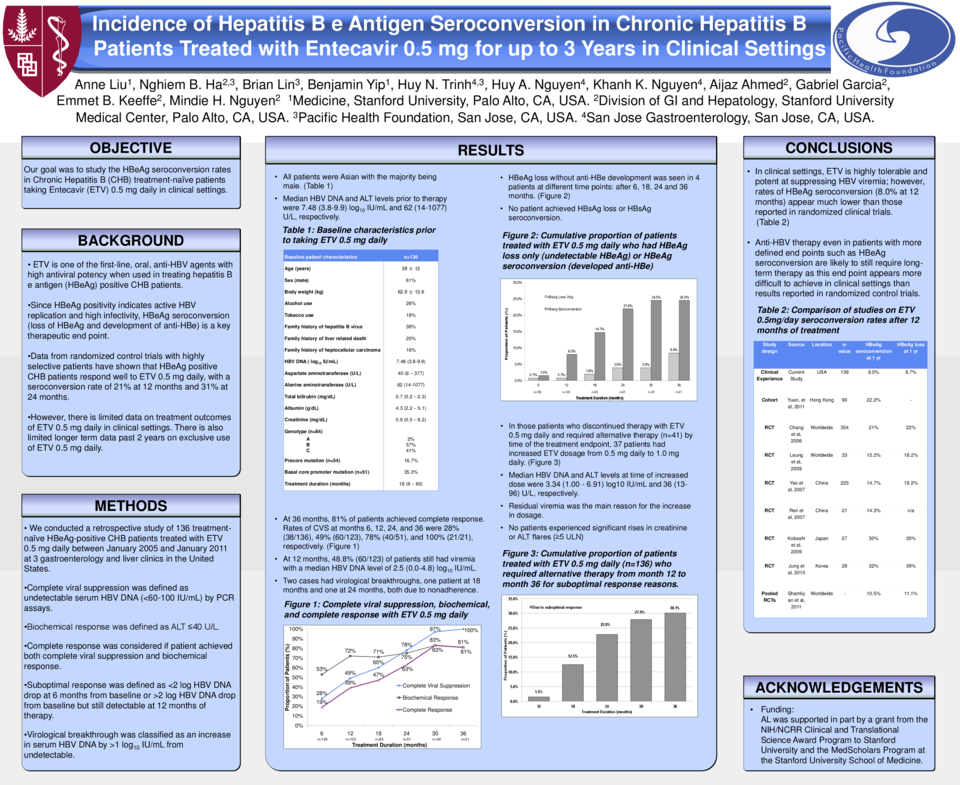
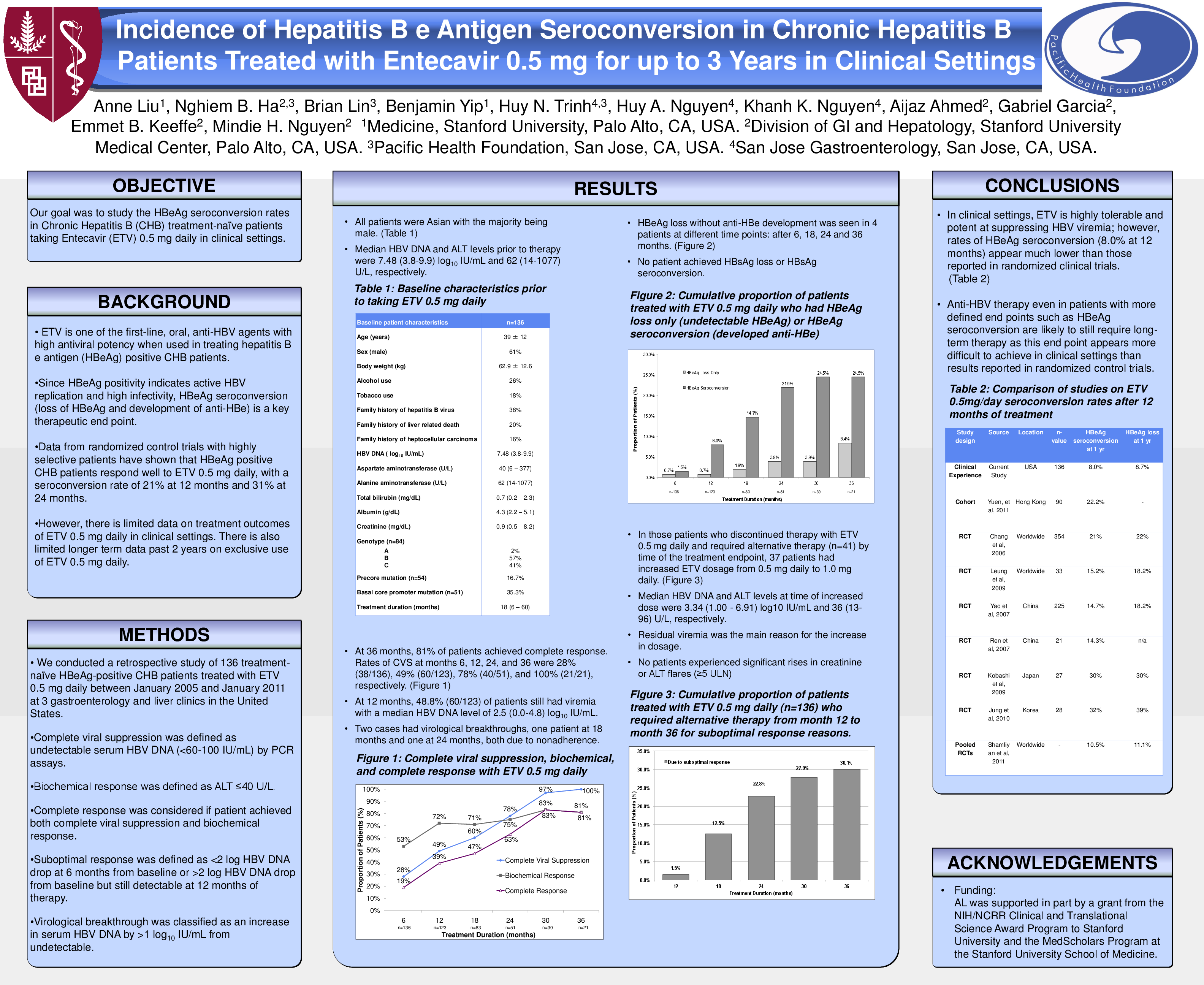
Purpose: Data from registration trials with highly selective patients have shown that hepatitis B e antigen (HBeAg) positive chronic hepatitis B (CHB) patients respond well to entecavir (ETV) 0.5 mg daily, with a seroconversion rate of 21% at 48 weeks. However, there is limited data on treatment outcomes to ETV 0.5 mg daily in clinical settings. Our goal was to examine treatment efficacy and tolerability of CHB patients treated with ETV 0.5 mg daily for up to 3 years in clinical settings. Methods: We conducted a retrospective cohort study of 137 consecutive treatment-naïve HBeAg-positive CHB patients treated with ETV 0.5 mg daily between January 2005 and September 2010 at 3 gastroenterology and liver clinics in the United States. Complete viral suppression (CVS) was defined as undetectable serum HBV DNA (<100 IU/mL). Suboptimal response was defined as <2 log HBV DNA drop at 6 months from baseline or >2 log HBV DNA drop from baseline but still detectable at 12 months. Results: The majority of patients was male (61%) with a mean age of 39±12 years. Prior to therapy, median HBV DNA and ALT levels were 7.6 (3.8-9.8) log10 IU/mL and 67 (12-1077) U/L, respectively. Median treatment duration was 21 (3-63) months. Rates of CVS at months 6, 12, 24, and 36 were 28% (38 out of 137), 49% (59 out of 120), 80% (39 out of 49), and 100% (18 out of 18), respectively. At 12 months, 61 out of 120 patients were still viremic with a median HBV DNA level of 3.5 (1.9-4.8) log10 IU/mL. Cumulative HBeAg seroconversion rates were 8.0%, 22.6%, and 25.2% at months 12, 24, and 36, respectively. The cumulative proportions of patients who had HBeAg clearance (undetectable HBeAg) and/or HBeAg seroconversion (developed anti-HBe) are shown in Figure 1. Cumulative rates of alternative therapy due to suboptimal response at months 12, 24, and 36 were 1.5%, 22.6%, and 26.3%, respectively. No patients experienced adverse events or developed genotypic resistance to ETV. Conclusions: In clinical settings, ETV is highly tolerable and potent at suppressing HBV viremia; however, rates of HBeAg seroconversion appear much lower than those reported in registration trials.