Abstract
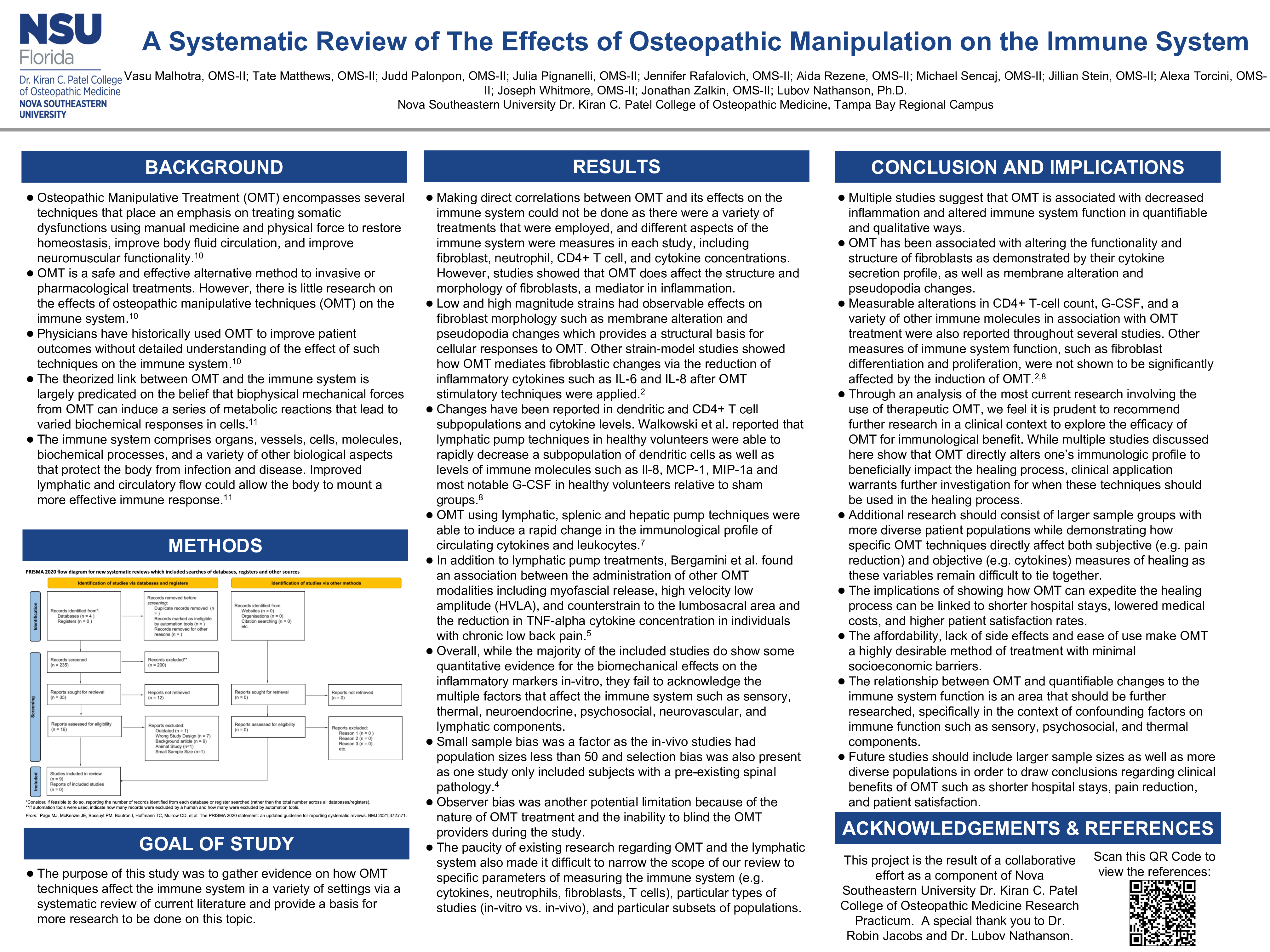
Osteopathic Manipulative Medicine (OMM) is a holistic approach to medicine that traditionally aims to treat a wide range of health conditions by facilitating the body’s ability to heal itself. It is a safe and effective alternative method to invasive or pharmacological treatments. However, there is little research on the effects of osteopathic manipulative techniques (OMT) on the immune system. More specifically, the degree to which OMT therapy benefits patients with a compromised immune system remains unclear. The purpose of this study was to gather evidence of how OMT strategies affect the immune system in a variety of settings via systematic review of current literature, and provide a basis for more research to be done on the topic. A computerized search of Embase, Google Scholar, Pubmed, and Medline was used in a systematic fashion to find articles that explored the relationship between OMT and the immune system. Using the Boolean/phrase (”Inflammation” OR “Immune system” OR “lymphatic” OR “Immune”); AND (“Osteopathic manipulation” OR “osteopathic manual” OR “osteopath”) 235 articles were screened. We extracted data from only those studies that contained quantitative results that met our inclusion criteria of 1) any Patient treated with OMT, 2) subjects with compromised immune system or pain, and 3) studies that included cytokines, inflammation markers, or immune molecules as their qualitative measures. 9 studies were retained for the final review. Multiple studies suggest that OMT is associated with decreased inflammation and altered immune system function in quantifiable and qualitative ways. OMT has been associated with altering the functionality and structure of fibroblasts as demonstrated by their cytokine secretion profile, as well as membrane alteration and pseudopodia changes. Measurable alterations in CD4+ T-cell count, G-CSF, and a variety of other immune molecules in association with OMT treatment were also reported throughout several studies. Other measures of immune system function, such as fibroblast differentiation and proliferation, were not shown to be significantly affected by the induction of OMT. The relationship between OMT and quantifiable changes to the immune system function is an area that should be further researched, specifically in the context of confounding factors on immune function such as sensory, psychosocial, and thermal components. Future studies should include larger sample sizes as well as more diverse populations in order to draw conclusions regarding clinical benefits of OMT such as shorter hospital stays, pain reduction, and patient satisfaction.