Abstract
Background:
Cognitive dysfunction (CD), a broad term, mainly incorporates all the aspects of decline in a person’s
cognition. It mainly encompasses deficits in attention, language, memory, visual-spatial processing,
executive function, processing speed, and motor functioning. Though age is the greatest risk factor of
CD, it is also a hallmark feature of many psychiatric disorders. In adolescents, CD is associated with
ADHD and MDD. Problematic internet use and increased screen time have led to detrimental changes in
neuropsychological domains, sleep issues, and depression. We aim to study the prevalence and
characteristics of cognitive dysfunction among US high school students and its association with time
spent on digital devices.
Methods
We performed a cross-sectional survey study using YRBSS 2019 data of US high school students in
grades 9-12. CD was defined as difficulties in recall, concentration, and decision making due to
emotional, physical, or mental problems. Digital screen time included daily time spent on TV,
computers, tablets, and phone. Univariate and multivariable survey logistic regression analysis was
applied to identify the prevalence of CD and its association with time spent on digital devices. Variables
such as age, sex, race/ethnicity, grades, substance abuse, sleep duration, sadness, and self-reported CD
were included in the study.
Results
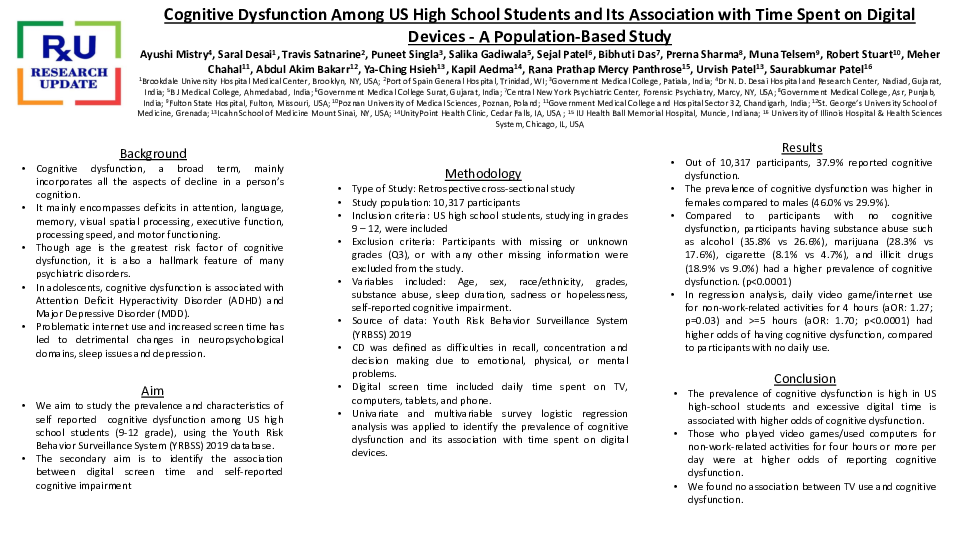
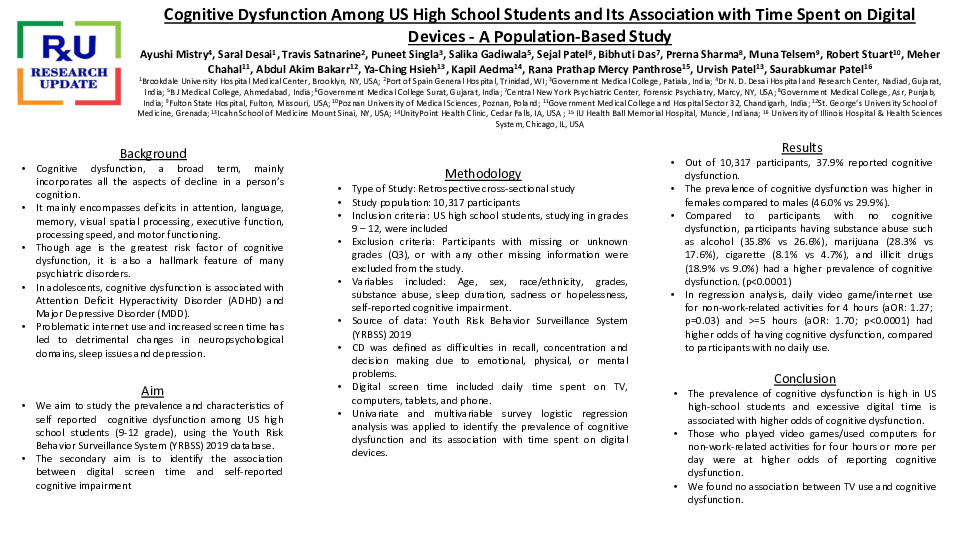
Out of 10,317 participants, 37.9% reported CD. The prevalence of CD was higher in females compared to
males (46.0% vs 29.9%). Compared to participants with no CD, participants having substance abuse such
as alcohol (35.8% vs 26.6%), marijuana (28.3% vs 17.6%), cigarette (8.1% vs 4.7%), and illicit drugs
(18.9% vs 9.0%) had a higher prevalence of CD. (p<0.0001) In regression analysis, daily video
game/internet use for non-work-related activities for 4 hours (aOR: 1.27; p=0.03) and >=5 hours (aOR:
1.70; p<0.0001) had higher odds of having CD, compared to participants with no daily use, as
summarized in Table 1 (attached file separately)
Conclusion
The prevalence of CD is high in US high-school students and excessive digital time is associated with
higher odds of cognitive dysfunction. Those who played video games/used computers for non-work-
related activities for four hours or more per day were at higher odds of reporting CD. We found no
association between TV use and CD.