Abstract
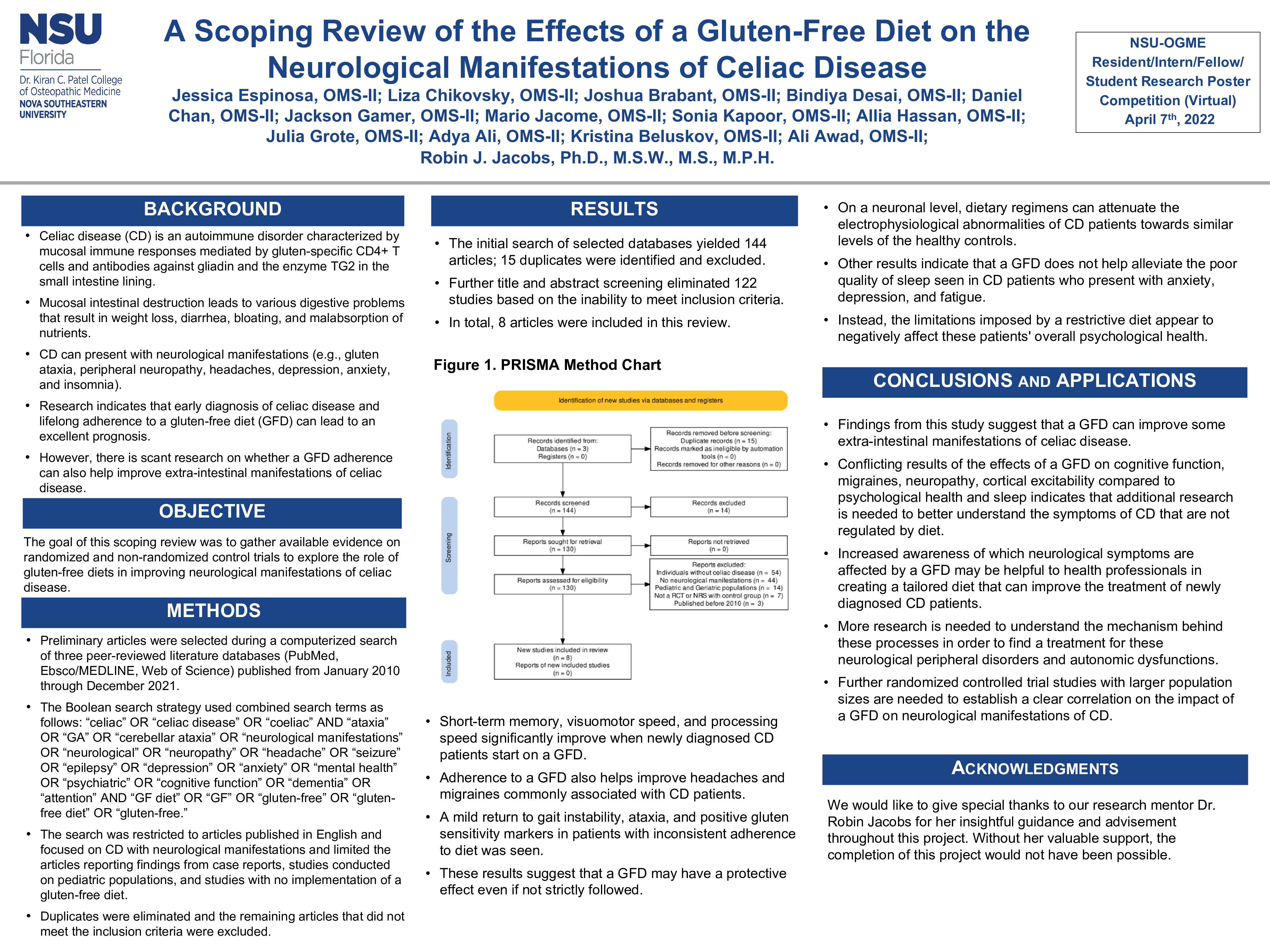
Background: Celiac disease (CD) is an immune disorder that damages the lining of the small intestine due to consumption of gluten. The primary manifestation of this disease causes digestive problems that result in weight loss, diarrhea, bloating, and malabsorption of nutrients. The main treatment for these complications is a lifelong adherence to a gluten-free diet (GFD). There is extensive research that has shown that early diagnosis of celiac disease and strict eradication of all gluten-containing foods from the diet can lead to an excellent prognosis in patients. However, celiac disease can also present with neurological manifestations such as gluten ataxia, peripheral neuropathy, headaches, depression, anxiety, and insomnia. There is scant research on whether GFD adherence can also help improve extra-intestinal manifestations of celiac disease.
Objective: The goal of this scoping review was to gather available evidence on randomized and non-randomized control trials to explore whether a gluten-free diet can improve the neurological manifestations of celiac disease.
Methods: We conducted a scoping review to gather available evidence from randomized and non-randomized control trials. Following PRISMA guidelines, we searched peer-reviewed literature published from January 2010 through December 2021 using databases PubMed, Ebsco/MEDLINE, and Web of Science. We restricted the search to articles published in English and focused on celiac disease with neurological manifestations and limited the articles reporting findings from case reports, studies conducted on pediatric populations, and studies with no implementation of gluten-free diet. We used a Boolean search strategy, which combined search terms as follows: “celiac” OR “celiac disease” OR “coeliac” AND “ataxia” OR “GA” OR “cerebellar ataxia” OR “neurological manifestations” OR “neurological” OR “neuropathy” OR “headache” OR “seizure” OR “epilepsy” OR “depression” OR “anxiety” OR “mental health” OR “psychiatric” OR “cognitive function” OR “dementia” OR “attention” AND “GF diet” OR “GF” OR “gluten free” OR “gluten free diet” OR “gluten-free”.
Results: Our initial search yielded 144 records. After screening for relevance and conducting cross-validation, 8 articles were selected. Findings suggest that strict adherence to a gluten-free diet can help improve neurological manifestations of celiac disease such as headaches, migraines, brain fog, neuropathy, and overall physical health. However, dietary changes did not improve sleep disorders, rather the imposed limitations of a restrictive diet decreased overall physical health.
Conclusion: Results of this study suggest that a GFD may play a key role in controlling neurological manifestations of celiac disease. Nonetheless, additional research is needed to identify those conditions that form part of the spectrum of signs and symptoms of CD and are not regulated by diet. This might allow health professionals to create a personalized diet that can improve prognosis of newly diagnosed CD patients.