Abstract
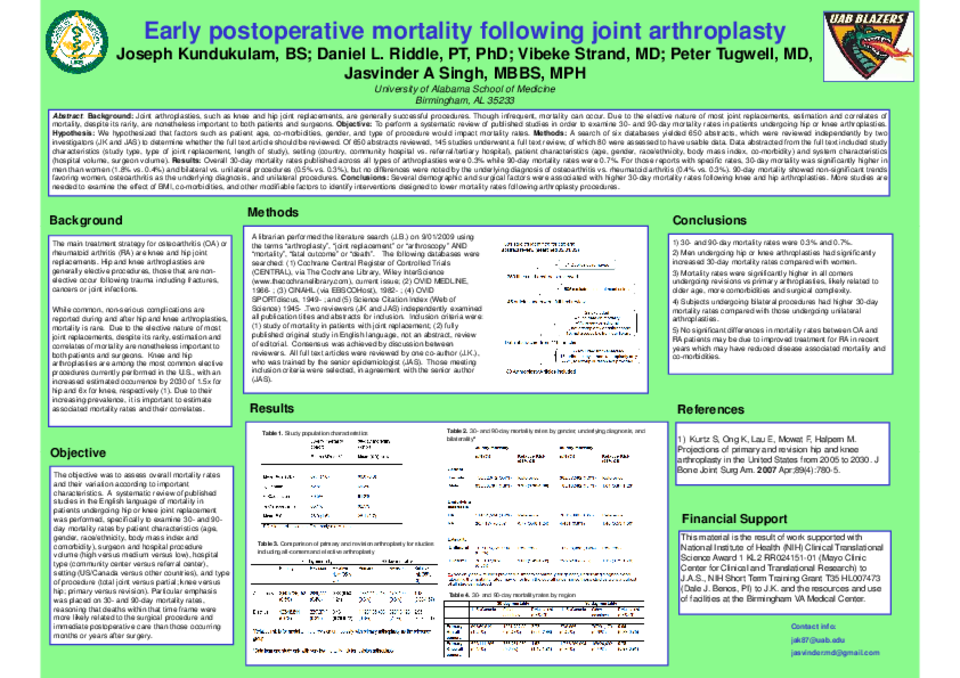
Background: Joint arthroplasties, such as knee and hip joint replacements, are generally successful procedures. Though infrequent, mortality can occur. Due to the elective nature of most joint replacements, estimation and correlates of mortality, despite its rarity, are nonetheless important to both patients and surgeons.
Objective: To perform a systematic review of published studies in order to examine 30- and 90-day mortality rates in patients undergoing hip or knee arthroplasties.
Hypothesis: We hypothesized that factors such as patient age, co-morbidities, gender, and type of procedure would impact mortality rates.
Methods: A search of six databases yielded 650 abstracts, which were reviewed independently by two investigators (JK and JAS) to determine whether the full text article should be reviewed. Of 650 abstracts reviewed, 145 studies underwent a full text review, of which 80 were assessed to have usable data. Data abstracted from the full text included study characteristics (study type, type of joint replacement, length of study), setting (country, community hospital vs. referral/tertiary hospital), patient characteristics (age, gender, race/ethnicity, body mass index, co-morbidity) and system characteristics (hospital volume, surgeon volume).
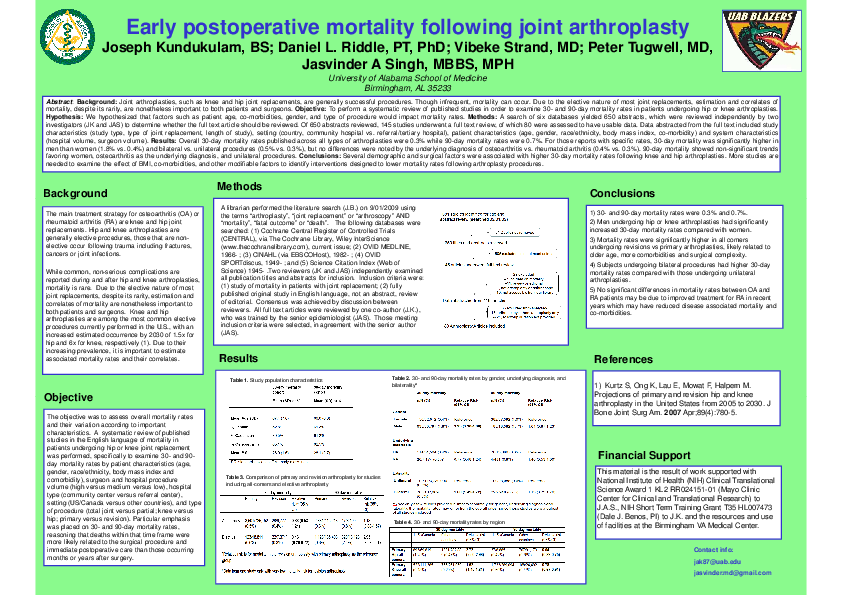
Results: Overall 30-day mortality rates published across all types of arthroplasties were 0.3% while 90-day mortality rates were 0.7%. For those reports with specific rates, 30-day mortality was significantly higher in men than women (1.8% vs. 0.4%) and bilateral vs. unilateral procedures (0.5% vs. 0.3%), but no differences were noted by the underlying diagnosis of osteoarthritis vs. rheumatoid arthritis (0.4% vs. 0.3%). 90-day mortality showed non-significant trends favoring women, osteoarthritis as the underlying diagnosis, and unilateral procedures.
Conclusions: Several demographic and surgical factors were associated with higher 30-day mortality rates following knee and hip arthroplasties. More studies are needed to examine the effect of BMI, co-morbidities, and other modifiable factors to identify interventions designed to lower mortality rates following arthroplasty procedures.