This account has been removed.

Videogames and Robotic Surgical Competency: A Scoping Review


Abstract

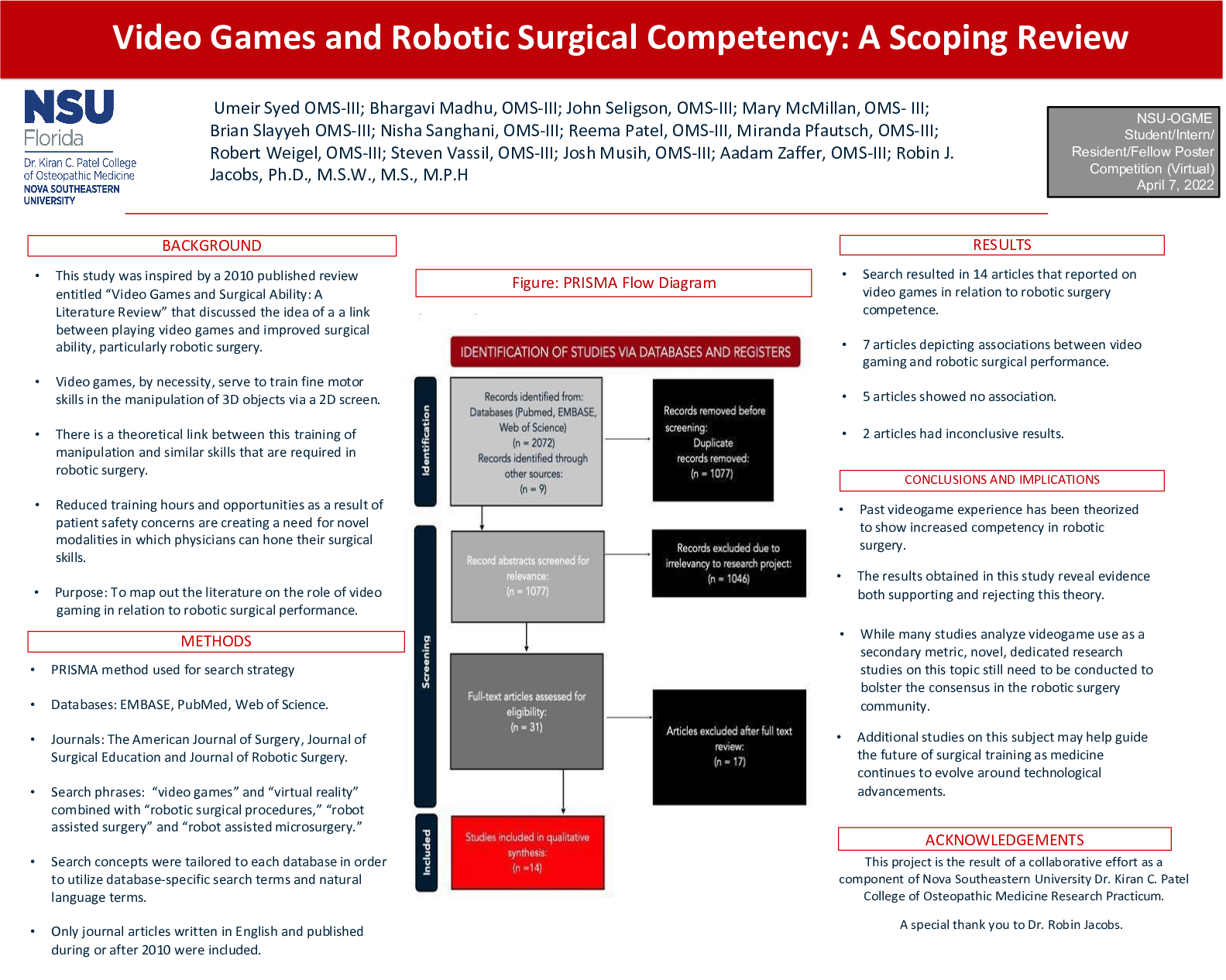
Background: Video games have been proposed to improve hand-eye coordination and manual dexterity. With the increase in complexity over time of robotic surgical tasks, the use of novel skills training and educational backgrounds is becoming a popular topic of discussion. If a connection can be made between the skill development of videogame experience and its application to robotic surgery, shorter training times and better surgical outcomes could be achieved.

Objective: To map out the literature on the role of video gaming in relation to robotic surgical performance.

Materials and Methods: Search was conducted in databases (EMBASE, PubMed, Web of Science) and related journals (The American Journal of Surgery, Journal of Surgical Education and Journal of Robotic Surgery). Search concepts included “video games” and “virtual reality” combined with “robotic surgical procedures,” “robot assisted surgery” and “robot assisted microsurgery.” Additionally, search concepts were tailored to each database in order to utilize database-specific search terms and natural language terms. Only journal articles written in English and published during or after 2010 were included. 

Results: Our search resulted in 14 articles that reported on video games in relation to robotic surgery competence. We arranged the articles into categories with 7 positive correlations, 5 negative correlations, and 2 neutral correlations.

Conclusion: Past video game experience has been theorized to show increased competency in robotic surgery. The results obtained in this study reveal evidence supporting and denying this theory. While many studies analyze video game use as a secondary metric, novel, dedicated research studies on this topic need to be conducted to bolster the consensus in the robotic surgery community. 

Poster
non-peer-reviewed

Videogames and Robotic Surgical Competency: A Scoping Review


Author Information

Umeir Syed

Osteopathic Medicine, Nova Southeastern University Dr. Kiran C. Patel College of Osteopathic Medicine, Clearwater, USA

Bhargavi Madhu Corresponding Author

Dr. Kiran C. Patel College of Osteopathic Medicine, Nova Southeastern University, Fort Lauderdale, USA

John Seligson

Dr. Kiran C. Patel College of Osteopathic Medicine, Nova Southeastern University, Fort Lauderdale, USA

Mary McMillan

Dr. Kiran C. Patel College of Osteopathic Medicine, Nova Southeastern University, Fort Lauderdale, USA

Brian Slayyeh

Dr. Kiran C. Patel College of Osteopathic Medicine, Nova Southeastern University, Fort Lauderdale, USA

Nisha Sanghani

Dr. Kiran C. Patel College of Osteopathic Medicine, Nova Southeastern University, Fort Lauderdale, USA

Reema S. Patel

Osteopathic Medicine, Nova Southeastern University Dr. Kiran C. Patel College of Osteopathic Medicine, Ocala, USA

Miranda Pfautsch

Basic Sciences, Nova Southeastern University Dr. Kiran C. Patel College of Osteopathic Medicine, Clearwater, USA

Robert Weigel

Dr. Kiran C. Patel College of Osteopathic Medicine, Nova Southeastern University, Fort Lauderdale, USA

Steven Vassil

Dr. Kiran C. Patel College of Osteopathic Medicine, Nova Southeastern University, Fort Lauderdale, USA

Josh Musih

Dr. Kiran C. Patel College of Osteopathic Medicine, Nova Southeastern University, Fort Lauderdale, USA

Aadam Zaffer

Dr. Kiran C. Patel College of Osteopathic Medicine, Nova Southeastern University, Fort Lauderdale, USA

Robin J. Jacobs

Medical and Behavioral Research; Health Informatics; Medical Education, Nova Southeastern University, Fort Lauderdale, USA


PDF Share