Abstract
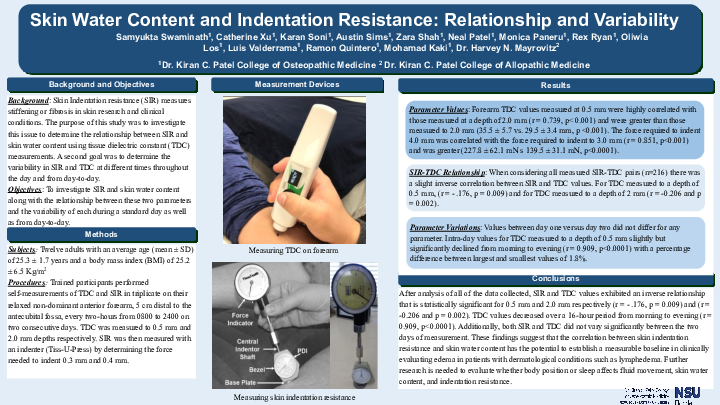
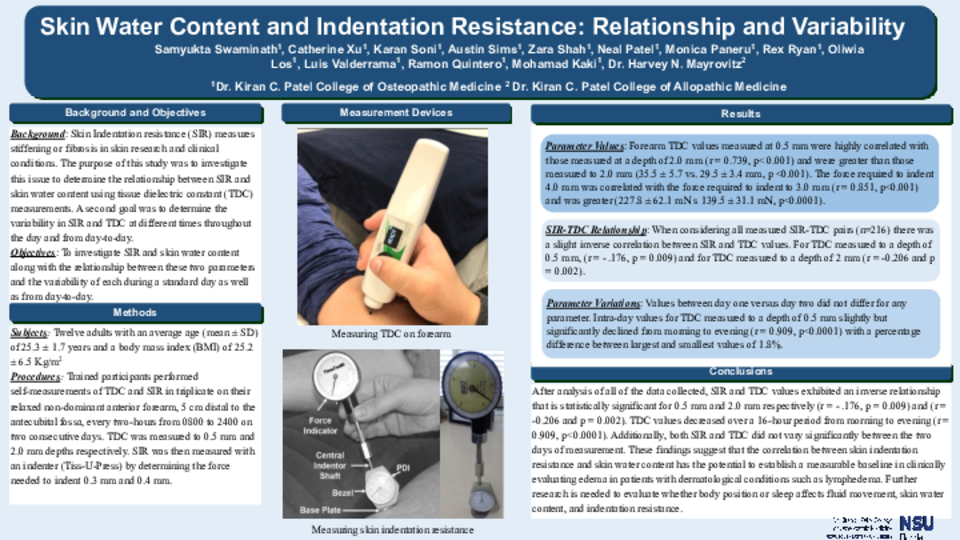
Background: Skin Indentation resistance (SIR) measures stiffening or fibrosis in skin research and clinical conditions. The purpose of this study was to investigate this issue to determine the relationship between SIR and skin water content using tissue dielectric constant (TDC) measurements. A second goal was to determine the variability in SIR and TDC at different times throughout the day and from day-to-day.
Objective: To investigate SIR and skin water content along with the relationship between these two parameters and the variability of each during a standard day as well as from day-to-day.
Methods: Subjects: Twelve adults with an average age (mean ± SD) of 25.3 ± 1.7 years and a body mass index (BMI) of 25.2 ± 6.5 Kg/m2 Procedures: Trained participants performed self-measurements of TDC and SIR in triplicate on their relaxed non-dominant anterior forearm, 5 cm distal to the antecubital fossa, every two-hours from 0800 to 2400 on two consecutive days. TDC was measured to 0.5 mm and 2.0 mm depths respectively. SIR was then measured with an indenter (Tiss-U-Press) by determining the force needed to indent 0.3 mm and 0.4 mm.
Results: Parameter Values: Forearm TDC values measured at 0.5 mm were highly correlated with those measured at a depth of 2.0 mm (r = 0.739, p< 0.001) and were greater than those measured to 2.0 mm (35.5 ± 5.7 vs. 29.5 ± 3.4 mm, p <0.001). The force required to indent 4.0 mm was correlated with the force required to indent to 3.0 mm (r = 0.851, p<0.001) and was greater (227.8 ± 62.1 mN s 139.5 ± 31.1 mN, p<0.0001). SIR-TDC Relationship: When considering all measured SIR-TDC pairs (n=216) there was a slight inverse correlation between SIR and TDC values. For TDC measured to a depth of 0.5 mm, (r = - .176, p = 0.009) and for TDC measured to a depth of 2 mm (r = -0.206 and p = 0.002). Parameter Variations: Values between day one versus day two did not differ for any parameter. Intra-day values for TDC measured to a depth of 0.5 mm slightly but significantly declined from morning to evening (r = 0.909, p<0.0001) with a percentage difference between largest and smallest values of 1.8%.
Conclusions: After analysis of all of the data collected, SIR and TDC values exhibited an inverse relationship that is statistically significant for 0.5 mm and 2.0 mm respectively (r = - .176, p = 0.009) and (r = -0.206 and p = 0.002). TDC values decreased over a 16-hour period from morning to evening (r = 0.909, p<0.0001). Additionally, both SIR and TDC did not vary significantly between the two days of measurement. Further research is needed to evaluate whether body position or sleep affects fluid movement, skin water content, and indentation resistance.