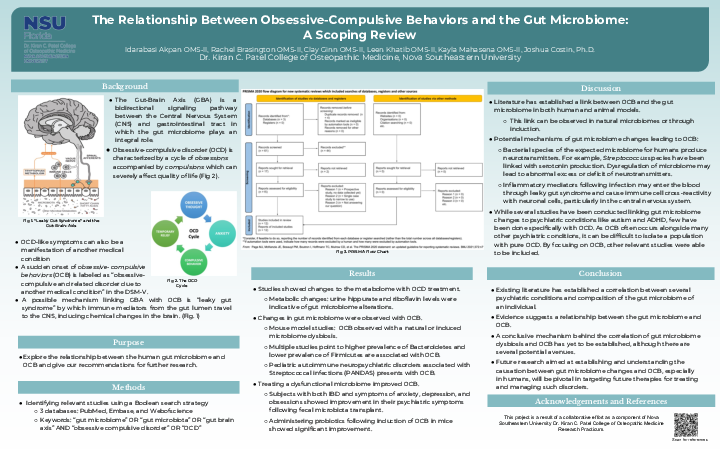
Abstract
The goal of our scoping review aims to analyze and expose the current understanding of a possible relationship between the gut-brain-axis (GBA) and obsessive compulsive behaviors (OCB), highlight any discrepancies in research or gaps in our current knowledge, and give our recommendations for further research. A Boolean search strategy was used in the following 3 databases: PubMed, Embase, and Webofscience. Three specific search terms were combined: “gut microbiome” OR “gut microbiota” OR “gut brain axis” AND “obsessive compulsive disorder” OR “OCD”. Initial searches yielded 61 results. After screening for appropriateness, relevance, and validity, 12 articles were agreed upon, including results from animal studies (n=7) and 8 human studies (n=8). Studies showed changes to the metabolome with obsessive compulsive disorder (OCD) treatment, gut microbiome compositions and diversity. Inactivation of certain microbiome compositions was linked with the induction of OCD and addition of protective microbiome compositions was linked with the decrease of OCD. A proposed mechanism connecting the gut and the brain is “leaky-gut-syndrome” where immune mediators from the lumen of the gut into the blood vessels beneath can travel to the central nervous system and induce changes to the brain. Current studies have shown that including the evaluation of the gut microbiome is important for the treatment and management of patients with obsessive-compulsive behaviors as part of their clinical picture. Future research needs to focus on human subjects with a diagnosis of OCD, incorporating a homogenous control group for robust comparison of gut microbiota. Specifically, studies should be aimed at establishing a causal relationship between OCB/OCD and GBA by identifying the specific bacteria prevalent in disordered human gut microbiota.