
Abstract
Background: The SARS-CoV-2 epidemic started in December 2019 and continues to affect
people all around the globe. A risk factor that has been shown to lead to increase death is preexisting
diabetes mellitus, which has increased in incidence by 41% in the past decade in the
United States.
Objective: This scoping review aimed to gather available evidence on the treatment outcomes,
length of hospitalization, and mortality rates of patients hospitalized with COVID-19 and treated
for type 2 diabetes mellitus and compare the results with different type 2 diabetes mellitus
medications. At this time, drug regimens which can lead to decreased mortality and length of
hospital stay in patients simultaneously affected with COVID-19 and diabetes mellitus type 2 has
not been stated.
Methods: We gathered available evidence on outcomes for treatment of type 2 diabetes mellitus
in patients hospitalized with COVID-19. Specifications used in prioritization of outcomes
include addressing factors such as length of hospital stay, development/absence of
complications, recovery rate, mortality rate, tolerance with comorbidities, etc. We searched
through Pubmed, NCVI, and EBSCO to gather results. Articles used were restricted to those
published in English and focused on Type 2 diabetes mellitus patients hospitalized with COVID-
19 and limited to articles reporting findings from non-hospitalized patients. We used a Boolean
search strategy, which combined search terms as follows: (((((type 2 diabetes) and (COVID-19))
and (mortality)) and (hospitalized)) and (treatment)) not (type 1 diabetes)) not (out-patient)) and
(metformin or DPP-4 or hydroxychloroquine).
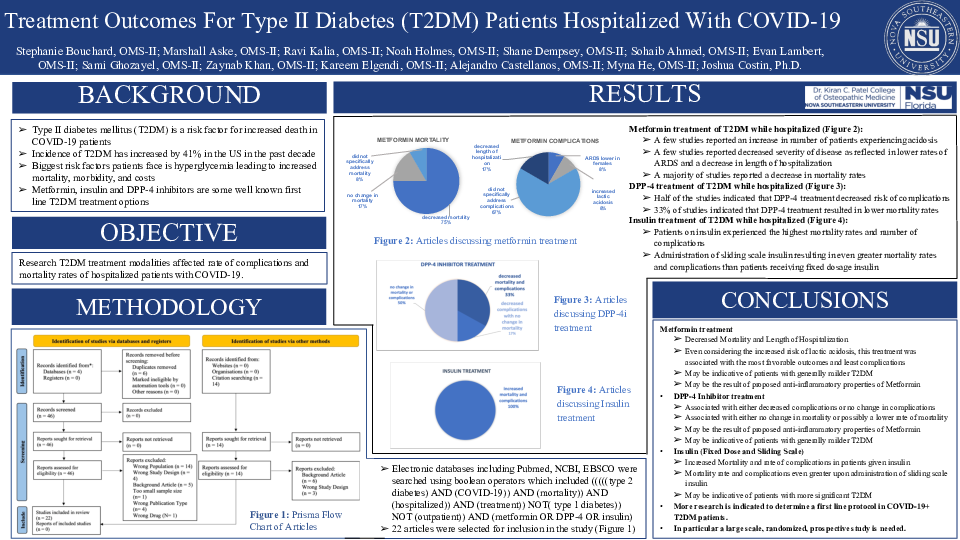
Results: Our initial search yielded 69 articles. After screening for relevance and
inclusion/exclusion criteria, 22 articles were selected. 50% of articles (n= 11) directly discussed
effects of metformin. 32% of articles (n=7) directly discussed effects of DDP-4 inhibitors. 10%
of articles (n=2) directly discussed efficacy of insulin by using either the sliding scale or fixed
dose insulin. The most significant and consistent beneficial outcomes seen among various
therapeutic approaches was with Metformin finding decreased mortality. DDP-4 inhibitors
studies did not consistently find significant results with most studies noting no change in
mortality, hospital stay or complications. Insulin studies noted increased mortality overall, while
some studies specifically noted sliding scale to be worse than fixed dose insulin.
Conclusions: Findings from our scoping review comparing the mortality, length of hospital stay,
and complications state that the incorporation of metformin therapy for diabetes control in
patient hospitalized with COVID-19 infection had decreased mortality over other first line
glucose lowering therapies. DDP-4 inhibitors failed to show positive or negative effects on
mortality, length of hospital stay, or complications relative to other second and third line diabetic
glucose lowering therapies. In addition, fixed dose insulin had increased mortality, especially
sliding scale insulin. Future research is needed to assess the standardization and control of
different baseline risk factors in patients on varying glucose lowering treatments to concretely
state the direct effects of specific treatment approaches.




