Abstract
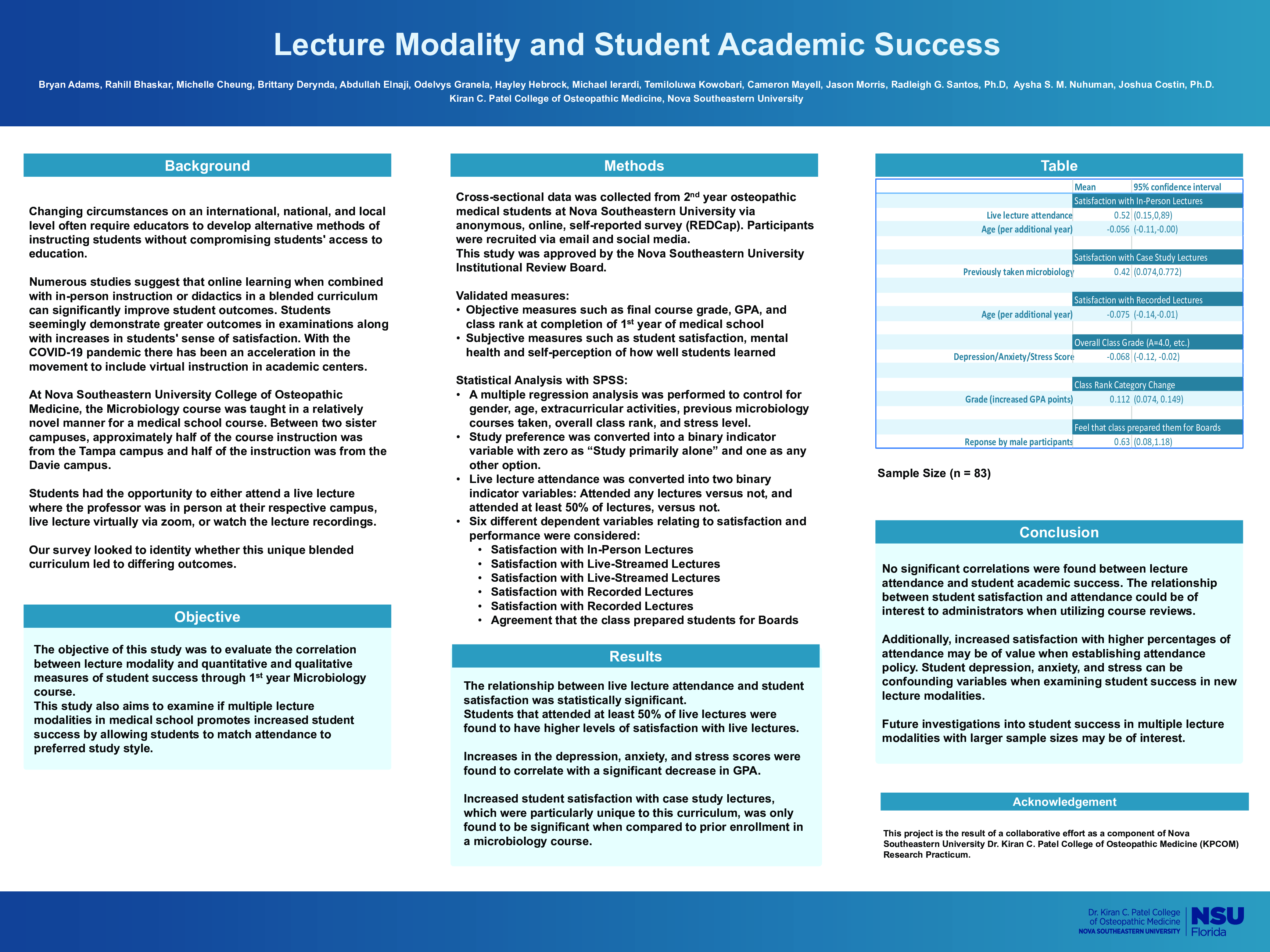
Background: Changing circumstances on an international, national, and local level often require educators to develop alternative methods of instructing students, without compromising students' access to education. Numerous studies suggest that online learning when combined with in-person instruction or didactics in a blended curriculum can significantly improve student outcomes. Students seemingly demonstrate greater outcomes in examinations along with increases in students' sense of satisfaction. With the COVID-19 pandemic, there has been an acceleration in the movement to include virtual instruction in academic centers. At Nova Southeastern University College of Osteopathic Medicine, the Microbiology course was taught in a relatively novel manner for a medical school course. Between the two sister campuses, approximately half of the course instruction was from the Tampa campus and the other half was from the Davie campus. Students had the opportunity to either attend a live lecture where the professor was in person at their respective campus, live lecture virtually via zoom, or watch the lecture recordings. Our survey looked to identity whether this unique blended curriculum led to differing outcomes.
Objective: The objective of this study was to determine if increased live lecture attendance in a medical school microbiology course correlates with increased student success and satisfaction. This study aims to determine if case study style lectures increase student satisfaction as well as increase a student's subjective perception of learning. This study also aims to examine if multiple lecture modalities in medical school promotes increased student success by allowing students to match attendance to preferred study style.
Methods: An anonymous online survey was created through RedCap and distributed to second year medical students at Nova Southeastern University Dr. Kiran C Patel College of Osteopathic Medicine via email (N=83). The survey included a demographic section, questions relating to mental health at the time of course, questions pertaining to percent of live lectures attended, and student satisfaction for each lecture modality. Student academic success was measured with final course grade and GPA at completion of first year of medical school with class rank.
Results: The relationship between live lecture attendance and student satisfaction was statistically significant. Students that attended at least 50% of live lectures were found to have higher levels of satisfaction with live lectures. Increases in the depression, anxiety, and stress score were found to correlate with a significant decrease in GPA. Increased student satisfaction with case study lectures, which were particularly unique to this curriculum, was only found to be significant when compared to prior enrollment in a microbiology course.
Conclusion: No significant correlations were found between lecture attendance and student academic success. The relationship between student satisfaction and attendance could be of interest to administrators when utilizing course reviews. Additionally, increased satisfaction with higher percentages of attendance may be of value when establishing attendance policy. Student depression, anxiety, and stress could be confounding variables when examining student success in new lecture modalities. Future investigations into student success in multiple lecture modalities with larger sample sizes may be of interest.