Abstract
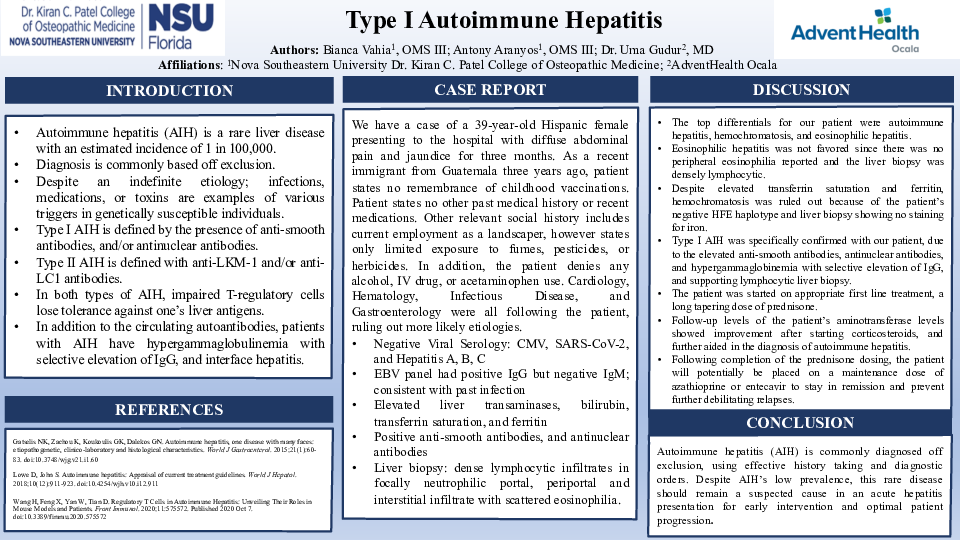
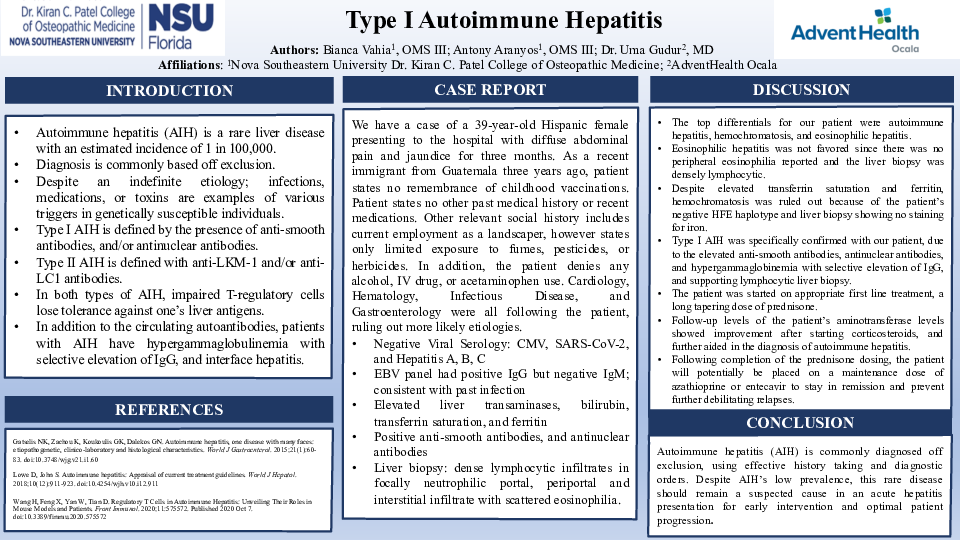
Introduction: Autoimmune hepatitis (AIH) is a rare liver disease with an estimated incidence of 1 in 100,000, carrying a low diagnostic suspicion as a result. Diagnosis is commonly based off exclusion. Despite an indefinite etiology, infections, medications, or toxins are examples of various triggers in genetically susceptible individuals. In both types of AIH, impaired T-regulatory cells lose tolerance against one’s liver antigens.
Case Description: We have a case of a 39-year-old Hispanic female presenting to the hospital with diffuse abdominal pain and jaundice for three months. As a recent immigrant from Guatemala three years ago, patient states no remembrance of childhood vaccinations. Patient states no other past medical history or recent medications. Other relevant social history includes current employment as a landscaper, however states only limited exposure to fumes, pesticides, or herbicides. In addition, the patient denies any alcohol, IV drug, or acetaminophen use.
Cardiology, Hematology, Infectious Disease, and Gastroenterology were all following the patient, ruling out more likely etiologies. The patient’s lab results included a negative viral serology for CMV, SARS-CoV-2, and Hepatitis A,B,C. The EBV panel was positive IgG and negative IgM, however consistent with past infection. Additional lab results showed elevated liver transaminases, bilirubin, anti-smooth antibodies, antinuclear antibodies, transferrin saturation, and ferritin. For confirmatory measures, a liver biopsy showed dense lymphocytic infiltrates in focally neutrophilic portal, periportal and interstitial infiltrate with scattered eosinophilia. These liver biopsy findings and a negative HFE haplotype effectively eliminated eosinophilic hepatitis and hemochromatosis as other remaining etiologies. With a liver biopsy and antibodies consistent with AIH, our patient was started on appropriate first line treatment, a long tapering dose of prednisone. Follow-up levels of the patient’s aminotransferase levels showed improvement after starting corticosteroids, and further aided in the diagnosis of autoimmune hepatitis. Following completion of the prednisone dosing, the patient will potentially be placed on a maintenance dose of azathioprine or entecavir to stay in remission and prevent further debilitating relapses.
Discussion: Autoimmune hepatitis (AIH) is commonly diagnosed off exclusion, using effective history taking and diagnostic orders. The top differentials for our patient were autoimmune hepatitis, hemochromatosis, and eosinophilic hepatitis. Eosinophilic hepatitis was not favored with no peripheral eosinophilia reported and a densely lymphocytic liver biopsy. Hemochromatosis was ruled out despite elevated transferrin saturation and ferritin because of the patient’s negative HFE haplotype and liver biopsy showing no staining for iron. Type I AIH was specifically confirmed with our patient, due to the elevated anti-smooth antibodies, antinuclear antibodies, and hypergammaglobinemia with selective elevation of IgG, and supporting lymphocytic liver biopsy. Despite AIH’s low prevalence, this rare disease should remain a suspected cause in an acute hepatitis presentation for early intervention and optimal patient progression.