Abstract
Background:Studies demonstrate measurable adverse biologic effects and health risks
associated with e-cig use. E-cig aerosols contain harmful chemicals that cause
respiratory damage and many are known cancer-causing chemicals.Yet, there is still a
staggering incidence of e-cig use, especially in young adults. This demonstrates a need
to expand our knowledge on e-cig use and to improve public health approaches
regarding the issue.
Objective: The objective of this study was to investigate e-cig prevalence in Florida with
the goal of identifying possible correlations between e-cig use and sex, age, race, and
mental health in order to propose strategies to reduce the use of e-cigs.
Methods: A cross-sectional study was conducted using data from the 2018 Behavioral
Risk Factor Surveillance System (BRFSS), an annual telephone survey involving health
related questions. The prevalence data for e-cig use was extracted and grouped into
“e-cig smokers'' and “non e-cig smokers”. These particpants’ sex, age, race, and mental
health data was then also extracted and analyzed using descriptive statistics. Further
regression analysis was conducted using ANOVA. Pearson correlation r and p-values
were calculated to determine statistical significance.. The eligibility criteria included
Florida residents who answered the survey question on whether they currently smoked
e-cigs. This included 2,755 total participants, with 626 in the e-cig smoker group and
2,129 in the non e-cig smoker group.
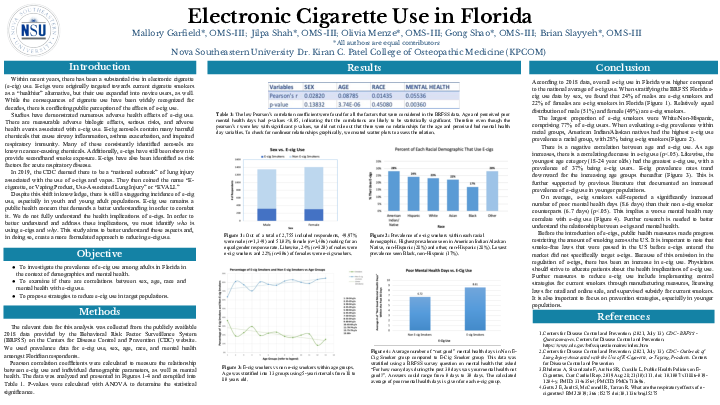
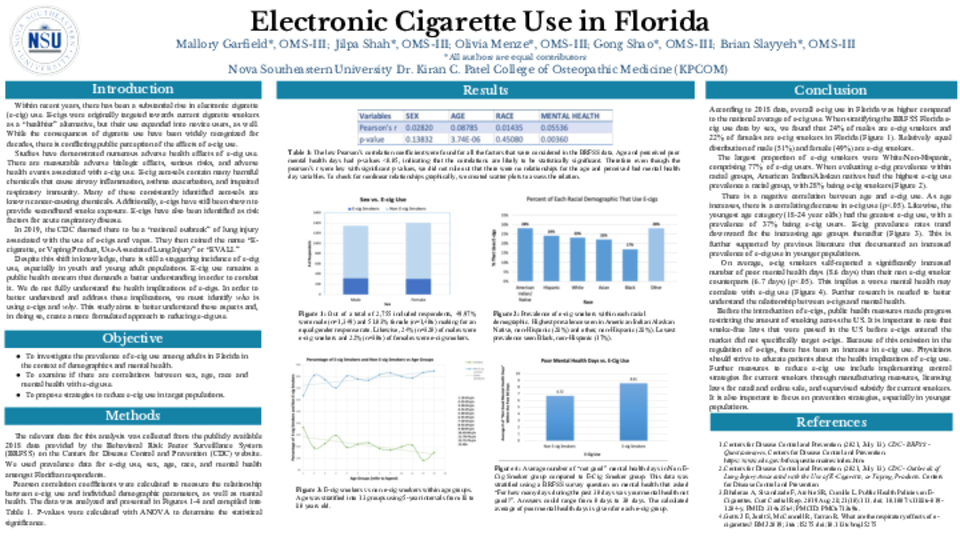
Results: After stratifying the BRFSS data, we observed a relatively equal distribution of
male (51%) and female (49%) e-cig smokers in Florida. A statistically significant
negative correlation was found between e-cig use and age (p-value < .05). When
categorizing age using 5-year intervals from 18 to 80 years old, the youngest category
(18-24 year olds) had the greatest e-cig use, with a prevalence of 37%. Regarding racial
demographics, the American Indian/Alaskan Native ethnicity had the highest prevalence
of e-cig use (28%). In the context of mental health, average e-cig smokers self-reported
an increased number of poor mental health days (average 8.61 days) than their non
e-cig smoker counterparts (6.72 days).
Conclusions: This study tested the hypothesis that a correlation exists between e-cig
use in Florida and each of the following: sex, race, age, and effects on mental health.
Through cross-sectional analysis of the data, we observed a greater correlation
between e-cig use and younger populations compared to e-cig use and older
populations. Self -reported poor mental health days are also positively correlated with
e-cig users compared to non e-cig users. A greater proportion of e-cig users are
white/non-hispanic and American Indian/Alaskan natives. Our study showed no
significant relationship between e-cig use and sex. Moving forward, physicians need to
actively implement strategies to educate and counsel on the harmful effects of e-cigs
and prioritize prevention strategies, especially in high risk populations.
Note: All authors are equal contributors.