Abstract
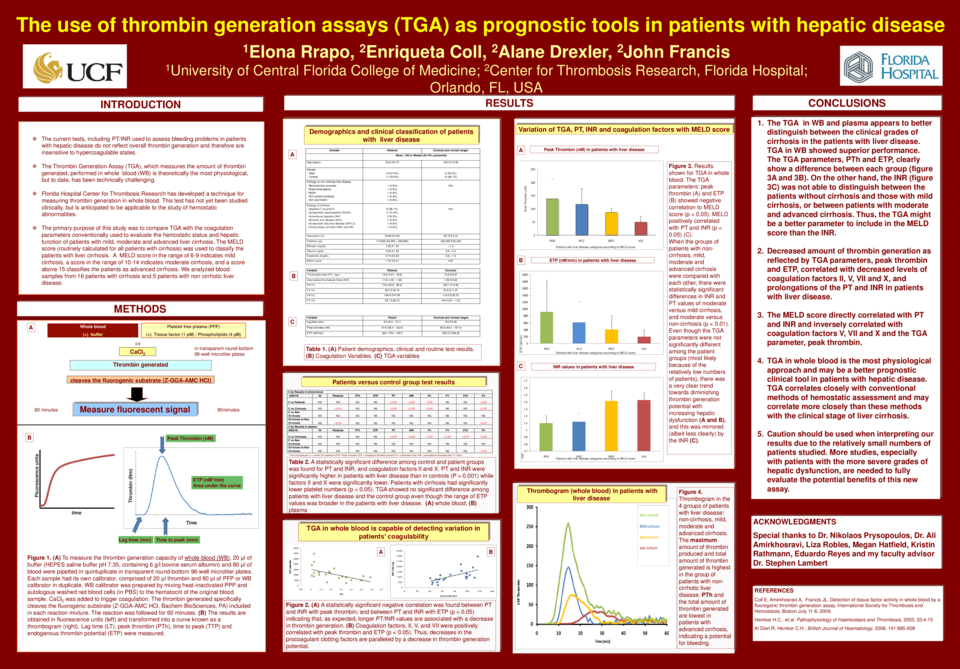
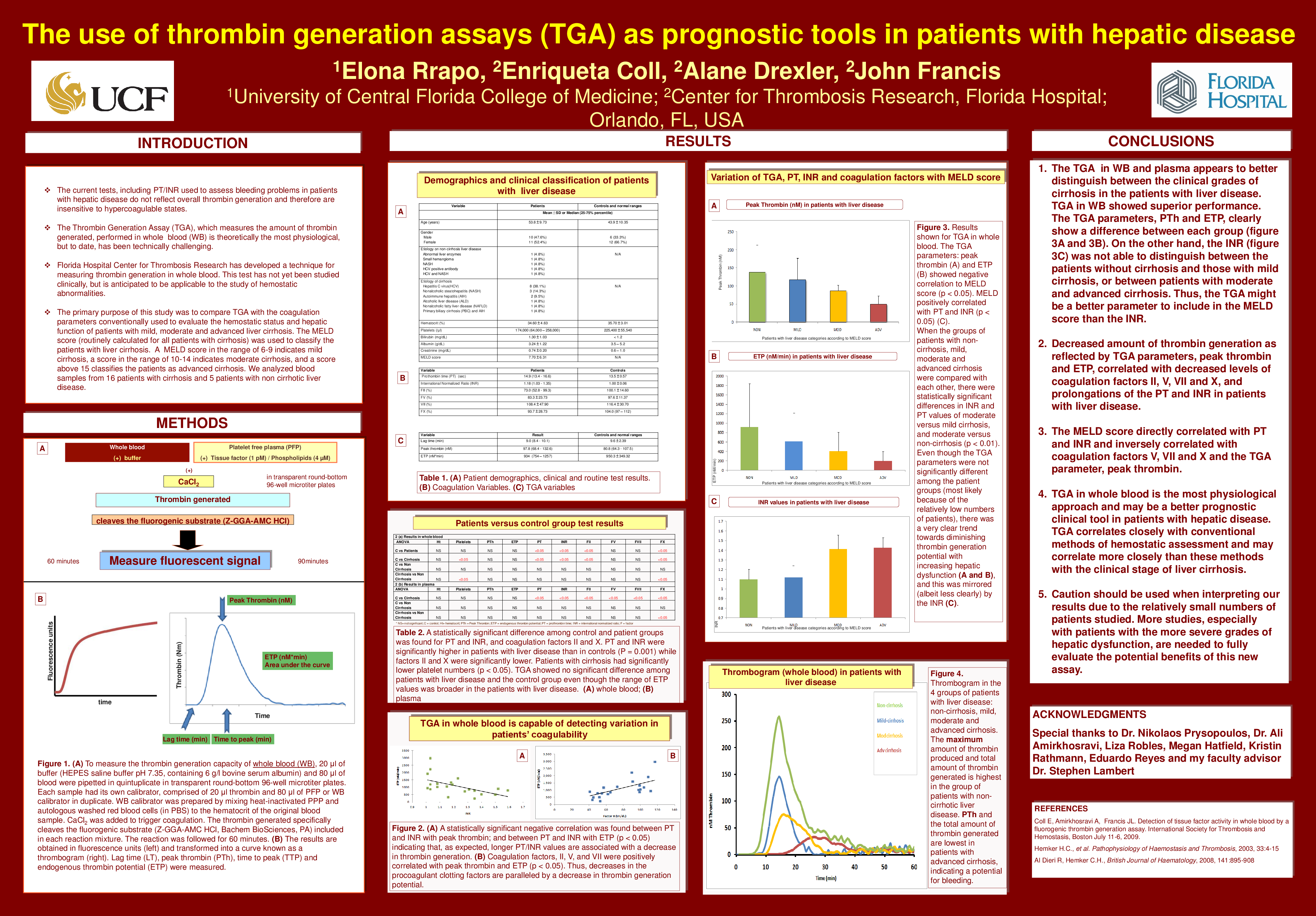
Introduction: The PT-INR is widely used to assess hypocoagulability in patients with hepatic disease and forms part of the Model End-stage Liver Disease (MELD) score, used to classify cirrhosis patients. However, since the hemostatic balance in such patients may remain unchanged due to the concurrent reduction in pro- and anti-coagulant factors, thrombin generation assays (TGA) may better assess hemostasis in these patients.
Objectives: To measure thrombin generation (TG) in whole blood (WB) and plasma of patients with liver disease and to correlate the TG parameters with PT-INR, coagulation factor (II, VII, and X) levels, and MELD scores.
Methods: Blood from 18 controls and 21 patients with liver disease (non-cirrhosis [n=4], mild [n=8], moderate [n=6], or advanced cirrhosis [n=2]) were tested. PT-INR and coagulation factors (F) were measured in platelet free plasma (PFP). TG was measured in WB and PFP using a fluorogenic thrombin generation assay. Lag time (LT), thrombin peak (TPeak), time to peak (TTP) and endogenous thrombin potential (ETP) were obtained.
Results: Compared to controls, PT-INR was increased (P<0.01) in patients while FII and FX were decreased (P<0.03). Among TGA parameters, only plasma ETP was decreased (P<0.01). In patients, Tpeak and ETP correlated inversely (P<0.01) with PT-INR, and directly (P<0.03) with factors II, VII and X. MELD score correlated directly with PT-INR (P<0.001), and inversely with TPeak, ETP (in WB and PFP; P<0.02) and FII, FVII and FX (P<0.001). Consistent with the PT-INR changes with disease stage, a clear trend towards a reduced TG potential with increasing hepatic dysfunction was observed in both WB and PFP. A similar pattern was observed with TPeak, while no differences in LT and TTP were found.
Conclusions: The TGA parameters ETP and TPeak (from both WB and plasma) can be used to assess liver-disease associated changes in coagulation and distinguish between various stages of cirrhosis.