Direct Current Stimulation Causes Selective Moderation �in Low Frequency Auditory Cortical Responses
Abstract
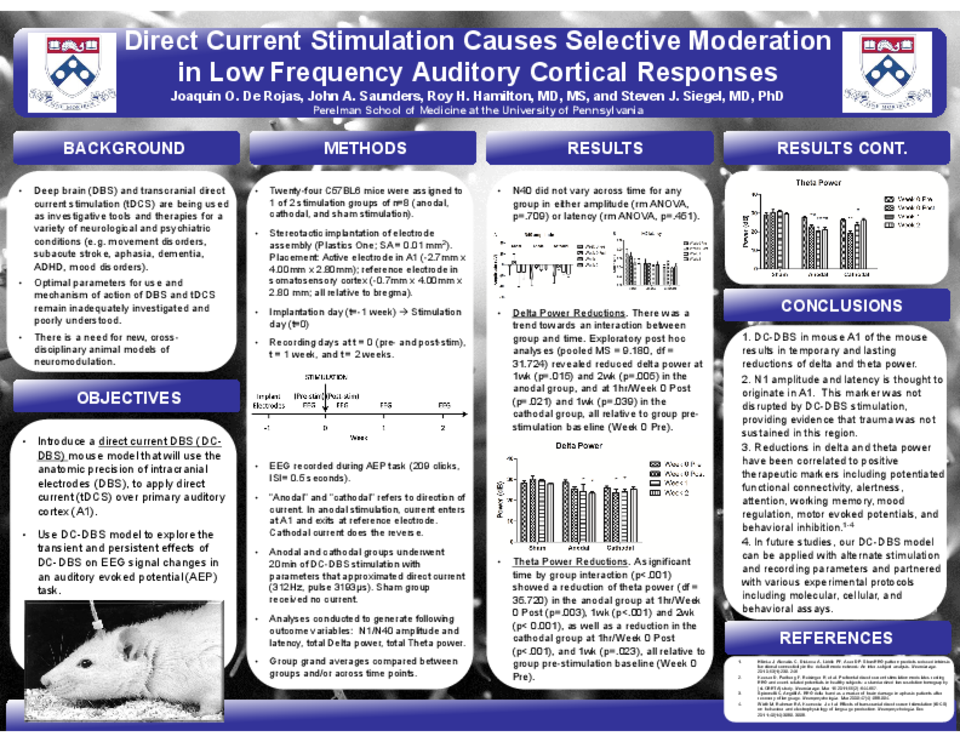
Background: Although deep brain (DBS) and transcranial direct current stimulation (tDCS) are being used as investigative tools and therapies for a variety of neurological and psychiatric conditions, their mechanisms of action remain poorly understood. Therefore, there is a need for new animal models of neuromodulation.
Objective: The goal of this study is to introduce and validate a direct current DBS (DC-DBS) model that will use the anatomic precision of intracranial electrodes, as used in DBS, to apply direct current, as used in tDCS, over primary auditory cortex (A1) and induce electroencephalographic (EEG) changes.
Methods: Twenty-four mice were assigned to one of two stimulation groups or a sham group and were implanted with electrodes in A1. Stimulation groups underwent DC-DBS stimulation for 20min at 20 µA. Auditory EEG was recorded before stimulation and at 1hr, 1wk, and 2wk post-stimulation. EEG was analyzed for changes in N1 (N100 in humans, N40 in mice) amplitude and latency as well as delta and theta power.
Results: DC-DBS led to significant EEG changes (all p values < .05). Among the stimulated animals, there were durable reductions in delta and theta power. There were no differences within the sham group, and neither N40 latencies nor amplitudes changed across time.
Conclusion: Our results show DC-DBS-induced reductions in slow-wave activity consistent with recent tDCS studies. We propose that this model will provide a means to explore basic mechanisms of neuromodulation and could facilitate future application of DC-DBS in humans.
Related articles