Abstract
Perspectives of Healthcare Providers on the Barriers and Facilitators to Palliative Delivery to Heart Failure Patients
Jamie Dimitui1, Manon Lemonde2
1 Health Sciences, Ontario Tech University, Oshawa, Ontario
2 Faculty of Health Sciences, Ontario Tech University, Oshawa, Ontario
Corresponding author: Jamie Dimitui, [email protected]
Abstract
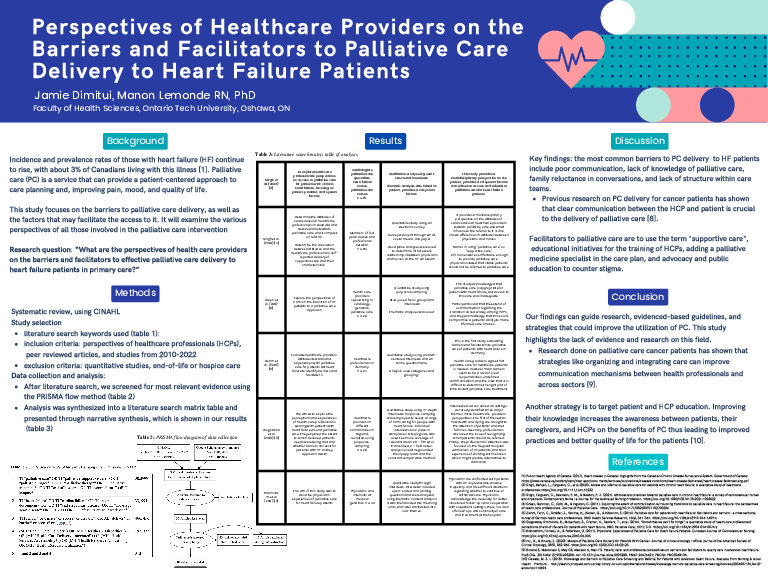
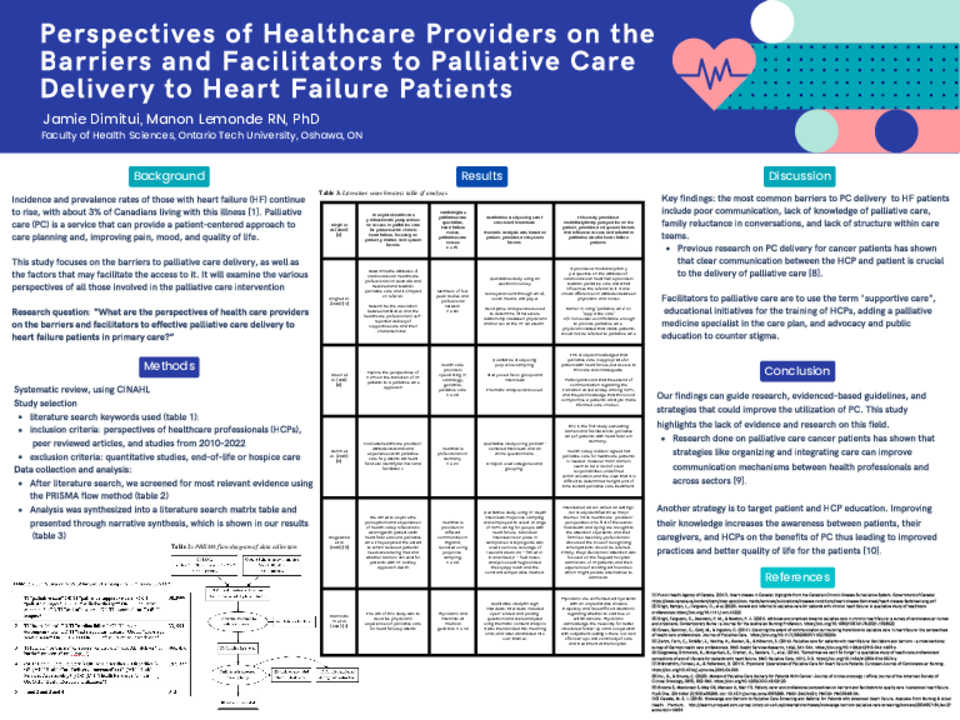
Introduction: Currently, there is strong evidence showing that patients with heart failure (HF) receive less palliative care (PC) than patients suffering from other life-limiting illnesses such as cancer. Available research for palliative care delivery in the HF patient population is limited, and the aims of this research are to examine present literature regarding palliative care delivery. Using a systematic review approach, the following research question will be explored: “What are the perspectives of healthcare providers on the barriers and facilitators to effective palliative care delivery to heart failure patients in primary care?”
Methods: A systematic review was used to gather the best and updated evidence on this topic. We used the database CINAHL for the comprehensive literature search, and data was extracted using PRISMA guidelines. Included articles were English peer-reviewed articles, any country, and 2010 to 2022. Data was analyzed and synthesized into a literature review matrix table.
Results: Our findings indicate the existence of barriers in communication, patient discussions, education, and referral. In addition, coordination and cooperation in decision-making is lacking among different care teams. Research shows that healthcare providers lack knowledge of palliative care delivery for HF patients, and this may be directly linked to inadequate referral for PC services. Facilitators to palliative care are using the term "supportive care", implementing educational initiatives for the training of HCPS, adding a palliative medicine specialist in the care plan, and advocating for public education to counter stigma.
Conclusion: Upon examining the barriers and facilitators to PC delivery, there is a need for evaluating tools that may facilitate the access of PC for HF patients. Our findings can guide future research, evidenced-based guidelines, and strategies to improve PC referral. Targeted education and improved communication could increase the awareness between heart failure patients, their caregivers, and HCPs on the benefits of PC, thus leading to improved practices and better quality of life for the patients.
Categories: medical education, palliative care, other
Key Words: systematic review, palliative care delivery, heart failure patients, healthcare providers