Abstract
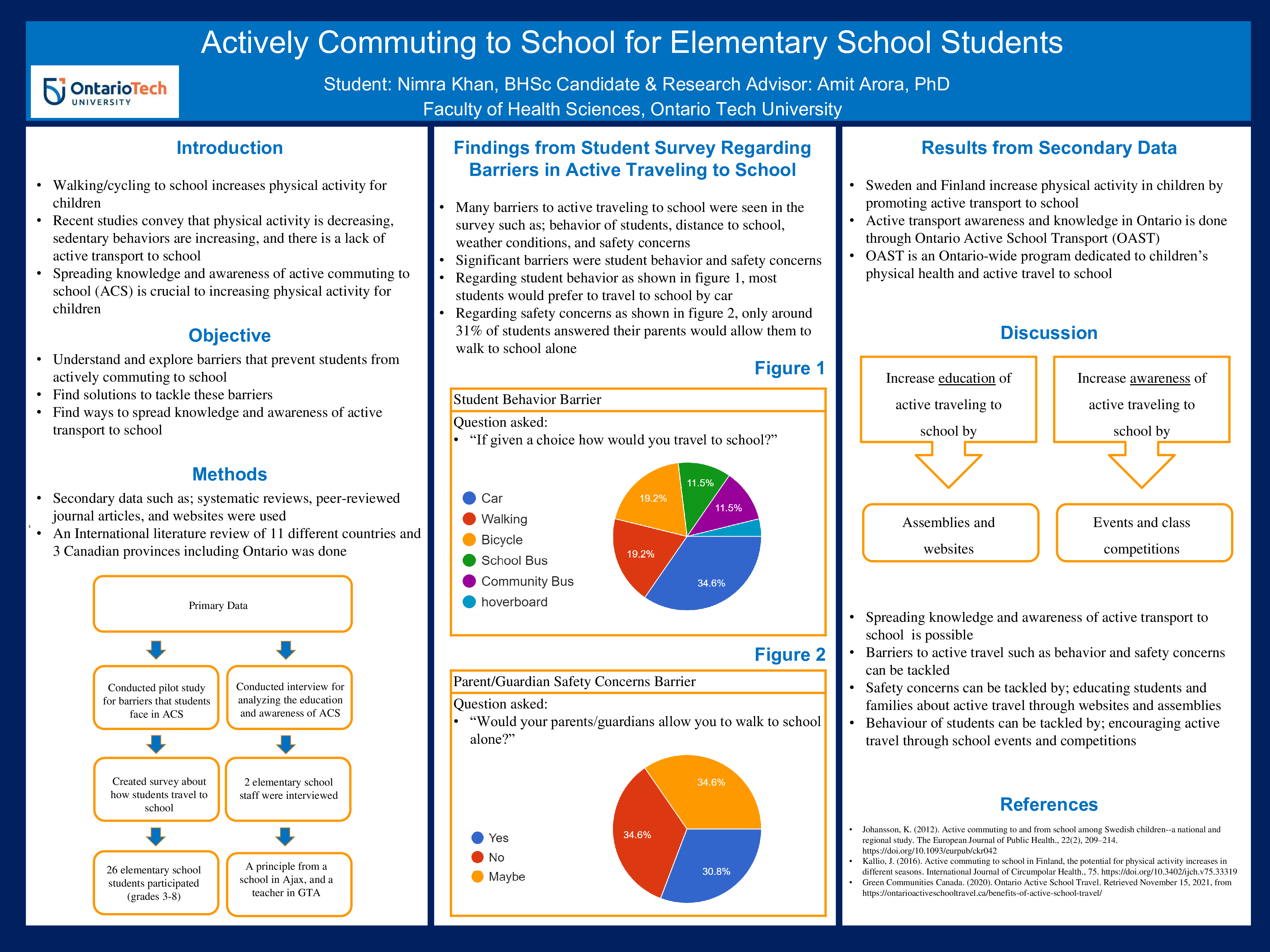
Introduction: Actively commuting to school (ACS) is crucial as it increases physical activity for children. However, recent international and Canadian findings depict that physical activity is decreasing, sedentary behaviors are increasing and there is a lack of ACS. Therefore, spreading knowledge and awareness of ACS to the public is crucial to increasing physical activity. The research investigates barriers that are relevant in Ontario that prevent elementary students from ACS and, ways to tackle these barriers.
Methods: A literature review was done using secondary sources, for instance, systematic reviews, peer-reviewed journals, and grey literature such as websites, and manuals. Further, primary research was conducted; a pilot study for barriers students face in ACS. The pilot study was a survey that 26 elementary school students (grades 3-8) participated in. The survey contained questions about how students travel to school. Moreover, to analyze the education and awareness of ACS in Ontario, 2 elementary school staff were interviewed; a principal of a school in Ajax and a teacher in the GTA.
Results: Many barriers to ACS were seen in the survey such as; behavior, distance to school, weather conditions, and safety concerns. Significant barriers were behavior and safety. Regarding behavior, students were asked, “If given a choice how would you travel to school?” 35% answered by car whereas, only 19% answered by walking and 19% answered by cycling. Regarding safety; when asked, “Would your guardians allow you to walk to school alone?” there was uncertainty as 31% said yes, 35% said no, and 35% said maybe.
The interview with the faculty concluded with different ways of promoting ACS to students and guardians. It was decided that the best way is through assemblies and websites. Also, ACS promotion can be achieved via events such as the walk-to-school week and class competitions.
Discussion: Thus, spreading knowledge and awareness of ACS is possible. However, there are barriers that students face such as behavior and family safety concerns. The safety concern of guardians can be tackled by, educating students and families about ACS through websites and assemblies. Also, events and competitions may change students' behavior and encourage them to ACS.