Abstract
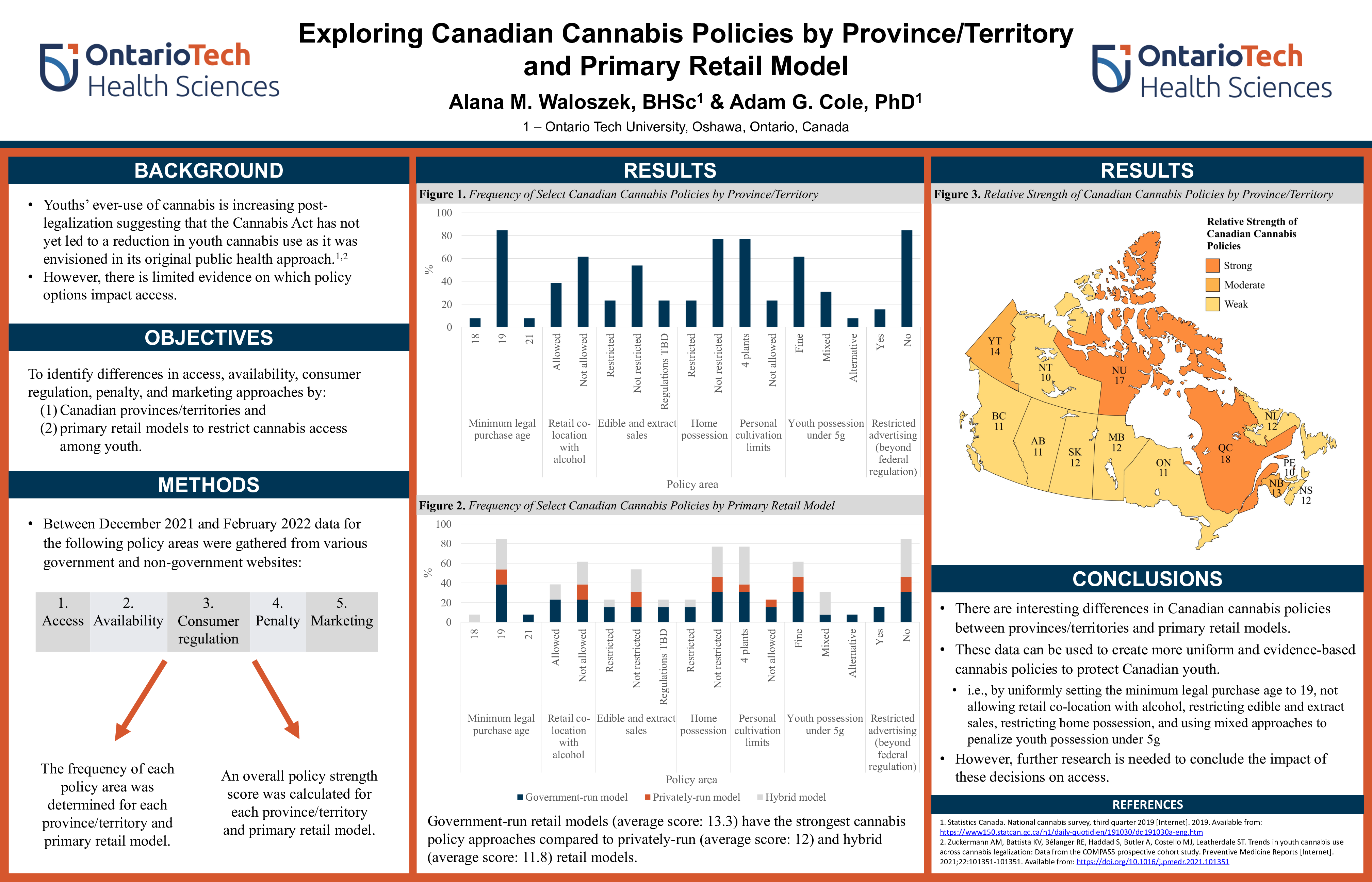
Significance: Youths’ ever-use of cannabis is increasing post-legalization suggesting that the Cannabis Act has not yet led to a reduction in youth cannabis use as it was envisioned in its original public health approach. However, there is limited evidence on which policy options impact access. The objectives of this study were to identify differences in access, availability, consumer regulation, penalty, and marketing approaches by (1) Canadian provinces/territories and (2) primary retail models to restrict cannabis access among youth.
Methods: Between December 2021 and February 2022 data for the following policy areas were gathered from various government and non-government websites: access, availability, consumer regulation, penalty, and marketing. The frequency of each policy area was determined for each province/territory and primary retail model. Also, an overall policy strength score was calculated for each province/territory and primary retail model.
Results: Many provinces/territories increased the minimum legal purchase age to 19 (84.6%), prohibited retail co-location with alcohol (61.5%), and used monetary fines for youth possession under 5g (61.5%) to restrict access to cannabis. Few restricted edible and extract sales (23.1%), restricted home possession (23.1%), and prohibited personal cultivation (23.1%). Compared to privately-run and hybrid retail models, a higher percentage of government-run retail models restricted edible and extract sales, home possession, and advertising beyond federal regulation to restrict access to cannabis. However, a lower percentage of government-run retail models used mixed approaches for youth possession under 5g. Ultimately, Quebec (score: 18) and Nunavut (score: 17) have the strongest cannabis policy approaches compared to other provinces/territories. Also, government-run retail models (average score: 13.3) have the strongest cannabis policy approaches compared to privately-run (average score: 12) and hybrid (average score: 11.8) retail models.
Conclusions: There are interesting differences in Canadian cannabis policies between provinces/territories and primary retail models. These data can be used to create more uniform and evidence-based cannabis policies to protect Canadian youth. However, further research is needed to conclude the impact of these decisions on access.