Abstract
Objective. This study was conducted to analyze the molecular mechanism of MDM2 regulation on AURKB in small cell lung cancer (SCLC). Background. SCLC is one of the most lethal forms of cancer, as it is often metastatic, and currently, there are limited treatment options available for SCLC patients. Therefore, new effective drugs need to be developed against SCLC to improve the patients’ survival rate. This study focused on both MDM2 and AURKB to develop a treatment strategy against SCLC.
Methods. H446 cell line was treated with RG7388, an MDM2 inhibitor, and Barasertib, an AURKB inhibitor, as well as a combination of both drugs for 24 hrs. Western blots were also performed for the MDM2, AURKB, FOXO3a, AKT, p-AKT, and β-actin to determine the impact of RG7388 and Barasertib on H446 cells. The expression level of β-actin was used as a loading control.
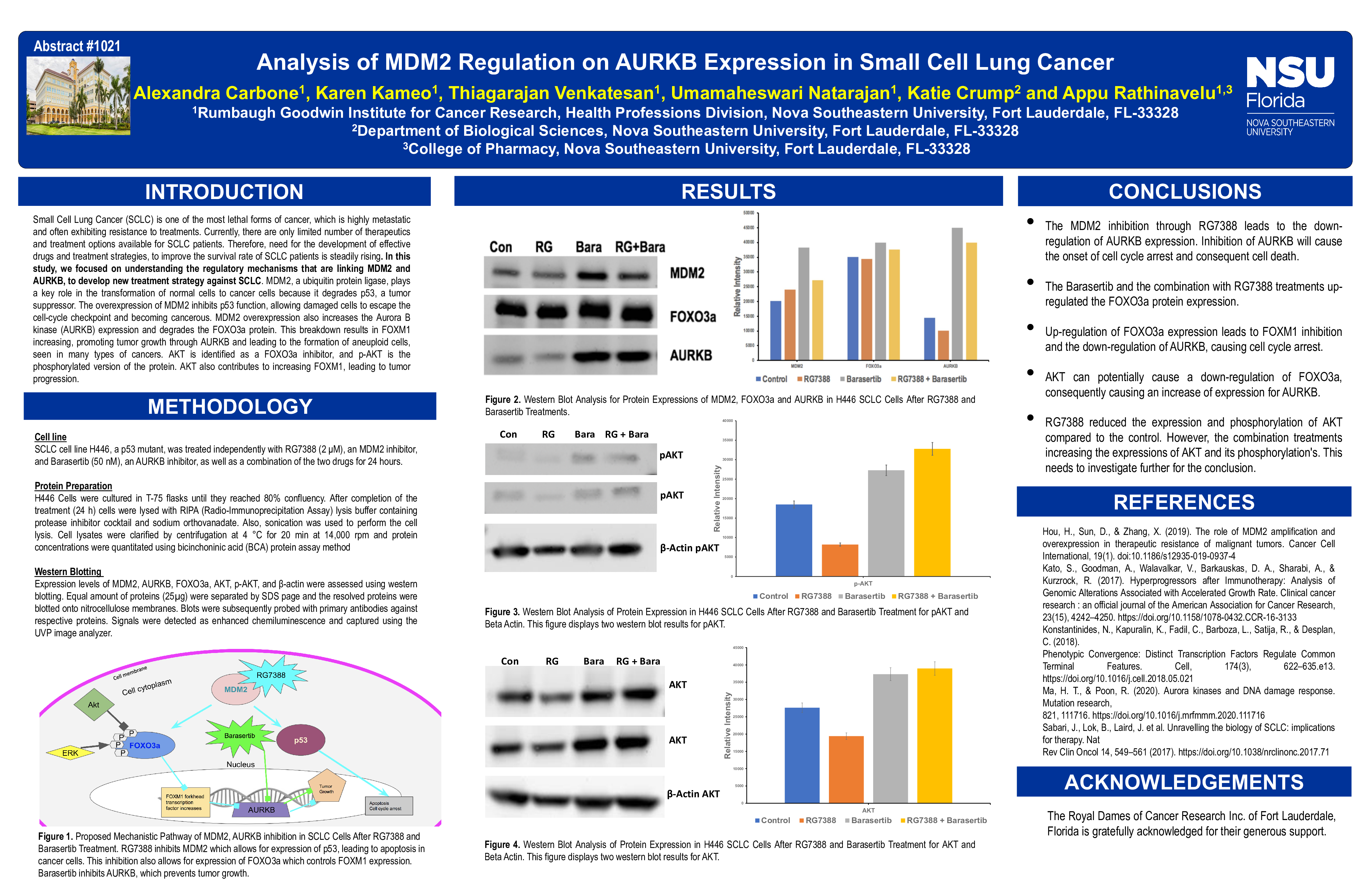
Results. Our western blot results indicated there was a down-regulation of MDM2 and AURKB expressions in the RG7388 after 24 hrs of treatment. Also, the level of p-AKT expression decreased.
Conclusion. MDM2 inhibition through RG7388 leads to down-regulation of AURKB expression. Inhibition of AURKB will lead to onset of cell cycle arrest and consequent cell death.
Grants. This study was funded by the PFRDG grant 334877 and the financial support from the Royal Dames of Cancer Research Inc., Ft. Lauderdale, Florida.