Abstract
Introduction:
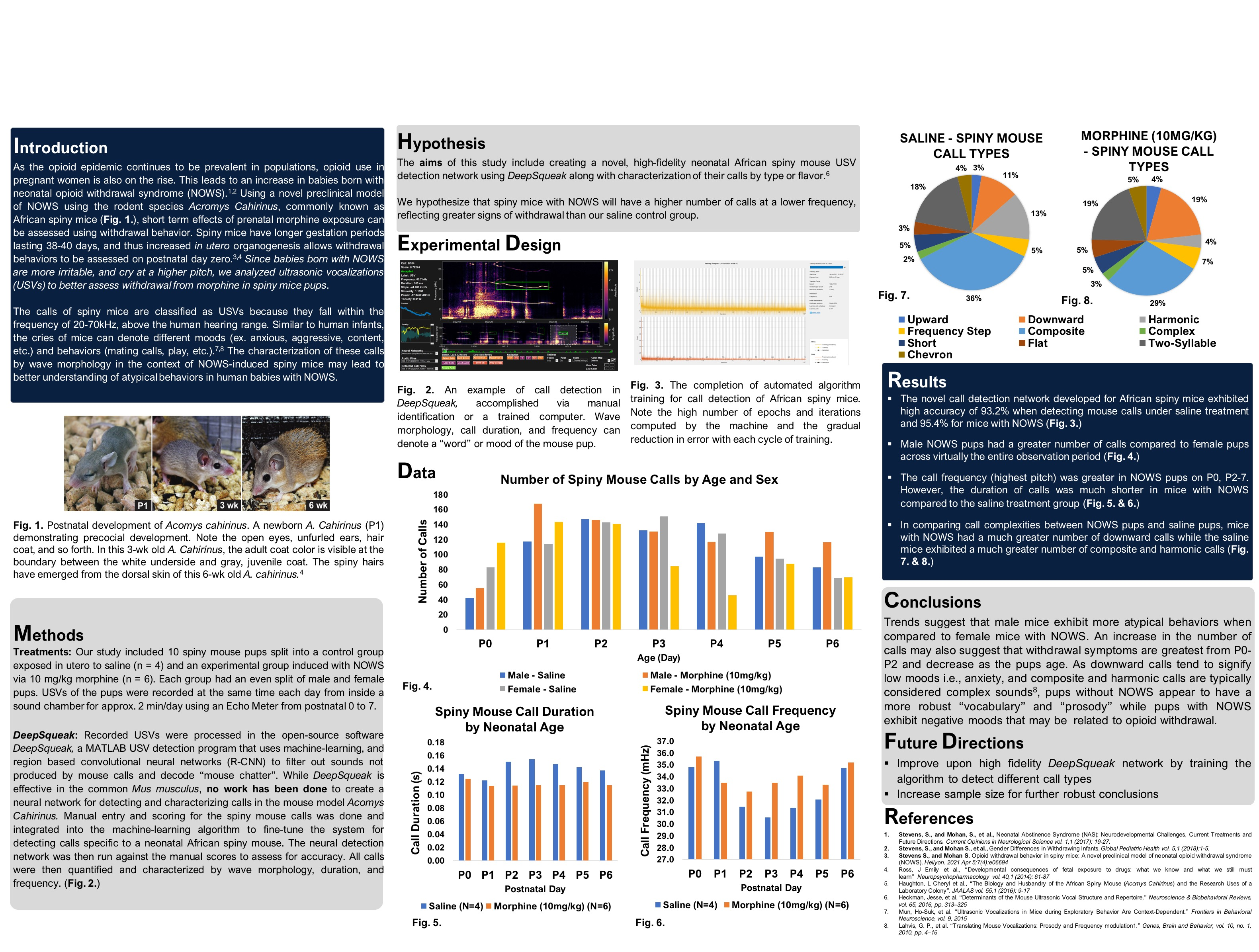
As the opioid epidemic continues to be prevalent in populations, opioid use in pregnant women is also on the rise. This leads to an increase in babies born with neonatal opioid withdrawal syndrome (NOWS). Using a novel preclinical model of NOWS using the rodent species Acromys Cahirinus, commonly known as spiny mice, short-term effects of prenatal morphine exposure can be assessed using withdrawal behavior. Spiny mice have longer gestation periods lasting 38 - 40 days and thus increased in utero organogenesis allows withdrawal behaviors to be assessed on postnatal day zero. Since babies born with NOWS are more irritable, crying more at higher pitches, we analyzed Ultrasonic Vocalization’s (USV’s) in spiny mice pups in withdrawal from morphine.
Methods:
NOWS was induced in spiny mouse pups by injecting dams with morphine (10 mg/kg) and recording the pup’s ultrasonic vocalization (USV’s) from postnatal 0 to 7. USVs were recorded using an Echo Meter used to detect bats since mice also have call frequency from 20-70 kHz, above the human hearing range. Recorded USVs were processed in open-source software called DeepSqueak; a MATLAB USV detection program designed by the Coffey lab at the University of Washington, School of Medicine. DeepSqueak uses machine-learning and region-based convolutional neural networks (R-CNN) to filter out sounds that are not produced by mouse calls and decode “mouse chatter” between different mice. While DeepSqueak is effective in the common Mus musculus, no work has been done in detecting and characterizing mouse calls in African spiny mice. The aims of this study include creating a novel, high-fidelity neonatal African spiny mouse USV detection network using DeepSqueak along with the characterization of their calls according to type or flavor. We hypothesize that spiny mice with NOWS will have a higher number of calls, exhibiting greater signs of withdrawal as reflected by the number of low-frequency calls.
Results:
Male mice with NOWS had a greater number of calls compared to female mice. The call frequency was greater in mice with NOWS on postnatal days 0, 2-7. However, the duration of calls was much shorter in mice with NOWS compared to the saline treatment group. When comparing call complexity between mice with NOWS and mice from the saline treatment group, the number of upward, and downward calls was greater.
Conclusion:
This study remains in progress, and the number of USV files requiring analysis will need to be increased before conclusions can be drawn. This data shows the development of a novel and accurate detection network designed specifically for neonatal African spiny mice. Downward calls are characterized by a lowering in frequency in the call, similar to a human moan. This represents an indication of an additional stressor on the NOWS mice that were not present in the control mice. With regard to the frequency differences, this can be used and applied to human patients if the frequency is indeed lower than healthy baby cries. These results show a promising alternative behavioral measure in this novel preclinical model of NOWS.