Abstract
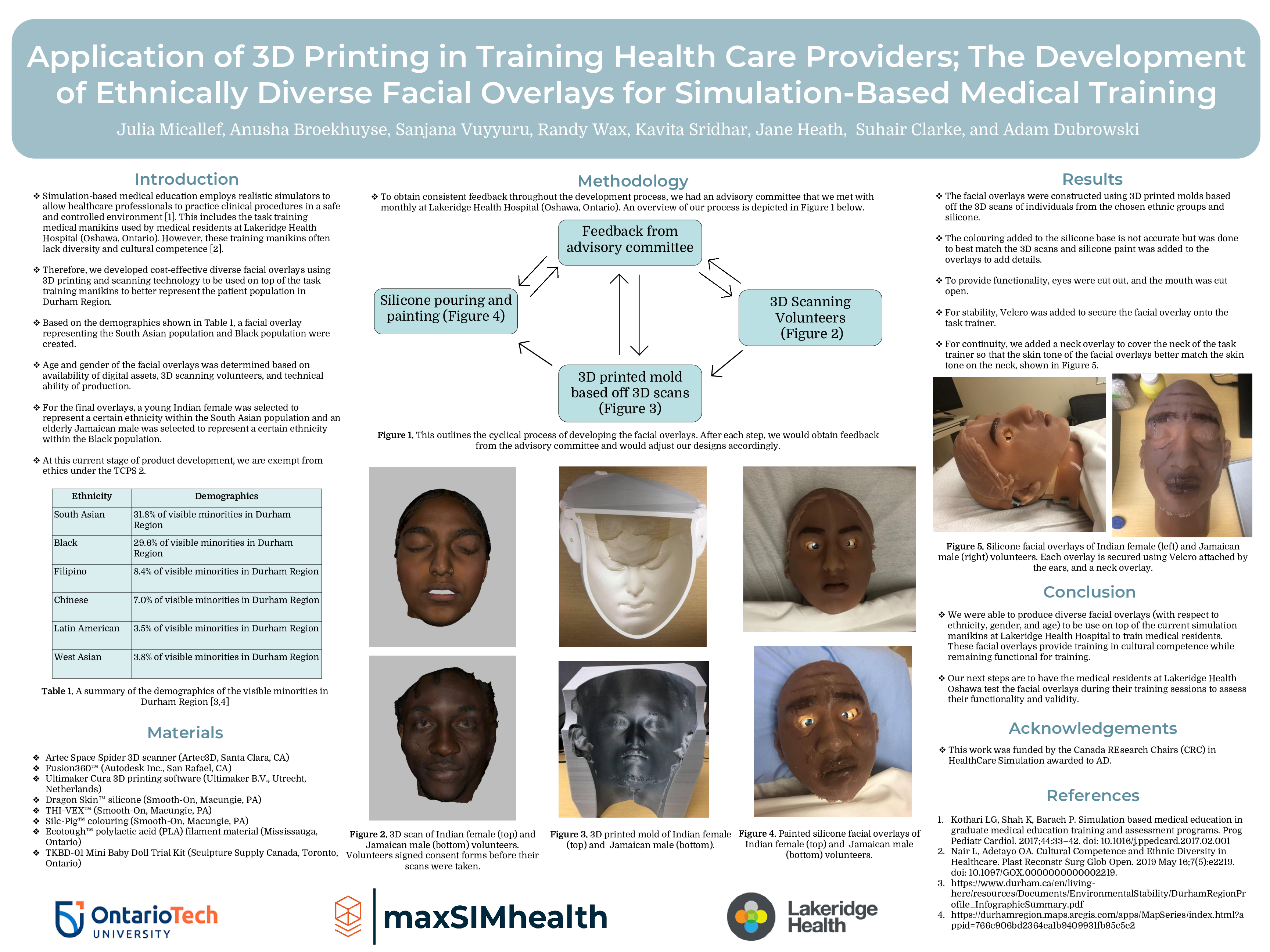
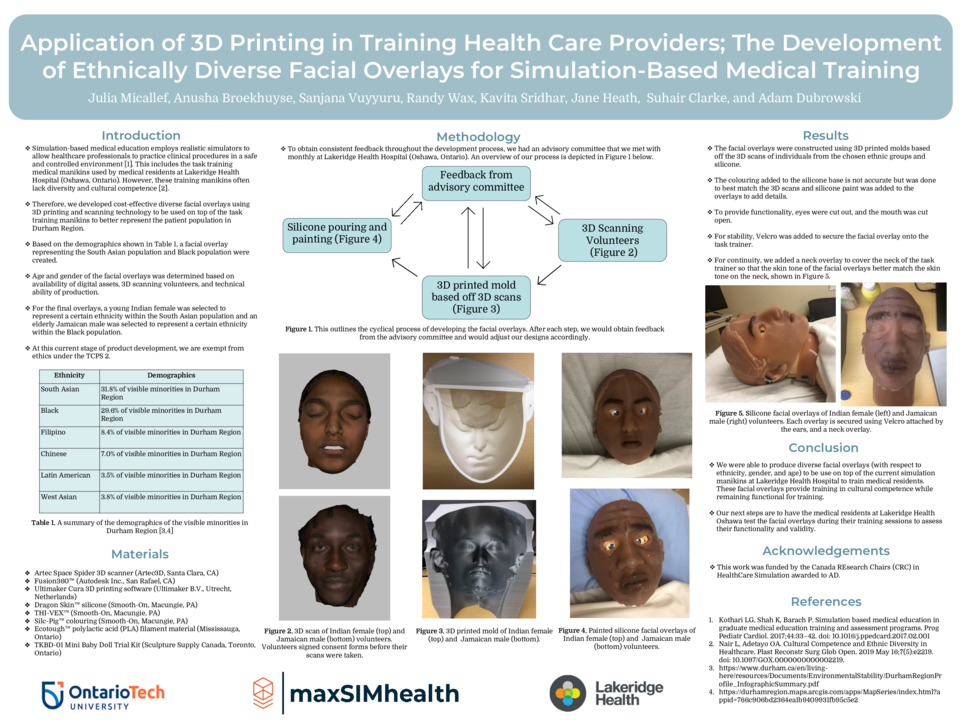
The task training medical manikins used by medical residents provide the training of numerous skills needed to enter the clinical setting. However, they often lack diversity, and therefore, cultural competence. The diverse simulators that are emerging in the market are limited in their range of ethnicities and are very expensive. In this poster, the development of diverse and cost-effective facial overlays is described through the use of 3D scanning, 3D printing, and silicone to be used on top of the current medical manikins at Lakeridge Health Hospital (Oshawa, Ontario). To obtain consistent feedback throughout the development process, an advisory committee was consulted monthly at Lakeridge Health Hospital. The process began by determining that the first two facial overlays were going to be made based on the most common minorities in Durham Region. As a result, it was decided that the facial overlays would represent the South Asian and Black demographic. Research was done on the various ethnicities within those two demographics to see what data was available to narrow down the target population. Due to the lack of existing data and having available volunteers within the two demographics, it was decided that an Indian female teen facial overlay would be made to represent an ethnicity within the South Asian demographic, and a Jamaican elderly male facial overlay would be made to represent an ethnicity within the Black demographic. The age for the facial overlays was determined at random and details were added to the facial overlays to represent the age group. The facial overlays were based on 3D scans of volunteers and used to create the design of the 3D printed molds. The silicone that was colored to match the skin tones of the volunteers was used as the base for the facial overlays, and details were painted on using silicone paint. Neck overlays were created to provide continuity in the skin tones between the facial overlays and the medical manikins. To retain the functionality of the medical manikins, the eyes of the facial overlays were cut out and the mouth was cut open to allow for intubation training. For stability purposes, Velcro attachments were added to the facial and neck overlays so they can be secured onto the medical manikins. In the end, cost-effective and diverse facial overlays were created to be used on top of the task training medical manikins that are currently training medical residents at Lakeridge Health Hospital.