Abstract
INTRODUCTION
- Metaplastic carcinoma of breast also known as carcinosarcoma is an extremely rare aggressive variant of breast cancer which accounts for less than 1% of cases.
- There is no any standard protocol or algorithm for treatment of metaplastic carcinoma till date. Molecular studies are found to be triple negative in most cases similar to ours.
CASE REPORT
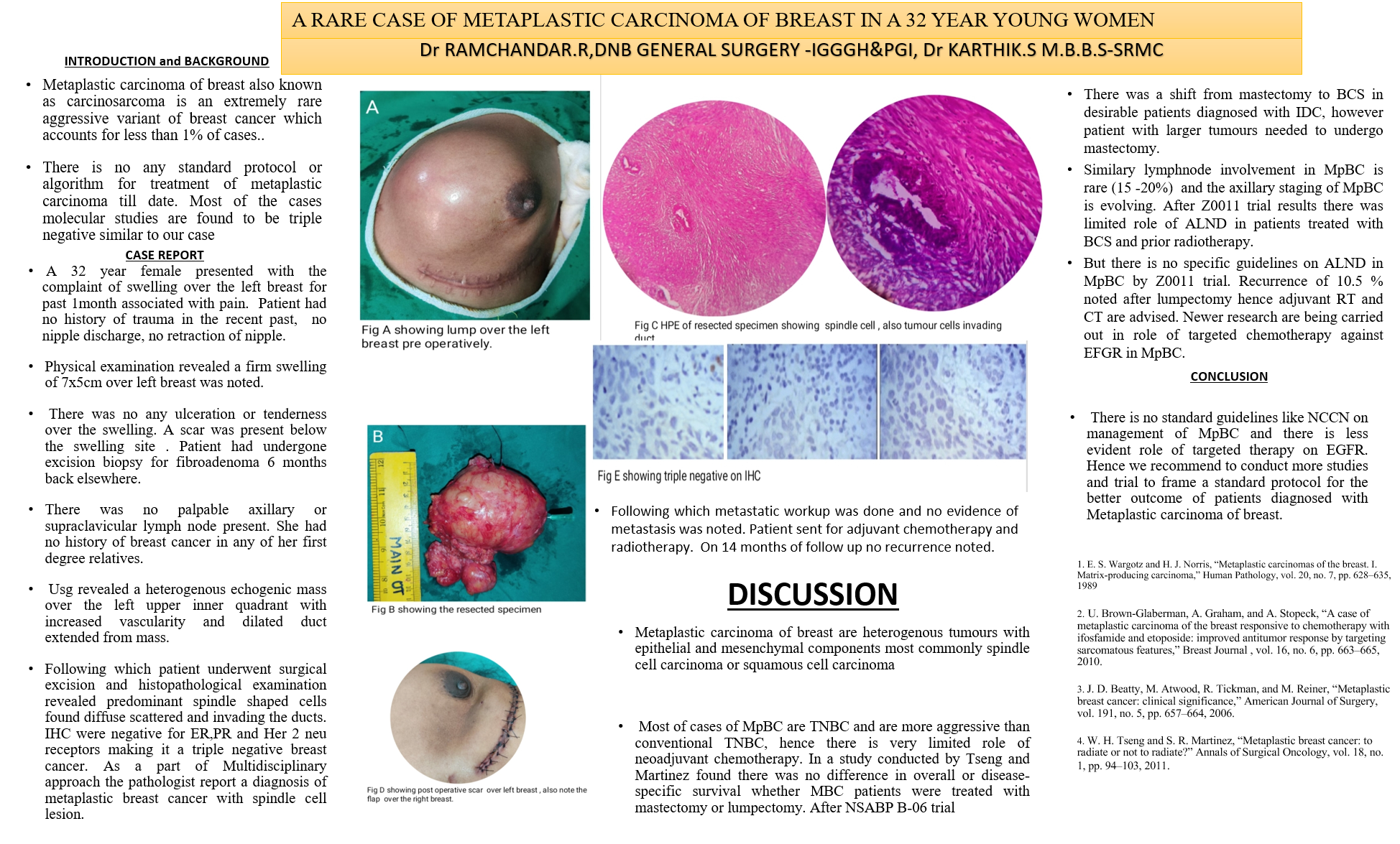
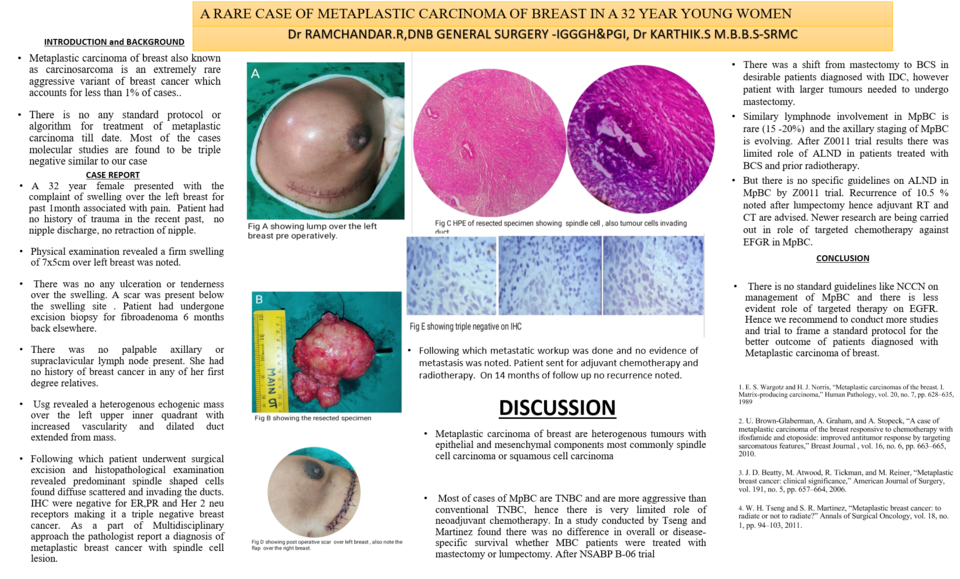
- A 32 year female presented with the complaint of swelling over the left breast for past 1month associated with pain. Patient had no history of trauma in the recent past, no nipple discharge/ retraction of nipple.
- On examination revealed a firm swelling of 7x5cm over left breast was noted and no any ulceration or tenderness over the swelling. A scar was present below the swelling site . Patient had undergone excision biopsy for fibroadenoma 6 months back elsewhere.
- No palpable axillary or supraclavicular lymph node present. Family history was found to be negative.
- Usg revealed a heterogenous echogenic mass over the left upper inner quadrant with increased vascularity and dilated duct extended from mass and patient underwent surgical excision and HPE revealed predominant spindle shaped cells found diffuse scattered and invading the ducts. IHC were negative for ER,PR and Her 2 neu receptors making it a triple negative breast cancer. The HPE report was conclusive of diagnosis of metaplastic breast cancer with spindle cell lesion.
- Following which metastatic workup was done and no evidence of metastasis was noted. Patient sent for adjuvant chemotherapy and radiotherapy. On 14 months of follow up no recurrence noted
DISCUSSION
- Metaplastic carcinoma of breast are heterogenous tumours with epithelial and mesenchymal components most commonly spindle cell carcinoma or squamous cell carcinoma
- Most of cases of MpBC are TNBC and are more aggressive than conventional TNBC, hence there is very limited role of neoadjuvant chemotherapy. In a study conducted by Tseng and Martinez found there was no difference in overall or disease-specific survival whether MBC patients were treated with mastectomy or lumpectomy. After NSABP B-06 trial.
- There was a shift from mastectomy to BCS in desirable patients diagnosed with IDC, however patient with larger tumours needed to undergo mastectomy.
- Similary lymphnode involvement in MpBC is rare (15 -20%) and the axillary staging of MpBC is evolving. After Z0011 trial results there was limited role of ALND in patients treated with BCS and prior radiotherapy.
- But there is no specific guidelines on ALND in MpBC by Z0011 trial. Recurrence of 10.5 % noted after lumpectomy hence adjuvant RT and CT are advised. Newer research are being carried out in role of targeted chemotherapy against EFGR in MpBC.
CONCLUSION
- There is no standard guidelines like NCCN on management of MpBC and there is less evident role of targeted therapy on EGFR. Hence we recommend to conduct more studies and trial to frame a standard protocol for the better outcome of patients diagnosed with Metaplastic carcinoma of breast.
REFERENCES
1. U. Brown-Glaberman, A. Graham, and A. Stopeck, “A case of metaplastic carcinoma of the breast responsive to chemotherapy with ifosfamide and etoposide: improved antitumor response by targeting sarcomatous features,” Breast Journal , vol. 16, no. 6, pp. 663–665, 2010.
2. W. H. Tseng and S. R. Martinez, “Metaplastic breast cancer: to radiate or not to radiate?” Annals of Surgical Oncology, vol. 18, no. 1, pp. 94–103, 2011.