Abstract
Introduction:
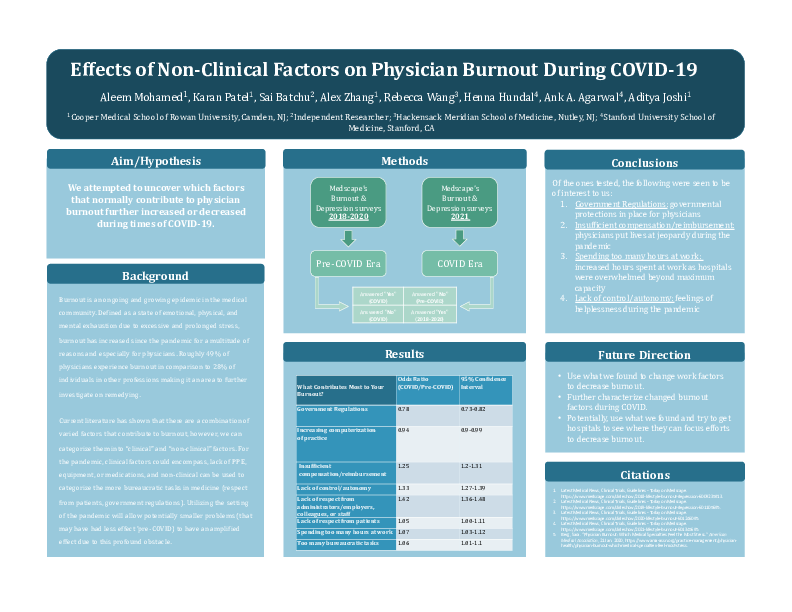
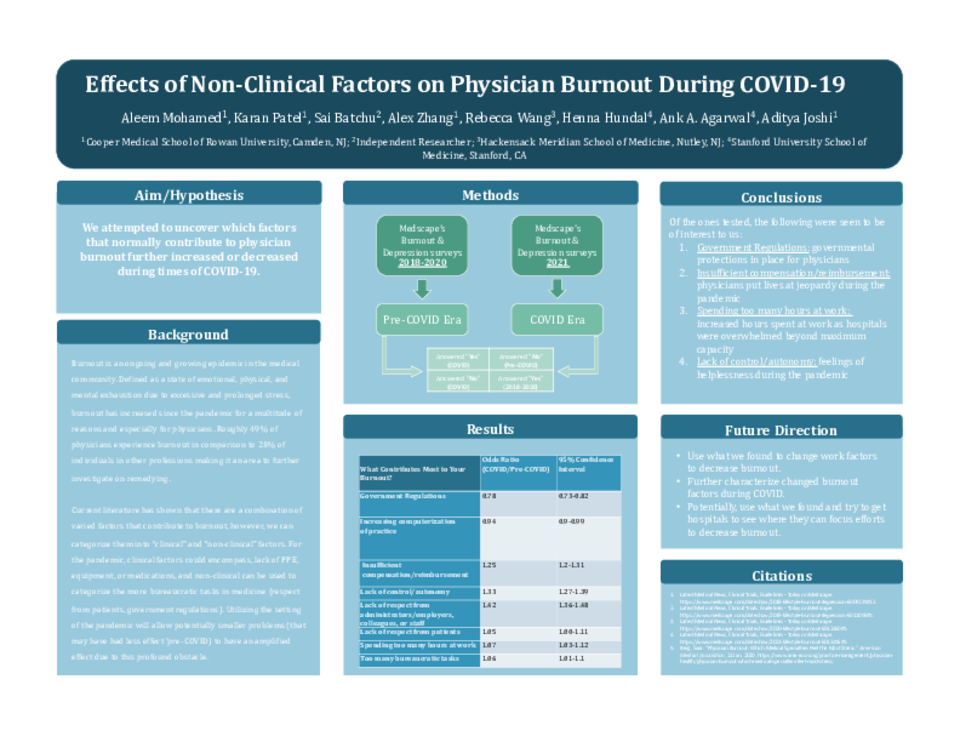
It has been well-documented in the literature that the COVID-19 pandemic has added to the stress experienced by physicians. In this study, we attempted to uncover which factors that normally contribute to physician burnout further increased or decreased during times of COVID-19.
Methods:
Using Medscape’s Burnout and Depression surveys from 2018-2021, we analyzed the primary reasons for physician burnout before and during the COVID-19 pandemic. We first separated our data, designating 2018-2020 as the “Pre-COVID era” and 2021 as the “COVID era.” This is because the surveys are published at the end of each year (i.e 2021 data was collected in 2020). We compared the primary reasons for burnout between these two groups to determine which factors increased burnout during the pandemic. All statistical analyses were calculated with R.
Results:
What Contributes Most to Your Burnout?
Government Regulations (OR 0.78; 95%CI, 0.73-0.82)
Increasing computerization of practice (OR 0.94; 95%CI, 0.9-0.99)
Insufficient compensation/reimbursement (OR 1.25; 95%CI, 1.2-1.31)
Lack of control/autonomy (OR 1.33; 95%CI, 1.27-1.39)
Lack of respect from administrators/employers, colleagues, or staff (OR 1.42; 95%CI, 1.36-1.48) Lack of respect from patients (OR 1.05; 95%CI, 1-1.11)
Spending too many hours at work (OR 1.07; 95%CI, 1.03-1.12)
Too many bureaucratic tasks (OR 1.06; 95%CI, 1.01-1.1)
Conclusion:
Many factors further increased physician burnout during times of the pandemic. It is especially interesting to note that governmental regulations actually decreased burnout, while a lack of respect for doctors, especially at the height of the pandemic, seemed to contribute to the largest difference in burnout rates between the pre-pandemic and pandemic eras.