Abstract
Introduction:
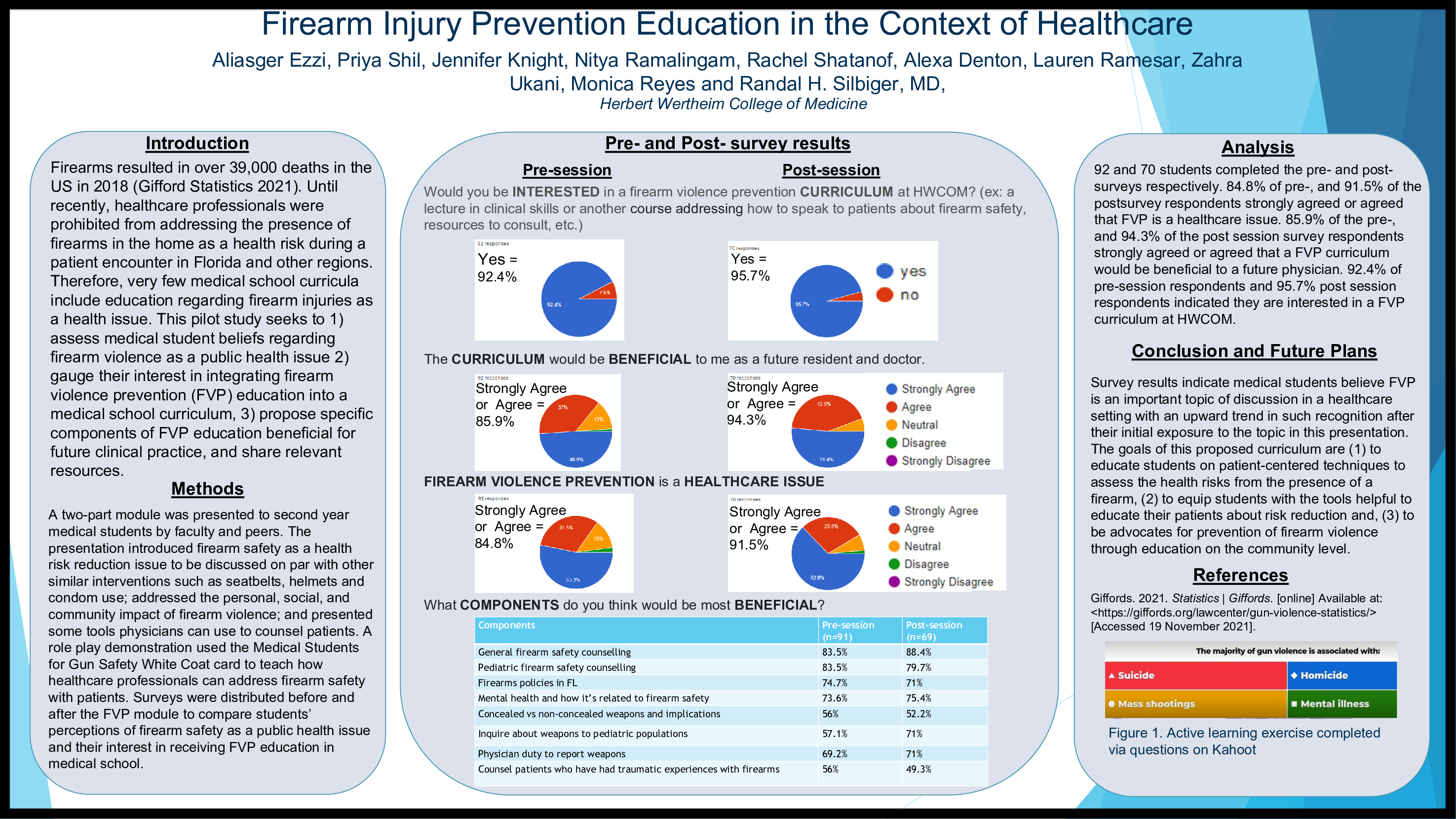
Firearms resulted in over 39,000 deaths in the US in 2018 (Gifford Statistics 2021). Until recently, healthcare professionals were prohibited from addressing the presence of firearms in the home as a health risk during a patient encounter in Florida and other regions. Therefore, very few medical school curricula include education regarding firearm injuries as a health issue. This pilot study seeks to 1) assess medical student beliefs regarding firearm violence as a public health issue 2) gauge their interest in integrating firearm violence prevention (FVP) education into a medical school curriculum, 3) propose specific components of FVP education beneficial for future clinical practice, and share relevant resources.
Methods:
A two-part module was presented to second year medical students by faculty and peers. The presentation introduced firearm safety as a health risk reduction issue to be discussed on par with other similar interventions such as seatbelts, helmets and condom use; addressed the personal, social, and community impact of firearm violence; and presented some tools physicians can use to counsel patients. A role play demonstration used the Medical Students for Gun Safety White Coat card to teach how healthcare professionals can address firearm safety with patients. Surveys were distributed before and after the FVP module to compare students’ perceptions of firearm safety as a public health issue and their interest in receiving FVP education in medical school.
Results:
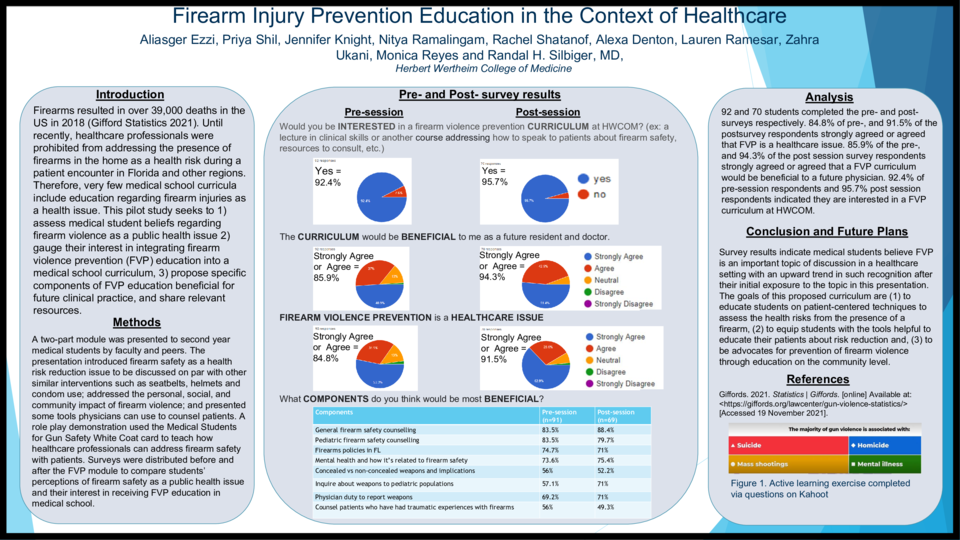
Ninety-two (92) and seventy (70) students completed the pre- and post-surveys respectively. 84.8% of pre-, and 91.5% of the postsurvey respondents strongly agreed or agreed that FVP is a healthcare issue. 85.9% of the pre-, and 94.3% of the post session survey respondents strongly agreed or agreed that a FVP curriculum would be beneficial to a future physician. 92.4% of pre-session respondents and 95.7% post session respondents indicated they are interested in a FVP curriculum at HWCOM.
Conclusions and Future Plans:
Survey results indicate medical students believe FVP is an important topic of discussion in a healthcare setting with an upward trend in such recognition after their initial exposure to the topic in this presentation. The goals of this proposed curriculum are (1) to educate students on patient-centered techniques to assess the health risks from the presence of a firearm, (2) to equip students with the tools helpful to educate their patients about risk reduction and, (3) to be advocates for prevention of firearm violence through education on the community level.