Abstract
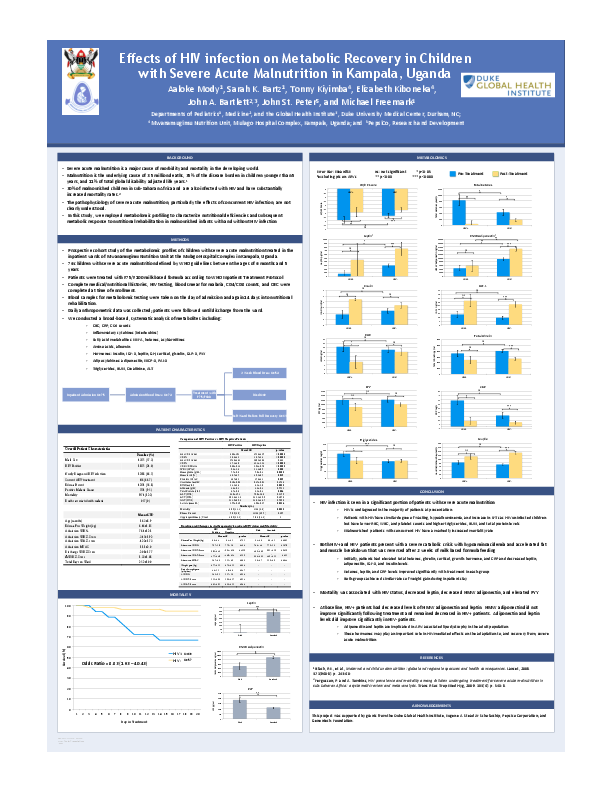
Background: Concurrent HIV infection is seen in 30% of children with severe acute malnutrition (SAM) in sub-Saharan Africa. Its effect on the pathophysiology of SAM remains unclear. We employed metabolomic profiling to characterize nutritional deficiencies and subsequent metabolic response to nutritional rehabilitation seen with comorbid HIV infection. Methods: A prospective cohort study of 74 malnourished children admitted to Mulago Hospital (Kampala, Uganda). Patients were treated with milk formulas F75 and F100. HIV testing/CD4 counts were done at admission; auxologic data and blood samples were obtained at admission and 14 days into treatment. Results: At admission, patients (mean age 16.3m, range 6-48m, 57.3% male) were malnourished with secondary growth failure (mean wt/ht z= -3.47), but improved with treatment (mean Δwt/ht z= +1.33). 24% (18/74) of patients were HIV+ (mean CD4=644, %=14.6); 67% (12/18) of these were not previously diagnosed. Overall mortality was 12% (9/74), but was significantly higher for HIV+ patients (33% v. 5%, RR=6.22). There were no differences in initial growth parameters or subsequent weight gain by HIV status. At baseline, HIV+ and - patients had elevated total ketones, ghrelin, cortisol, growth hormone, and CRP and decreased leptin, IGF-1, and insulin levels. Ketones, leptin, and CRP levels improved significantly with treatment in each group. Both at baseline and following treatment, HIV+ patients had lower total and high-molecular-weight (HMW) adiponectin levels than HIV- patients. Adiponectin levels increased with treatment in HIV- but not HIV+ patients. Conclusions: There is a high prevalence of HIV infection in children with SAM, and this is associated with significantly increased mortality. Among survivors, HIV+ patients do achieve similar nutritional and metabolic recovery as HIV- patients with the exception of adiponectin levels. The link with adiponectin suggests insulin sensitivity plays a role in any HIV-mediated effects on adaptation to, and recovery from, SAM.