Abstract
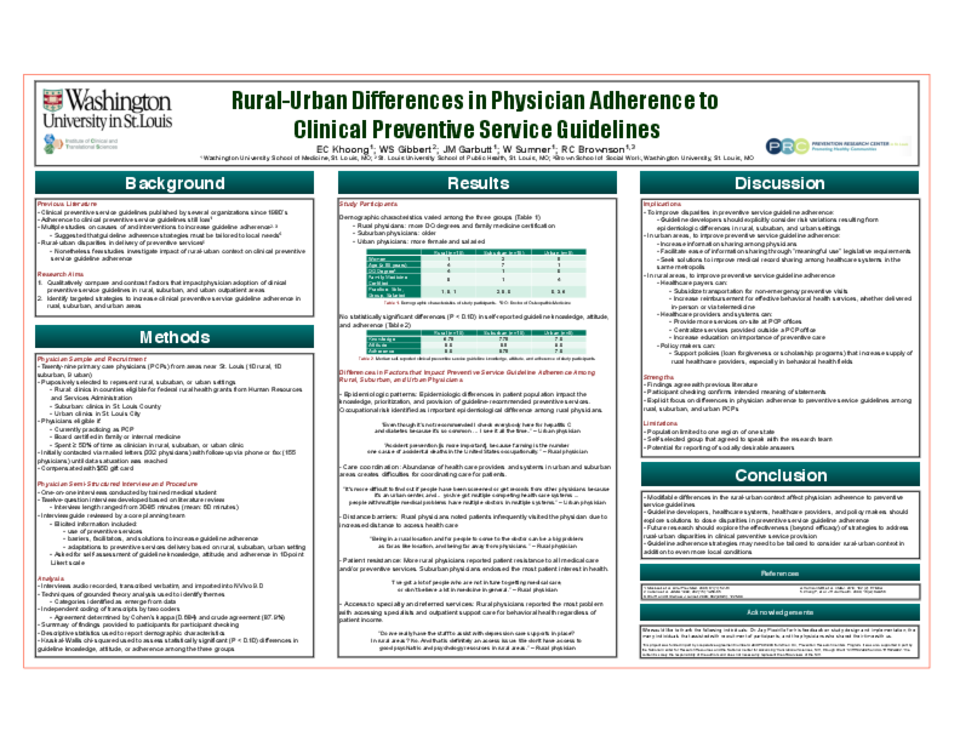
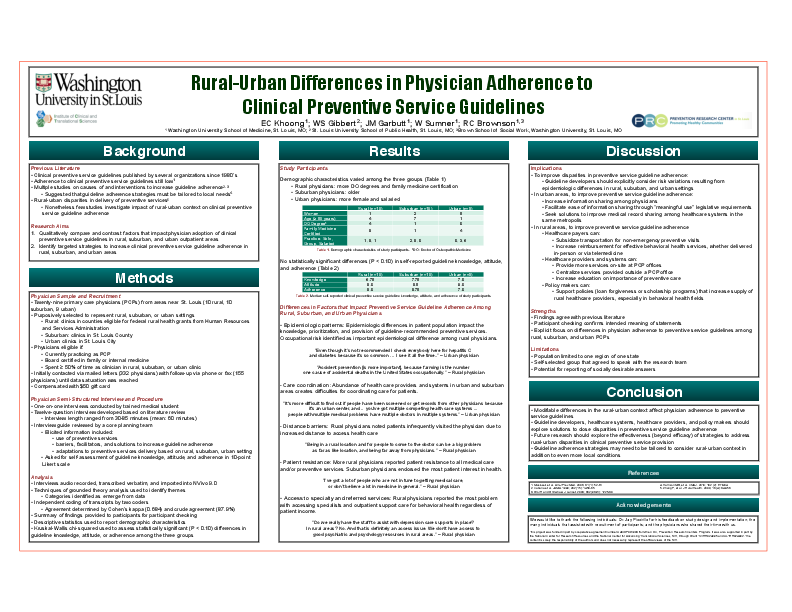
Background. Clinical preventive service guideline adherence and provision of preventive services remains low. Rural-urban disparities in the provision of preventive services have been shown, but there is sparse research on how rural, suburban, or urban differences impact physician adherence to clinical preventive service guidelines.
Objective. To qualitatively determine factors that may cause physician adherence to clinical preventive service guidelines to differ in rural, suburban, and urban outpatient settings.
Design. Qualitative study involving in-depth semi-structured interviews with purposively sampled physicians who practiced in three settings: rural, suburban, and urban clinics. Barriers and facilitators to clinical preventive service guideline adherence were elicited.
Participants. Twenty-nine primary care physicians (10 rural, 10 suburban, and 9 urban) practicing in Missouri.
Approach. Using techniques from grounded theory analysis, two coders independently conducted content analysis. The two reviewers met to reconcile any differences in coding and ensure agreement on intended meaning of transcripts.
Key Results. Patient descriptive epidemiology, distance to healthcare services, and care coordination were reported as prominent factors that resulted in differences in adherence to preventive service guidelines among rural, suburban, and urban physicians. Epidemiologic differences impacted all physicians, with rural physicians explicitly highlighting the importance of occupational risk factors in their patients. Reduced visit frequency resulting from increased distance to healthcare services was a more prominent barrier for rural physicians. Care coordination between multiple healthcare providers was noted to be most problematic for suburban and urban physicians. Patient resistance to all medical care and inadequate access to resources and specialists were identified as additional barriers for some rural physicians.
Conclusions. The rural, suburban, or urban context impacts how likely a physician will adhere to clinical preventive service guidelines. Future efforts to increase guideline adherence should consider the risks, barriers, and facilitators that are unique to rural, suburban, or urban areas.