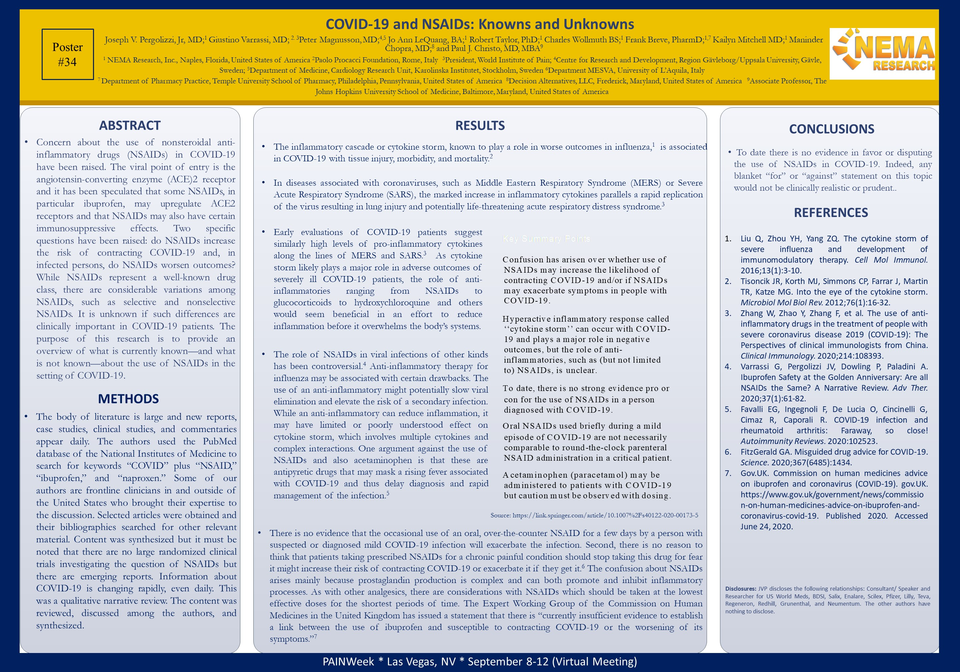
COVID-19 and NSAIDs: Knowns and Unknowns


Abstract

•Concern about the use of nonsteroidal anti-inflammatory drugs (NSAIDs) in COVID-19 have been raised. The viral point of entry is the angiotensin-converting enzyme (ACE)2 receptor and it has been speculated that some NSAIDs, in particular ibuprofen, may upregulate ACE2 receptors and that NSAIDs may also have certain immunosuppressive effects. Two specific questions have been raised: do NSAIDs increase the risk of contracting COVID-19 and, in infected persons, do NSAIDs worsen outcomes? While NSAIDs represent a well-known drug class, there are considerable variations among NSAIDs, such as selective and nonselective NSAIDs. It is unknown if such differences are clinically important in COVID-19 patients. The purpose of this research is to provide an overview of what is currently known—and what is not known—about the use of NSAIDs in the setting of COVID-19.


Poster
non-peer-reviewed

COVID-19 and NSAIDs: Knowns and Unknowns


Author Information

Joseph Pergolizzi

Cardiology, Native Cardio Inc., Naples, USA

Giustino Varrassi

President, Paolo Procacci Foundation, Rome, ITA

Peter Magnusson

Cardiology, Center of Research and Development Region Gävleborg /Uppsala University, Gävle, SWE

Jo Ann K. LeQuang Corresponding Author

NEMA Research, Inc., Naples, Florida, USA

Robert Taylor

Chief Operating Officer, NEMA Research, Inc., Naples, FL, USA

Charles Wollmuth

Research and Development, NEMA Research Group, Naples, FL, USA

Frank Breve

Department of Pharmacy, Temple University, Philadelphia, USA

Kailyn Mitchell

NEMA Research, Naples, USA

Maninder Chopra

Research, Decision Alternatives, LLC, Frederick, USA

Paul Christo

Pain Management, Johns Hopkins University School of Medicine, Baltimore, USA


PDF Share