Abstract
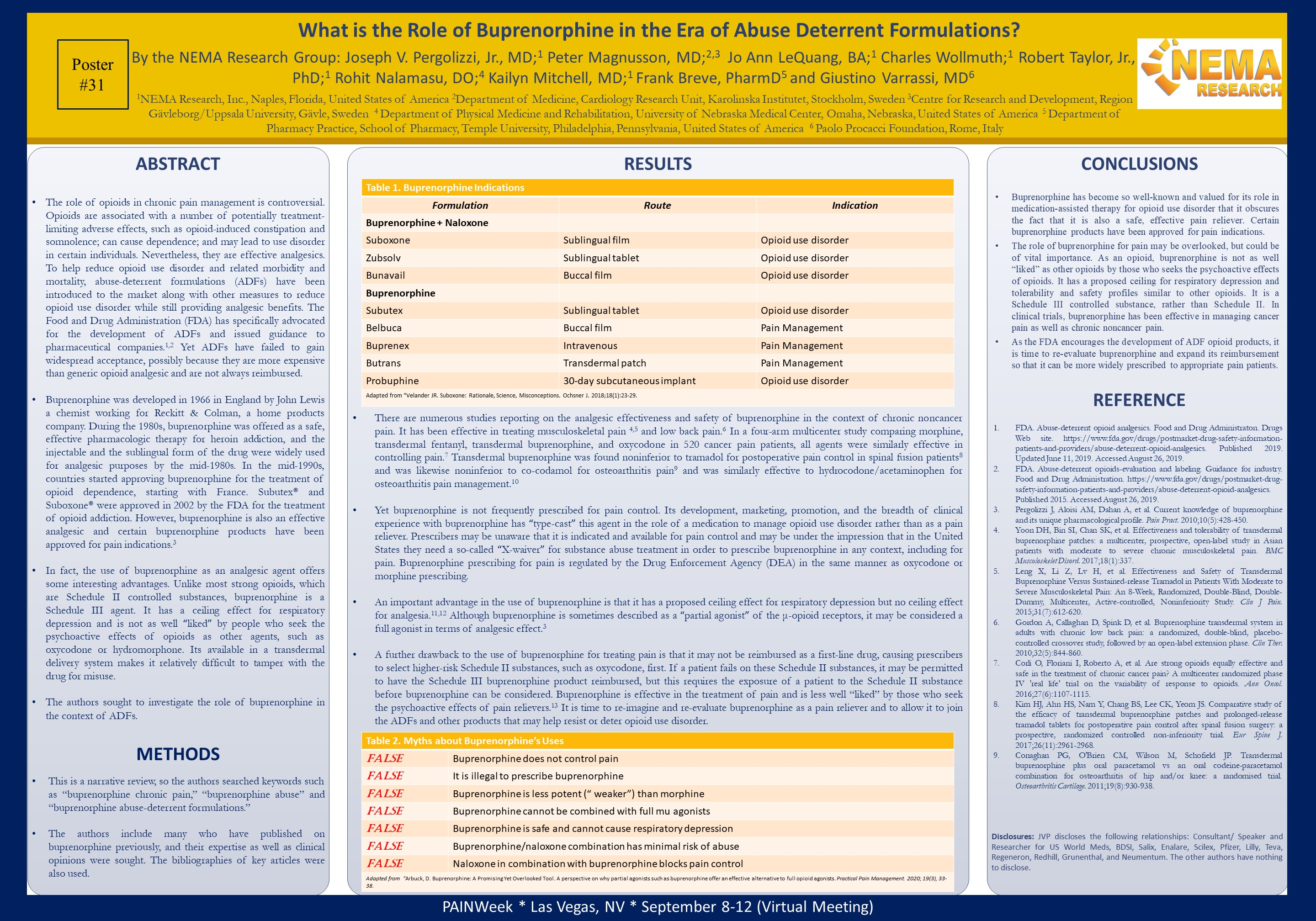
•The role of opioids in chronic pain management is controversial. Opioids are associated with a number of potentially treatment-limiting adverse effects, such as opioid-induced constipation and somnolence; can cause dependence; and may lead to use disorder in certain individuals. Nevertheless, they are effective analgesics. To help reduce opioid use disorder and related morbidity and mortality, abuse-deterrent formulations (ADFs) have been introduced to the market along with other measures to reduce opioid use disorder while still providing analgesic benefits. The Food and Drug Administration (FDA) has specifically advocated for the development of ADFs and issued guidance to pharmaceutical companies.1,2 Yet ADFs have failed to gain widespread acceptance, possibly because they are more expensive than generic opioid analgesic and are not always reimbursed.
•Buprenorphine was developed in 1966 in England by John Lewis a chemist working for Reckitt & Colman, a home products company. During the 1980s, buprenorphine was offered as a safe, effective pharmacologic therapy for heroin addiction, and the injectable and the sublingual form of the drug were widely used for analgesic purposes by the mid-1980s. In the mid-1990s, countries started approving buprenorphine for the treatment of opioid dependence, starting with France. Subutex® and Suboxone® were approved in 2002 by the FDA for the treatment of opioid addiction. However, buprenorphine is also an effective analgesic and certain buprenorphine products have been approved for pain indications.3
•In fact, the use of buprenorphine as an analgesic agent offers some interesting advantages. Unlike most strong opioids, which are Schedule II controlled substances, buprenorphine is a Schedule III agent. It has a ceiling effect for respiratory depression and is not as well “liked” by people who seek the psychoactive effects of opioids as other agents, such as oxycodone or hydromorphone. Its available in a transdermal delivery system makes it relatively difficult to tamper with the drug for misuse.
•The authors sought to investigate the role of buprenorphine in the context of ADFs.