DsbA Regulates the PhoQ/PhoP Two-Component System in Escherichia coli
Abstract
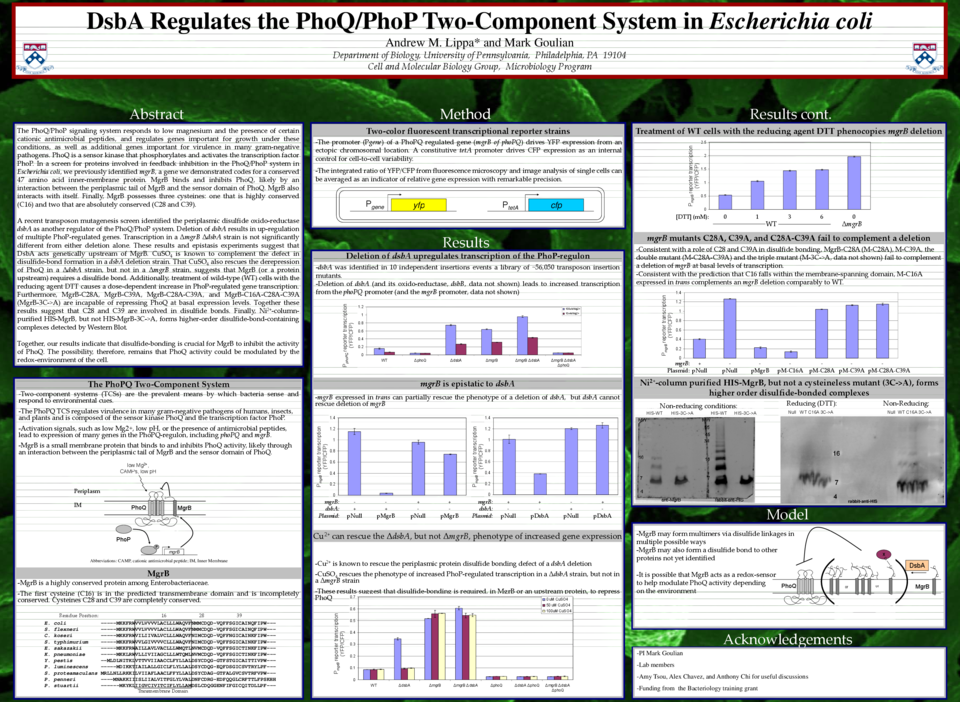
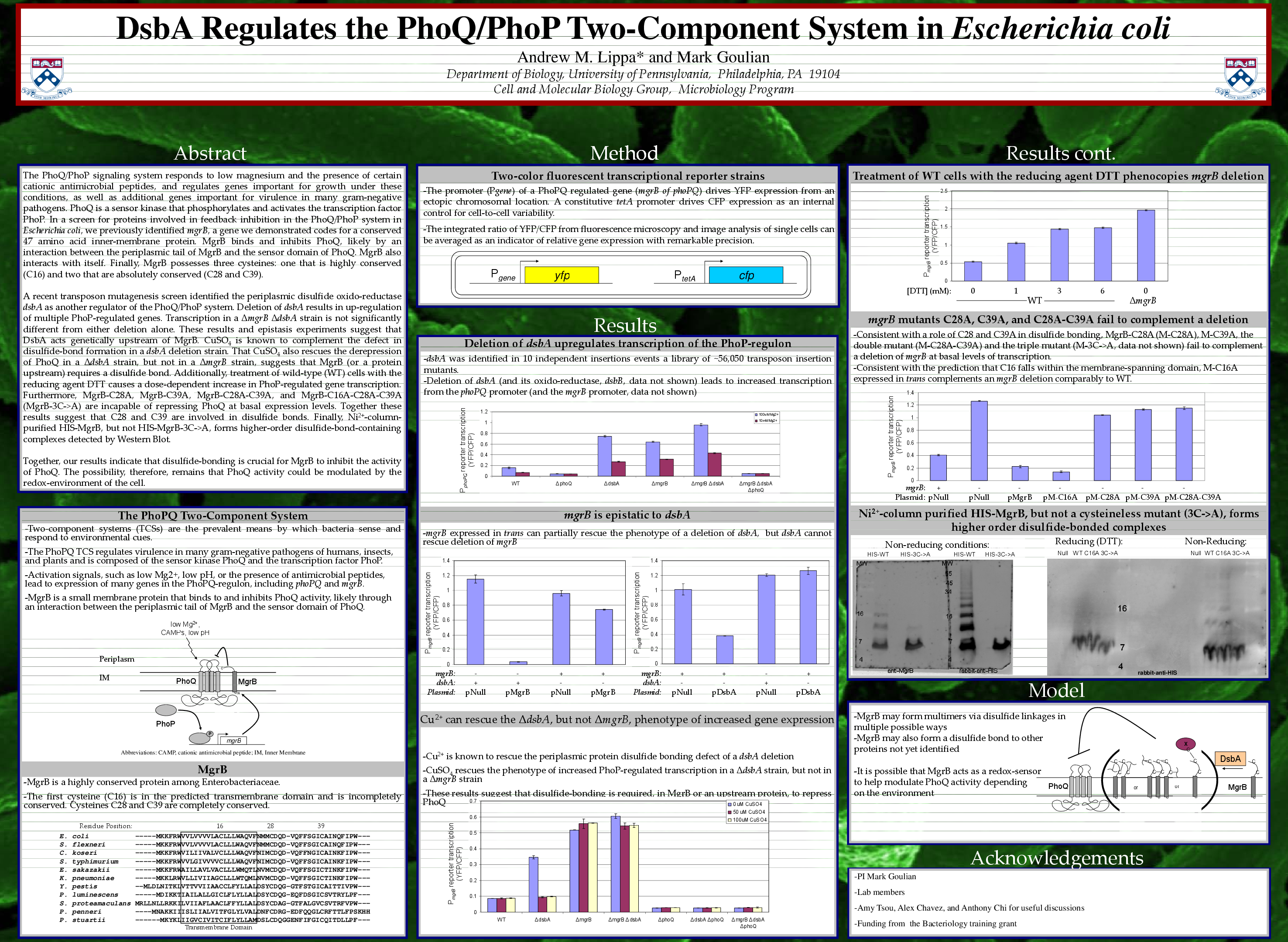
The PhoQ/PhoP signaling system responds to low magnesium and the presence of certain cationic antimicrobial peptides, and regulates genes important for growth under these conditions, as well as additional genes important for virulence in many gram-negative pathogens. PhoQ is a sensor kinase that phosphorylates and activates the transcription factor PhoP. In a screen for proteins involved in feedback inhibition in the PhoQ/PhoP system in Escherichia coli, we previously identified mgrB, a gene we demonstrated codes for a conserved 47 amino acid inner-membrane protein. MgrB binds and inhibits PhoQ, likely by an interaction between the periplasmic tail of MgrB and the sensor domain of PhoQ. MgrB also interacts with itself. Finally, MgrB possesses three cysteines: one that is highly conserved (C16) and two that are absolutely conserved (C28 and C39).
A recent transposon mutagenesis screen identified the periplasmic disulfide oxido-reductase dsbA as another regulator of the PhoQ/PhoP system. Deletion of dsbA results in up-regulation of multiple PhoP-regulated genes. Transcription in a ΔmgrB ΔdsbA strain is not significantly different from either deletion alone. These results and epistasis experiments suggest that DsbA acts genetically upstream of MgrB. CuSO4 is known to complement the defect in disulfide-bond formation in a dsbA deletion strain. That CuSO4 also rescues the derepression of PhoQ in a ΔdsbA strain, but not in a ΔmgrB strain, suggests that MgrB (or a protein upstream) requires a disulfide bond. Additionally, treatment of wild-type (WT) cells with the reducing agent DTT causes a dose-dependent increase in PhoP-regulated gene transcription. Furthermore, MgrB-C28A, MgrB-C39A, MgrB-C28A-C39A, and MgrB-C16A-C28A-C39A (MgrB-3C->A) are incapable of repressing PhoQ at basal expression levels. Together these results suggest that C28 and C39 are involved in disulfide bonds. Finally, Ni2+-column-purified HIS-MgrB, but not HIS-MgrB-3C->A, forms higher-order disulfide-bond-containing complexes detected by Western Blot.
Together, our results indicate that disulfide-bonding is crucial for MgrB to inhibit the activity of PhoQ. The possibility, therefore, remains that PhoQ activity could be modulated by the redox-environment of the cell.
Related articles