Abstract
Matrix-Bound Water as a Determinant of Fatigue Life in Trabecular Bone
Adrian J. Alepuz1, Peter C. Shen 2, Sasidhar Uppuganti3, Jeffry Nyman2,3,4
1Dr. Kiran C. Patel College of Allopathic Medicine , FL,2Vanderbilt University, Nashville, TN, 3Vanderbilt University Medical Center, Nashville, TN, 4VA Tennessee Valley Healthcare System, Nashville, TN
Introduction
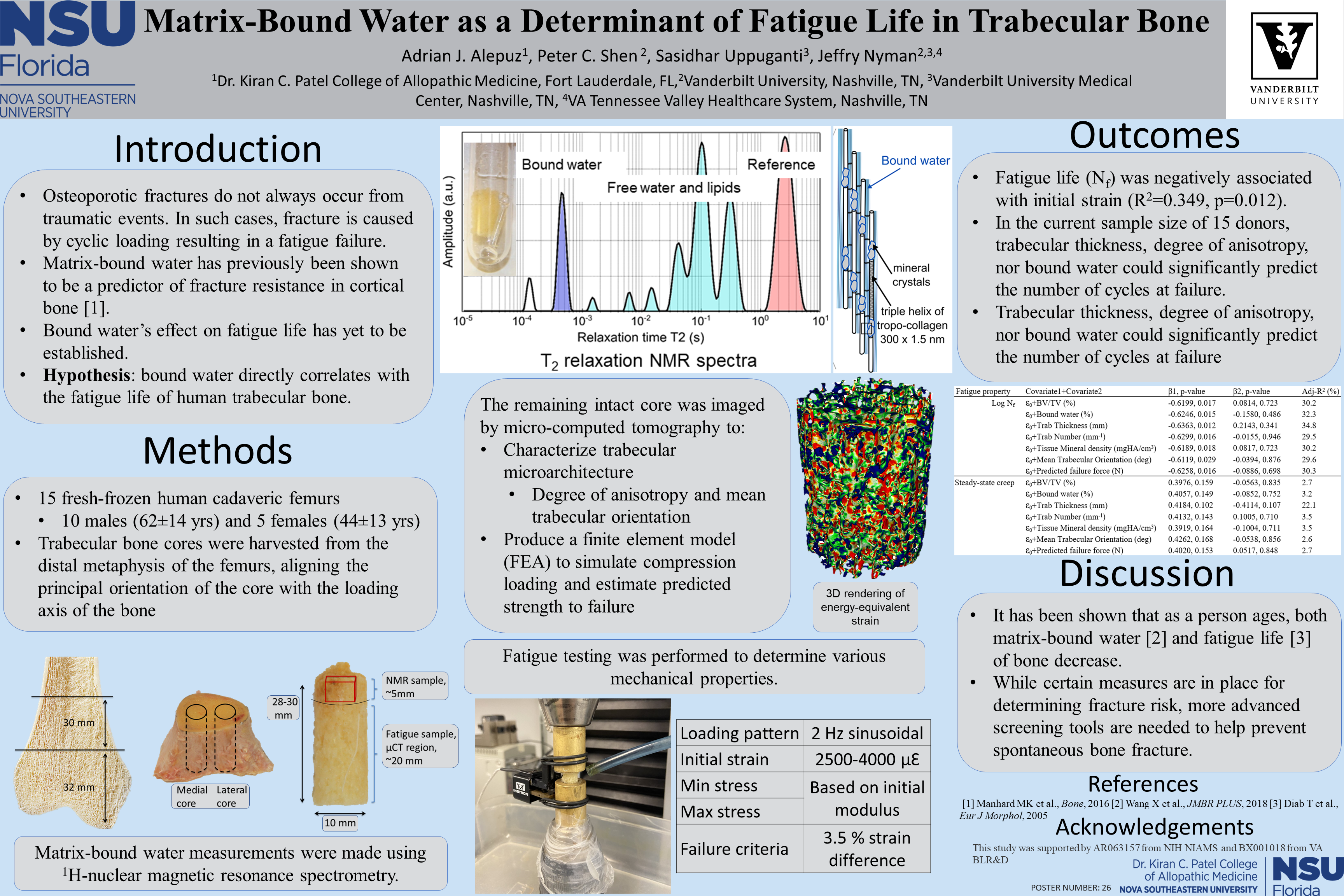
Osteoporotic fractures do not always occur from traumatic events. In such cases, fracture is caused by cyclic loading resulting in a fatigue failure. While bound water has previously been shown to be a predictor of fracture resistance in bone, its effect on fatigue life has yet to be determined. In this study, we hypothesize that matrix-bound water serves as a valuable predictor of mechanical failure prone to fatigue in human trabecular bone.
Methods
To test our hypothesis, we acquired fresh-frozen human cadaveric femurs from 16 donors. Trabecular bone cores were harvested from the distal metaphysis of the femurs, ensuring that the principal orientation of the core aligned with the loading axis of the bone. From each core, a mechanical testing specimen and an NMR sample were prepared for analysis. Cores were evaluated using microCT before undergoing fatigue testing, achieving target initial strains and loads. Standard mechanical equations for fatigue testing of cylindrical samples were used to calculate various biomechanical properties.
Outcomes
As anticipated, fatigue life was negatively associated with initial strain (p = 0.0243). Bound water volume fraction was found to be a weak indicator of fatigue. Fatigue life was not found to correlate with trabecular thickness, degree of anisotropy, or preferred orientation of the trabeculae.
Discussion
It has been shown that as a person ages, both matrix-bound water and trabecular fatigue life decrease. While certain measures are in place for determining fracture risk, more advanced screening tools are needed to help prevent spontaneous bone fracture.