
Abstract
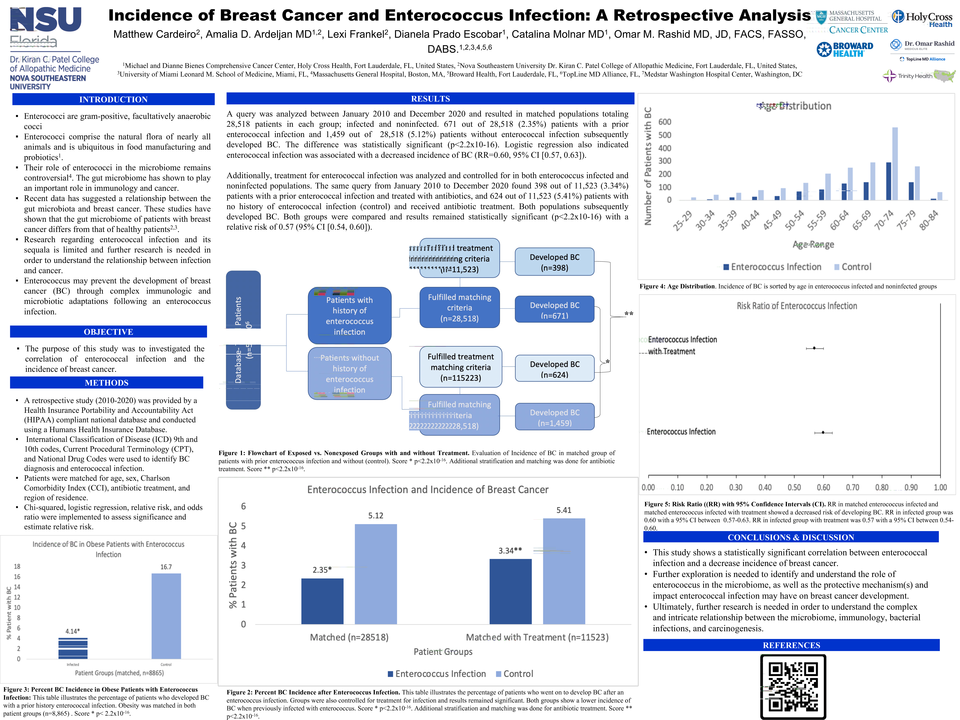
Introduction: Enterococci role in the microbiome remains controversial. The gut microbiome has shown to play an important role in immunology and cancer. Recent data has suggested a relationship between the gut microbiome and breast cancer (BC). Enterococcus may prevent the development of BC through complex immunologic and microbiotic adaptations following an enterococcus infection. This study investigated the effect of enterococcus infection and incidence of BC.
Methods: A retrospective study (2010-2020) was provided by a HIPAA compliant national database. ICD 9 and 10 codes, CPT, and National Drug Codes were used to identify BC diagnosis and enterococcus infection. Patients were matched for age, sex, CCI, antibiotic treatment, and region of residence. Statistical analyses were implemented to assess significance and estimate relative risk.
Results: Enterococcus infection was associated with a decreased incidence of BC (RR=0.60, 95% CI [0.57, 0.63]) and the difference was statistically significant (p<2.2x10⁻¹⁶). Treatment for enterococcus infection was controlled for in both enterococcus infected and noninfected populations. Patients with a prior enterococcus infection and treated with antibiotics were compared to patients with no history of enterococcus infection and received antibiotic treatment. Both populations subsequently developed BC. Results remained statistically significant (p<2.2x10⁻¹⁶) with a RR of 0.57 (95% CI [0.54, 0.60]).
Discussion: This study shows a statistically significant correlation between enterococcus infection and decreased incidence of BC. Further exploration is needed to identify and understand not only the role of enterococcus in the microbiome, but also the protective mechanism(s) and impact enterococcus infection may have on BC development.


