Abstract
The Effect of α-synuclein Reduction in Alzheimer’s Disease
Abigail Conroy1, Michael Mante2, Robert A. Rissman2
1 Nova Southeastern University Dr. Kiran C. Patel College of Allopathic Medicine (NSU MD)
2 Department of Neurosciences UCSD School of Medicine
Introduction
Alzheimer’s disease (AD) is a neurodegenerative disorder characterized by the accumulation of amyloid β (Aβ). α-synuclein (a-syn) is a protein involved in neurotransmitter release whose role in Parkinson’s disease has been investigated extensively. Recent studies have shown that a-syn may also play a role in AD and suggest that a-syn regulation could be protective against the toxic effects of Aβ accumulation. Previous studies show that a-syn KO in AD mice prevents neurodegeneration of cholinergic neurons and improved deficits. To better understand the functional consequences, this study aims to determine if selective knockdown of a-syn will ameliorate AD neurodegeneration.
Method
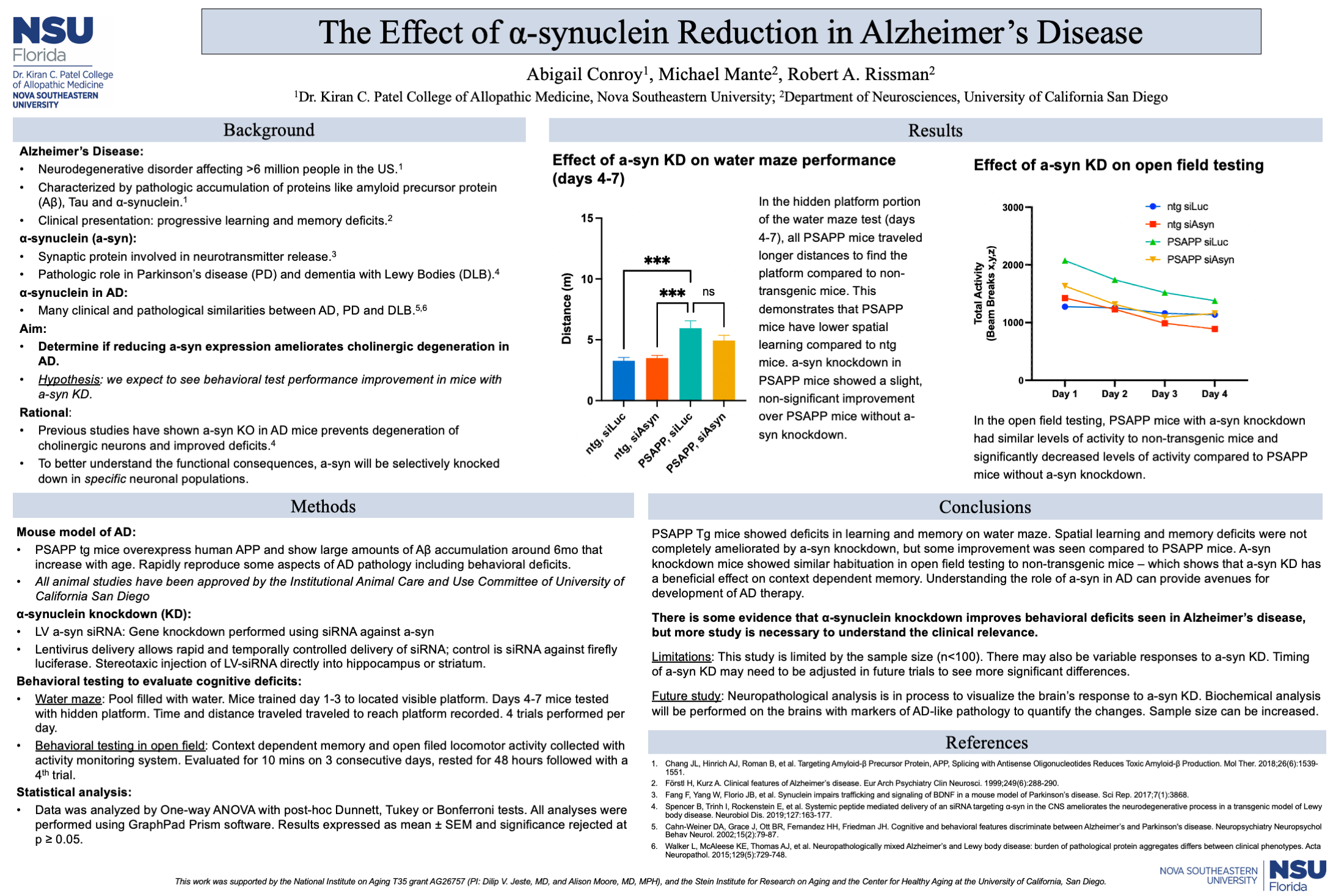
To evaluate the effect of a-syn knockdown, PSAPP transgenic mice were used to model AD, and knockdown of a-syn was performed by RNA interference. Behavioral testing, including Morris water maze (MWM), was used to assess cognitive deficits.
At the end of the behavioral experiments, brains were preserved and utilized for neuropathological analysis with immunostaining for markers of AD-like pathology.
Outcomes
Spatial learning and memory deficits were not completely ameliorated by a-syn knockdown, but some improvement was seen compared to PSAPP mice. A-syn knockdown mice showed similar habituation in open field testing to non-transgenic mice – which shows that a-syn KD has a beneficial effect on context-dependent memory.
Discussion
There is some evidence that α-synuclein knockdown improves behavioral deficits seen in Alzheimer’s disease, but more study is necessary to understand the clinical relevance. Understanding the role of a-syn in AD has implications for the future development of AD therapy. This study is limited by sample size (n<100) and future studies may see significant results with a larger n. The neuropathological analysis is ongoing and will help to better understand the brain’s response to a-syn KD.