Improved Cerebrovascular Compliance Quantification with Gated and Non-Gated PC-MRI
Abstract
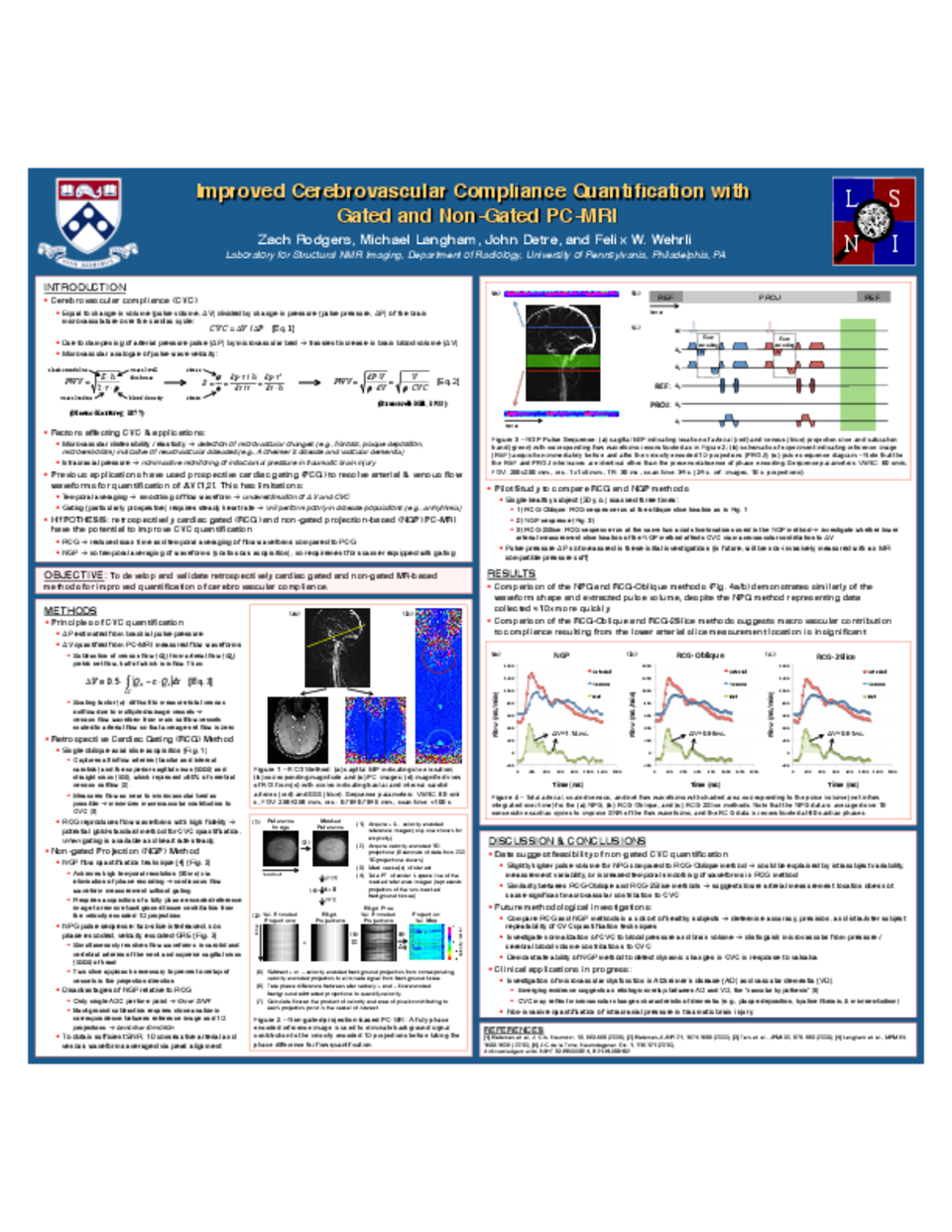
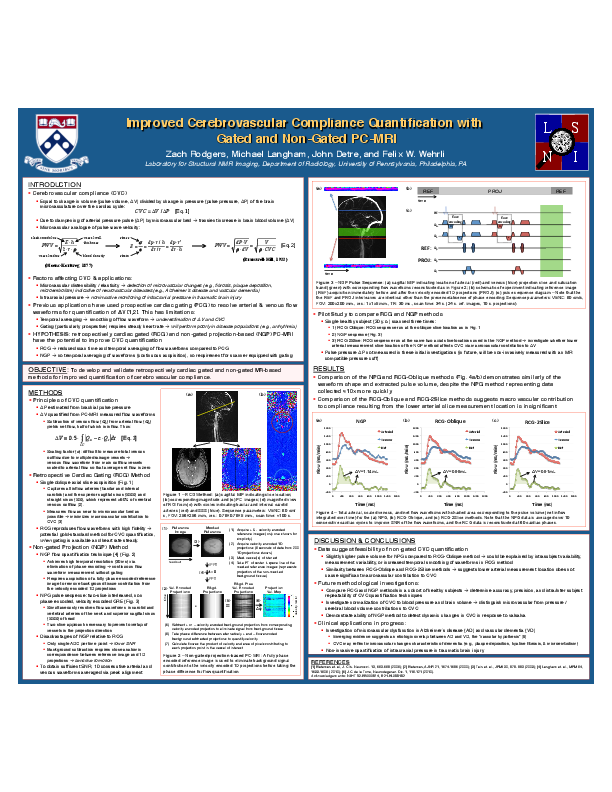
INTRODUCTION: MR-based methods offer a robust and non-invasive approach to quantifying cerebrovascular compliance (CVC), a measure of microvascular distensibility equal to the change in volume (the pulse volume) divided by the change in pressure (the pulse pressure) of the brain microvasculature over a cardiac cycle: CVC=dV/dP. CVC quantification requires resolving arterial inflow and venous outflow waveforms, which are temporally offset due to the dampening or “compliance” of the microvasculature. Subtracting these waveforms gives net flow, which integrated over the cardiac cycle gives pulse pressure. Pulse volume can easily be measured during the scan with a pressure cuff. Development and application of CVC quantification methods is limited by the use of cardiac gated PC-MRI, which produces overly smoothed flow waveforms due to temporal averaging, especially in subjects with unsteady heart rates. To address these limitations, we have explored CVC quantification using a novel non-gated projection PC-MRI method.
METHODS: A two-slice interleaved, velocity-encoded GRE sequence was developed to simultaneously resolve flow waveforms in the carotid and vertebral arteries of the neck and superior sagittal sinus (SSS) of the head. The pulse sequence is run without phase encoding to achieve 30 ms temporal resolution at each slice. Immediately before the non-phase encoded projection sequence, a fully phase encoded but otherwise identical reference sequence is used to acquire positive and negative velocity encoded 2D phase maps. The center k-space line of these 2D images, with vessels of interest (VOI) masked, represents the contribution of the background (non-VOI) signal to the projection images, which can be subjected from the corresponding positive or negative velocity encoded projection lines to obtained background-free velocity encoded projections. Taking the phase difference between consecutive projections produces a stack of velocity encoded 1D projection images. The non-gated method was compared to retrospectively gated PC-MRI in a single young healthy subject. In these initial investigations, dP was not measured, but could be easily obtained during the scan with an MR compatible pressure cuff.
RESULTS: The non-gated method produced flow waveforms qualitatively similar to those of the gated method, despite using data acquired in one tenth the time and without gating. The non-gated and gated methods resulted in quantified pulse volumes of 1.14 mL and 0.99 mL respectively, reflecting possible underestimation by the gated method due to waveform smoothing.
CONCLUSIONS: We have demonstrated the feasibility of non-gated CVC quantification. These investigations must be repeated in more subjects to determine accuracy, precision, and intra/inter subject repeatability of CVC measurement using the methods, and to determine whether differences in pulse volume quantified in this initial investigation are physiological or methodological. We are especially interested in applying this method to the study of Alzheimer’s disease (AD) because despite emerging evidence supporting a significant microvascular contribution to AD progression, few non-invasive methods exist for probing cerebral microvascular function.
Related articles