Abstract
Background
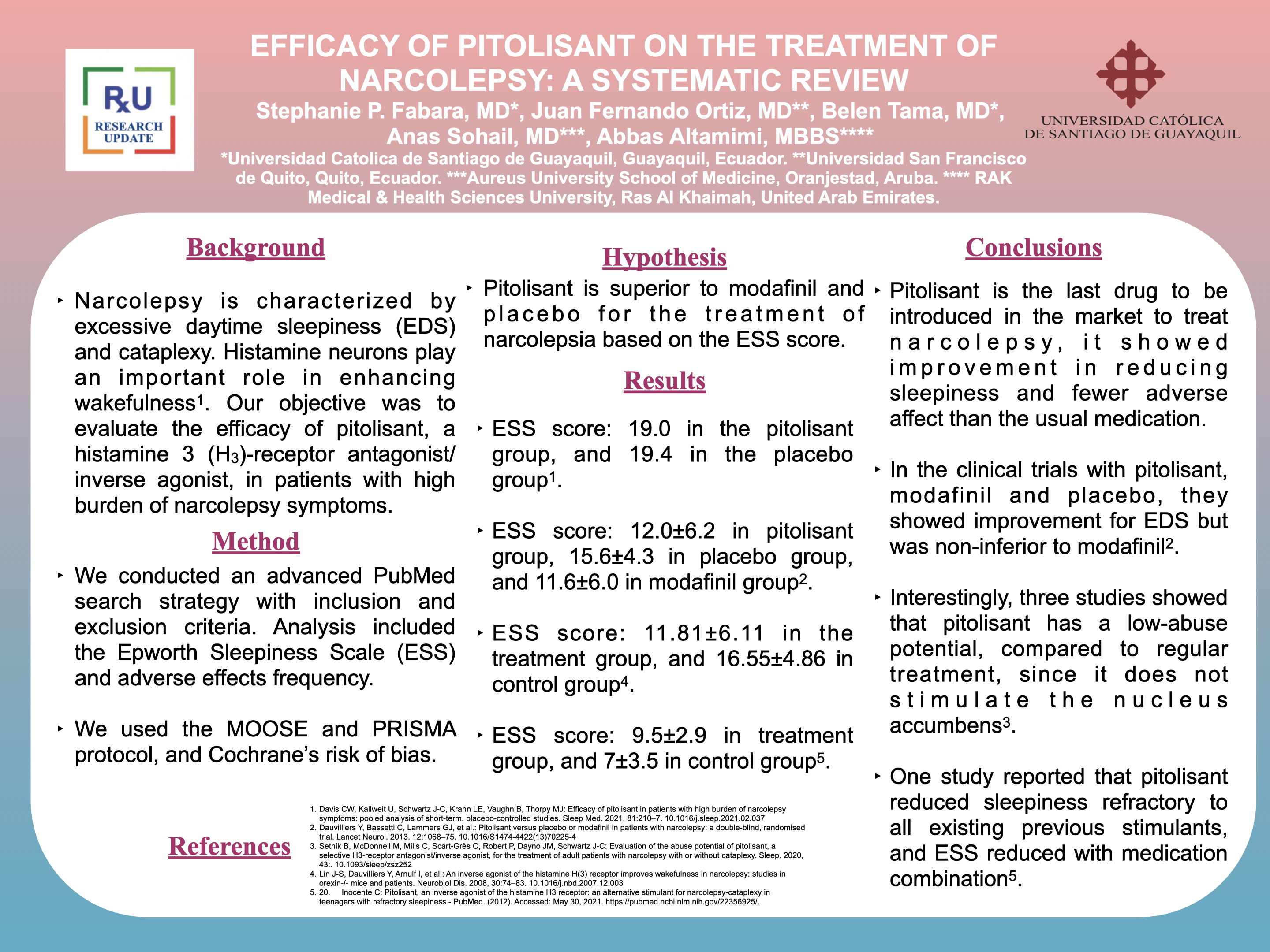
Narcolepsy is characterized by excessive daytime sleepiness (EDS) and cataplexy. Histamine neurons play an important role in enhancing wakefulness. Our objective was to evaluate the efficacy of pitolisant, a histamine 3 (H3)-receptor antagonist/inverse agonist, in patients with high burden of narcolepsy symptoms.
Methods
- We conducted an advanced PubMed search strategy with inclusion and exclusion criteria. Analysis included the Epworth Sleepiness Scale (ESS) and adverse effects frequency.
- We used the MOOSE and PRISMA protocol, and Cochrane’s risk of bias.
Hypothesis
Pitolisant is superior to modafinil and placebo for the treatment of narcolepsia based on the ESS score.
Results
- ESS score: 19.0 in the pitolisant group, and 19.4 in the placebo group.
- ESS score: 12.0±6.2 in pitolisant group, 15.6±4.3 in placebo group, and 11.6±6.0 in modafinil group.
- ESS score: 11.81±6.11 in the treatment group, and 16.55±4.86 in control group.
- ESS score: 9.5±2.9 in treatment group, and 7±3.5 in control group.
Conclusions
- Pitolisant is the last drug to be introduced in the market to treat narcolepsy, it showed improvement in reducing sleepiness and fewer adverse affect than the usual medication.
- In the clinical trials with pitolisant, modafinil and placebo, they showed improvement for EDS but was non-inferior to modafinil.
- Interestingly, three studies showed that pitolisant has a low-abuse potential, compared to regular treatment, since it does not stimulate the nucleus accumbens.
- One study reported that pitolisant reduced sleepiness refractory to all existing previous stimulants, and ESS reduced with medication combination.