Abstract
Background: On average, health declines with age. Even so, at any given age the health status across a group of people varies. Variability in health status and in the risk for adverse outcomes for people of the same age is referred to as “frailty,” which typically has been studied among older adults. Although frailty can be operationalized in different ways, in general, people who report having no health problems are more likely to be fit than people who report having many problems. Unsurprisingly, the chance of adverse outcomes—death, admission to a long-term care institution or to hospital, or worsening of health status increases with the number of problems that the individual has.
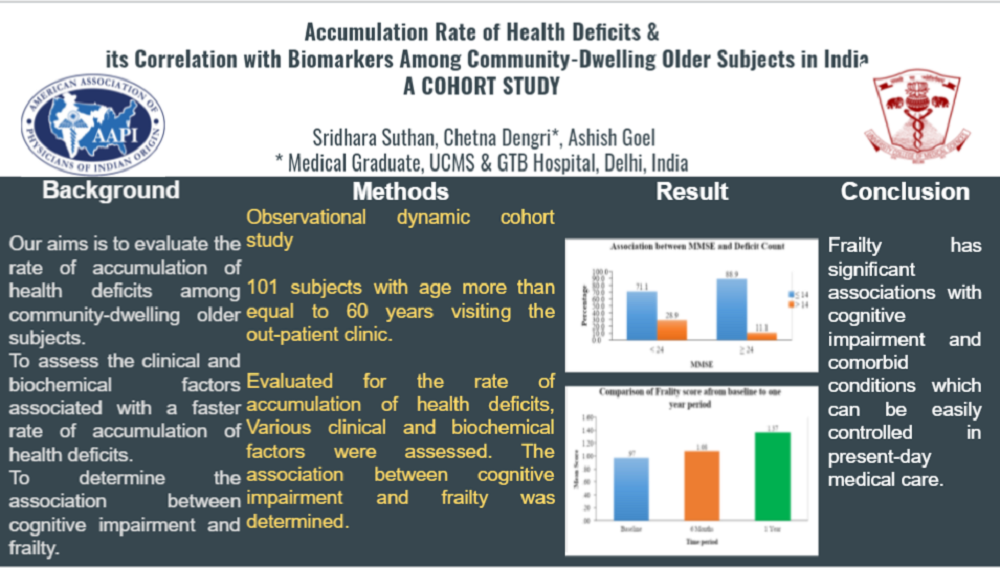
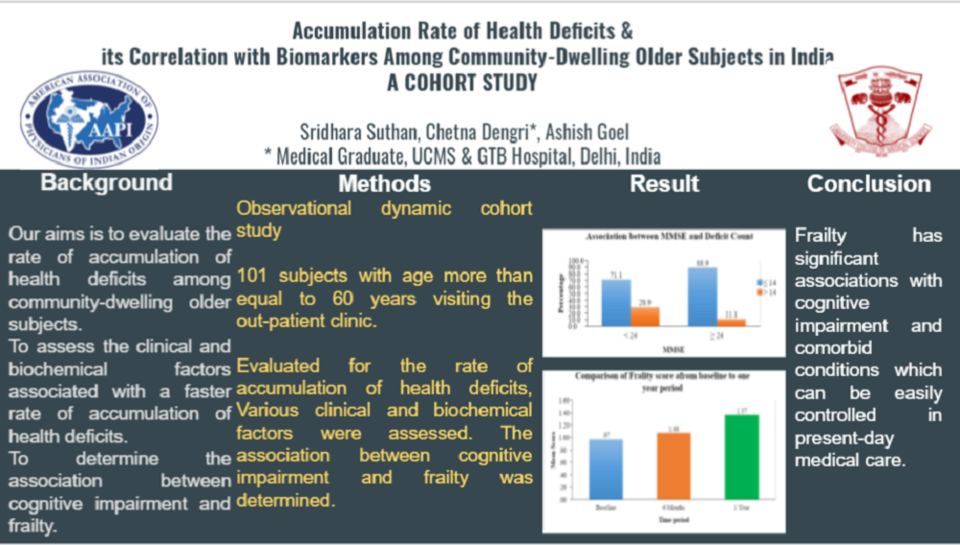
Aims: The aim of our study was to evaluate the rate of accumulation of health deficits among community-dwelling older subjects. Our study also attempts to assess the clinical and biochemical factors associated with a faster rate of accumulation of health deficits. Further, our study attempts to determine the association between cognitive impairment and frailty.
Methods: A total of 101 subjects with age more than equal to 60 years visiting the out-patient clinic in our department were included in this observational dynamic cohort study and they were evaluated for the rate of accumulation of health deficits over six-monthly intervals by calculating the difference between index score at follow-up and at baseline. Various clinical and biochemical factors associated with a faster rate of accumulation of health deficits were assessed. Further, the association between cognitive impairment and frailty was determined.
Result: Out of 101 subjects who had completed two follow-up visits, 64 subjects were in the age group of 60-65 years (63.5%), 20 subjects were in the age group of 66-70 years (19.8%), 13 subjects were in the age group of 71-75 years (12.9%) and four subjects were in the age group of 76-80 years (4.0%). Of these, there were 51 (50.5%) male subjects and 50 (49.5%) female subjects. The mean rate of accumulation of health deficits from baseline to six-month period was 0.0051 with an SD of 0.0157 and from six months to one year, the mean rate of accumulation was 0.0108 with an SD of 0.0176. It was found to be statistically significant (p, 0.026). Baseline frailty score, baseline deficit count, baseline depression score, and serum sirtuins-1 were significantly associated with a faster rate of accumulation of health deficits. The association between deficits in health (indigenous frailty index) and frailty score as per Fried’s criteria was found to be statistically significant (p <0.001). The association between cognitive impairment as measured by MMSE score and frailty was found to be statistically significant (p =0.023). The association between cognitive impairment as measured by clock drawing test and frailty was found to be statistically significant (p =0.023).
Conclusion: Frailty is an important problem in the older subjects visiting our hospital and contributes to significant morbidity in this group. Frailty has significant associations with cognitive impairment and comorbid conditions which can be easily controlled in present-day medical care. Local definitions to identify frailty can be easily developed and may be better suited to capture this subset among older people.