
Abstract
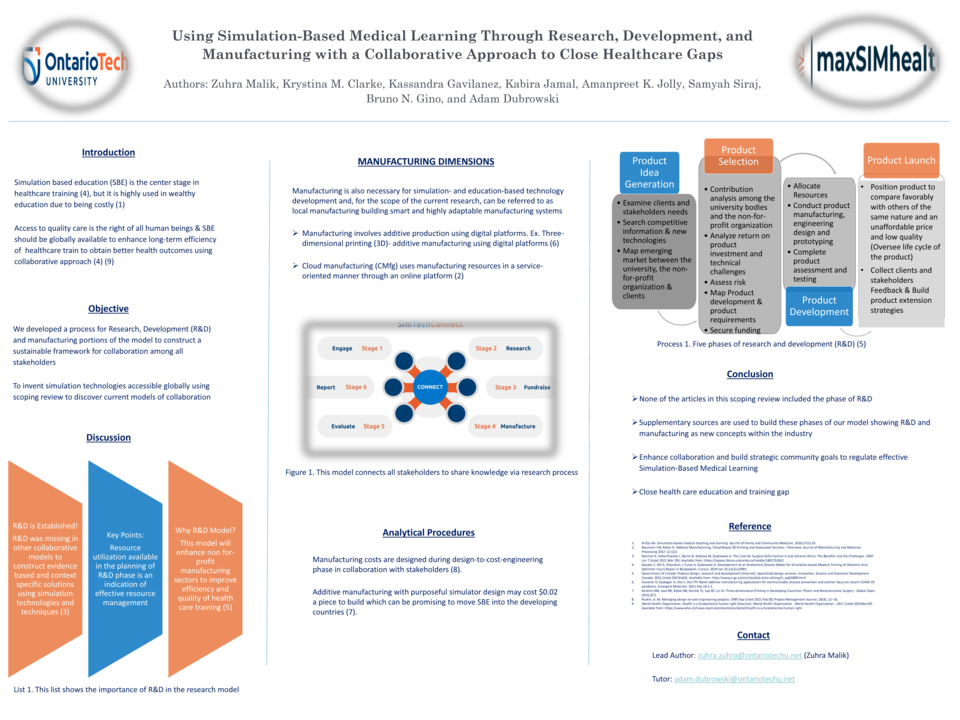
Introduction: Our objective is to develop the R&D portion of the model using Government of Canada's guidelines as a framework to construct a model for sustainable collaboration between all stakeholders enhancing the long-term efficiency of training and invent simulation technologies accessible globally by performing scoping review to discover current models of collaboration.
Discussion: We have established an R&D complement for our model because it was uncovered by our scoping review that R&D is not included in any other models of collaboration in the health care simulation space; we view this as a significant and unique contribution. Therefore, resource utilization available in the planning R&D phase is an indication of effective resource management ensuring R&D model is supporting projects following strategic community goals to determine effective outcomes. However, in the absence of 3D printing, the steps of R&D model will be utilized accordingly determining the most suitable solution. Additionally, manufacturing involves additive production using digital platforms. However, cloud manufacturing uses manufacturing resources in a service-oriented manner via an online platform.
Methods: R&D is a sequence of progress containing phases of product idea generation; product selection; product development; and product launch. The manufacturing costs are designed during design-to-cost engineering phase while developing product. Accordingly, manufacturing funds and the design adaptation will be discussed with stakeholders followed by the production phase and the resulting products will be delivered to stakeholders.
Results & Implication: None of the articles in this scoping review included the phase of R&D. Therefore, supplementary sources are used to build these phases of our model showing R&D and manufacturing as new concepts within the industry.
Conclusions: R&D and manufacturing models used in this review aim to close the healthcare simulation gap at an affordable cost. The idea of carrying out R&D and manufacturing phases based solely on budget is a unique characteristic.



