
Abstract
Background: Handedness is a lateral preference of the right or left upper limb. Often, the dominant upper limb possesses greater ability than the non-dominant upper limb. A commonly used ability measure is strength, which is the capacity to produce forceful exertions. A phenomenon known as the ‘10% Rule’ states that the dominant upper limb possesses 10% greater strength than the non-dominant upper limb. This strength characteristic coupled with the global population being 90% right-handed, suggests that handedness may influence upper limb strength, but this potential relationship is relatively unestablished by any form of existing literature review.
Objective: Completion of a scoping review will enhance understanding of the effects of handedness on upper limb strength by compiling evidence that identifies gaps in knowledge, clarifies concepts, and maps data.
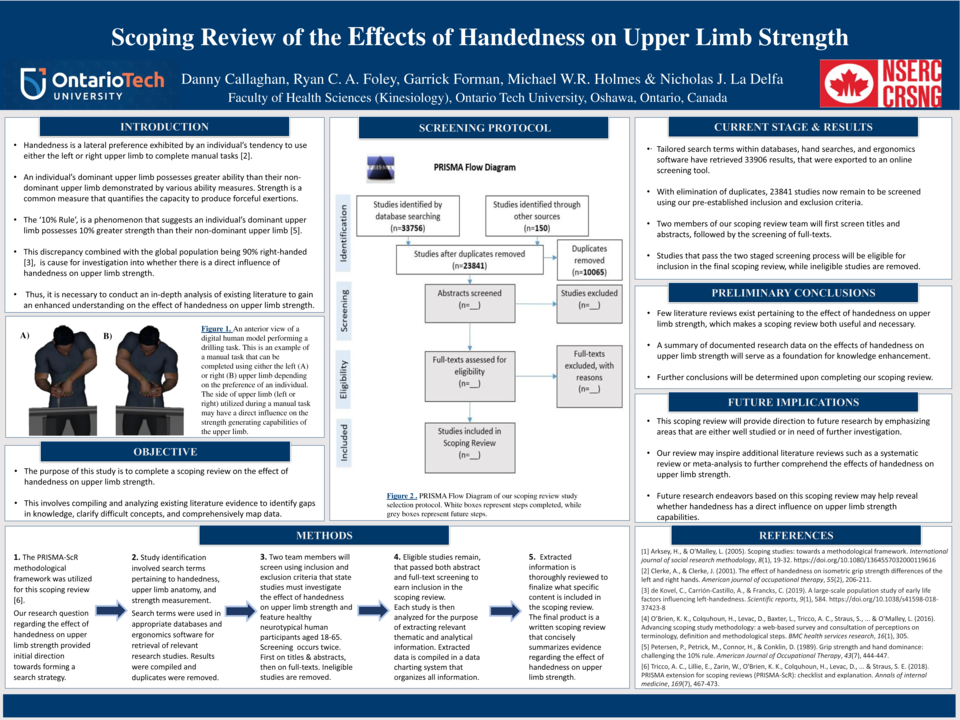
Methods: This study utilized the PRISMA-ScR (Scoping Review) protocol. The research question regarding the effect of handedness on upper limb strength provided direction towards a search strategy. A search terms list was created pertaining to handedness, upper limb anatomy, and strength along with the selection of appropriate databases and ergonomics software to utilize. Relevant studies were retrieved, and duplicates were eliminated. Two-staged screening of abstracts and then full texts will utilize pre-established inclusion and exclusion criteria. Studies on the effect of handedness on upper limb strength and that include healthy neurotypical human participants aged 18-65 will meet inclusion criteria. Thematic and analytical information will then be extracted from studies and stored in a data charting system. Extracted data will be compiled as a scoping review that summarizes the known effects of handedness on upper limb strength.
Results: The tailored search terms used within databases and ergonomics software retrieved 33906 results. After the elimination of duplicates, 23841 results remain to be screened.
Future Considerations: Completion of this scoping review permits enhanced understanding of knowledge and gaps that exist pertaining to the effects of handedness on upper limb strength and provides a foundation for future research studies or literature reviews such as a systematic review or meta-analysis.




