
Abstract
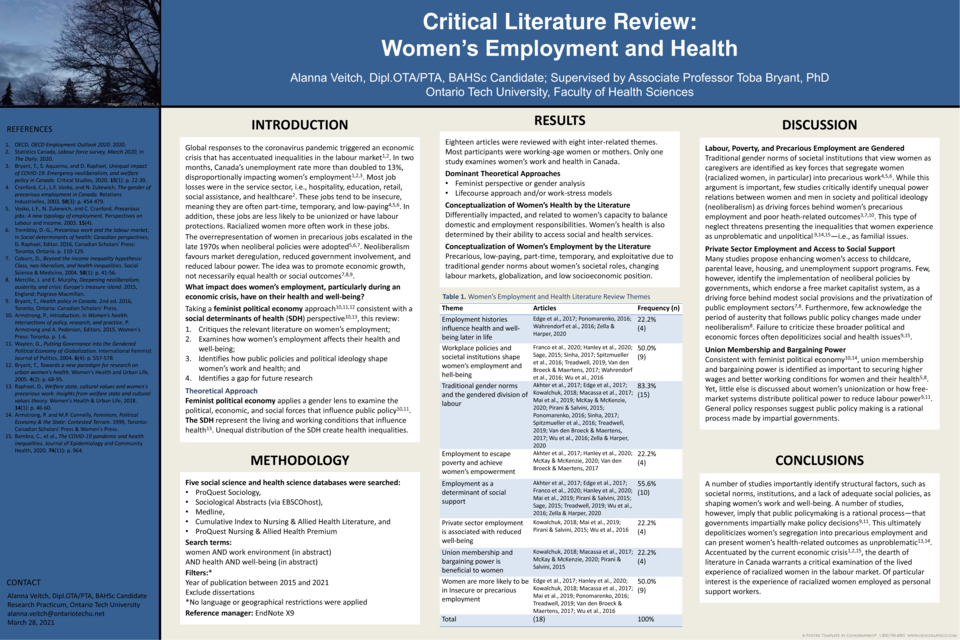
Background: The COVID-19 pandemic has had an unequal impact on women’s employment in Canada. It has accentuated the insecurities many women face in the labour market. Women—especially racialized women—work in jobs that are insecure. Since the late 1970s, insecure forms of employment increased in response to Canadian governments’ concern with promoting economic growth. A feminist political economy approach is applied to critically examine the research literature on women’s employment. Feminist political economy applies a gender lens to understand the impact of societal structures such as public policies on women. This literature review: (1) critiques literature on women’s employment; (2) examines how women’s employment affects their health; (3) identifies how public policies and political ideology shape women’s work and health; and (4) identifies a gap for future research.
Methodology: Five databases were used: ProQuest Sociology, Sociological Abstracts, Medline, CINAHL, and ProQuest Nursing & Allied Health Premium. Search terms included: women, work environment, health, and well-being. Results were filtered by publication year between 2015 and 2021, and exported into EndNote X9.
Results: Eighteen articles were reviewed. Eight inter-related themes were identified that discuss employment histories, policies, gender norms, and bargaining power. Women’s employment is generally conceptualized as precarious which differentially impacts their health. Many identify structural forces as contributing to the insecurity many women experience, but neglect issues of power and political ideology in shaping the conditions of women’s employment, especially racialized women
Conclusion: Broad political and economic forces distribute power and shape women’s work and health, especially that of racialized women. The dearth of literature on this issue in Canada warrants research on the lived experiences of racialized women employed as personal support workers during the current crisis.



