Abstract
Aim
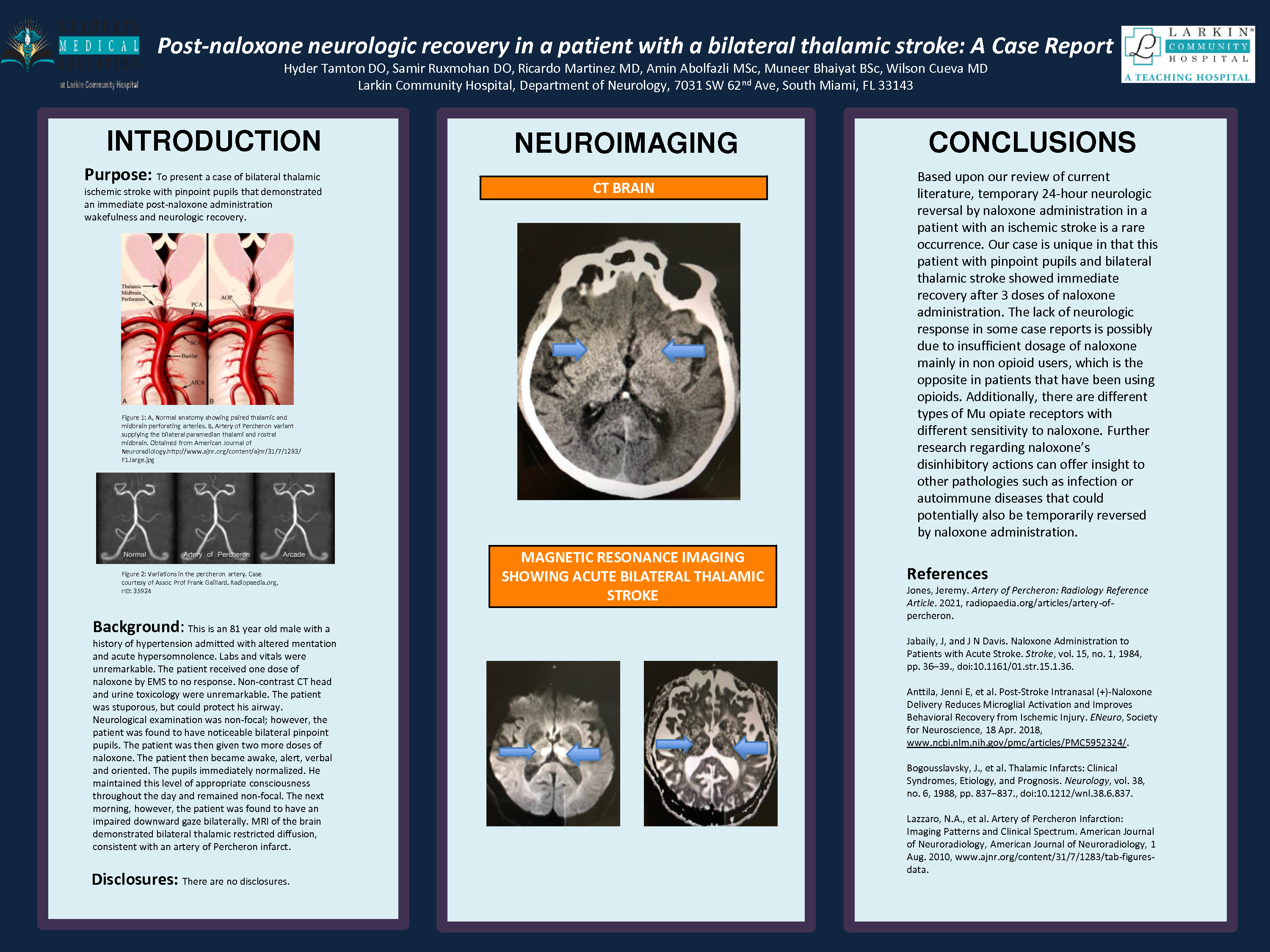
To present a case of bilateral thalamic ischemic stroke with pinpoint pupils that demonstrated an immediate post-naloxone administration wakefulness and neurologic recovery.
Background
This is an 81 year old male with a history of hypertension admitted with altered mentation and acute hypersomnolence. Labs and vitals were unremarkable. The patient received one dose of naloxone by EMS to no response. Non-contrast CT head and urine toxicology were unremarkable. The patient was stuporous, but could protect his airway. Neurological examination was non-focal; however, the patient was found to have noticeable bilateral pinpoint pupils. The patient was then given two more doses of naloxone. The patient then became awake, alert, verbal and oriented. The pupils immediately normalized. He maintained this level of appropriate consciousness throughout the day and remained non-focal. The next morning, however, the patient was found to have an impaired downward gaze bilaterally. MRI of the brain demonstrated bilateral thalamic restricted diffusion, consistent with an artery of Percheron infarct.
Conclusion
Based upon our review of current literature, temporary 24-hour neurologic reversal by naloxone administration in a patient with an ischemic stroke is a rare occurrence. Our case is unique in that this patient with pinpoint pupils and bilateral thalamic stroke showed immediate recovery with naloxone administration. The lack of neurologic response in some case reports is possibly due to insufficient dosage of naloxone. Additionally, there are different types of Mu opiate receptors with different sensitivity to naloxone. Further research regarding naloxone’s disinhibitory actions can offer insight to other pathologies such as infection or autoimmune diseases that could potentially also be temporarily reversed by naloxone administration.