Abstract
Introduction:
Malignant mesothelioma is a highly lethal malignancy with incidence of 1.94 (men) and 0.41(women) per 100,000 and approximately 3300 cases diagnosed in the United States every year, only 10 to 15 percent are peritoneal. We are presenting a 71-year-old male with non-specific symptoms of malignant peritoneal mesothelioma ( MPM ).
Case Report:
A 71-year-old male with multiple vascular risk factors hypertension, hyperlipidemia, type 2 diabetes mellitus, ischemic stroke and a history of iron deficiency anemia presents to the emergency room with non-productive cough, dyspnea for 2 days. He reported hematochezia, nausea, and vomiting. He also complained of abdominal distension and bloating for 3-4 days.His social history is significant for heavy tobacco use. His family history is significant for head and neck cancer.
Physical examination and vitals were within normal limits. His labs were significant for Hemoglobin of 9.7 g/dl, MCV of 79.6 fL, Iron 14 mcg/dL, TIBC 164 mcg/dL, Ferritin 2790ng/mL, CRP 292.60 mg/L and D-Dimer 550 ng/mL. Microbiology for COVID 19, Legionella, Stool PCR were negative.

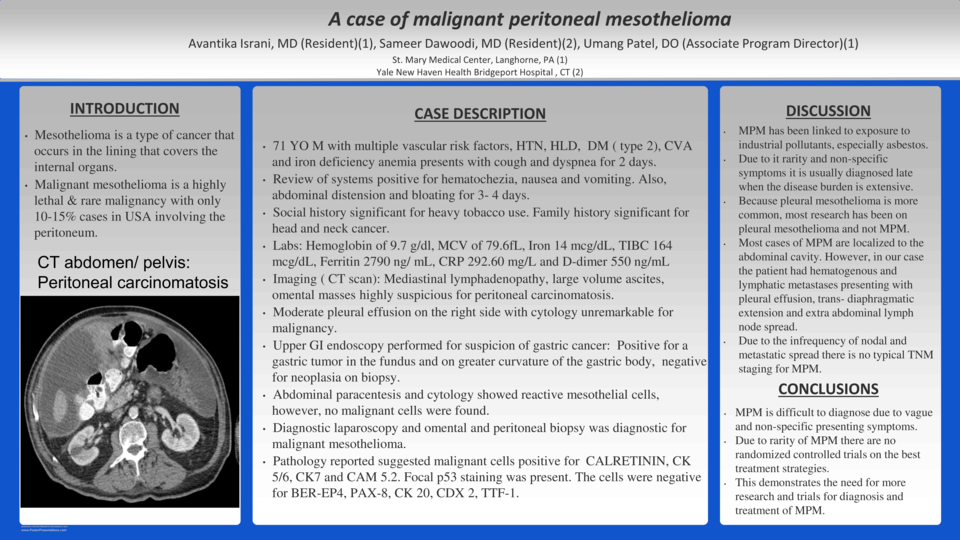
CT chest and abdomen demonstrated mediastinal lymphadenopathy, large volume ascites and soft tissue masses throughout the omentum highly suspicious for peritoneal carcinomatosis. There was also moderate right sided pleural effusion which was drained concerning for malignant effusion, however, cytology was negative for the same.
He subsequently underwent upper GI endoscopy for suspicion of gastric cancer. He was found to have a gastric tumor in the fundus and on greater curvature of the gastric body which was biopsied. The biopsy was negative for neoplasia. He underwent paracentesis and cytology which demonstrated reactive mesothelial cells however, no malignant cells. Eventually, he underwent a diagnostic laparoscopy and peritoneal biopsy which was diagnostic for malignant mesothelioma.
Pathology report suggested the malignant cells were positive for calretinin, CK5/6, CK7 and CAM5.2. Focal p53 staining was present.
Discussion:
MPM has been linked to exposure to industrial pollutants, especially asbestos. Due to it rarity and non-specific symptoms it is usually diagnosed late when the disease burden is extensive. Because pleural mesothelioma is more common, most research has been on pleural mesothelioma and not MPM. Most cases of MPM are localized to the abdominal cavity. However, in our case the patient had hematogenous and lymphatic metastases presenting with pleural effusion, trans- diaphragmatic extension and extra abdominal lymph node spread. Due to the infrequency of nodal and metastatic spread there is no typical TNM staging for MPM.
Conclusion:
MPM is difficult to diagnose due to vague and non-specific presenting symptoms. Due to rarity of MPM there are no randomized controlled trials on the best treatment strategies. This demonstrates the need for more research and trials for diagnosis and treatment of MPM.