Abstract
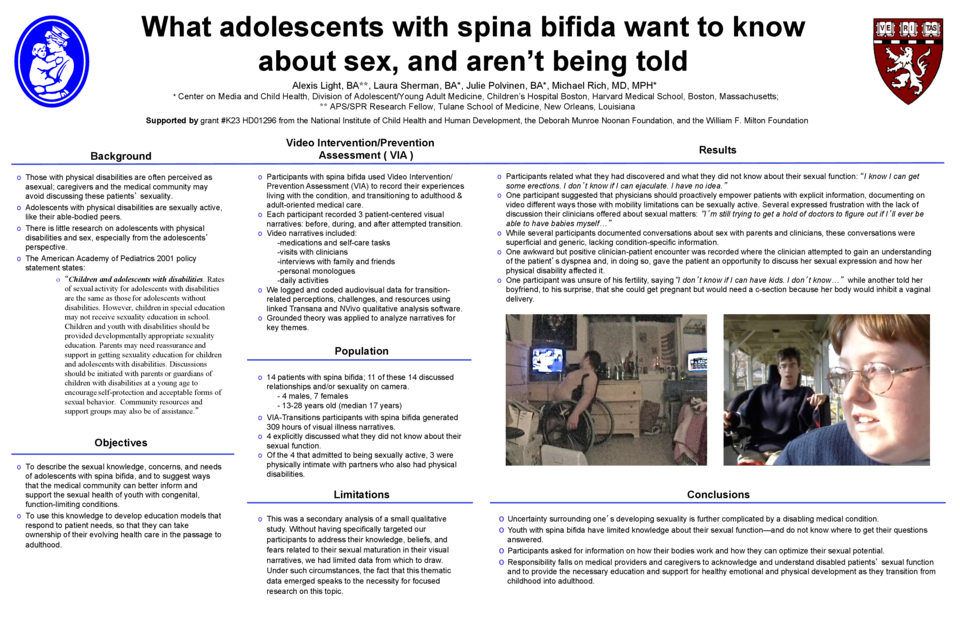
Purpose: Although adolescents with physical disabilities are as sexually curious, and often capable, as their peers, they are often inadequately informed about sex and how their physical condition interacts with their sense of self as sexual beings. Little is known about sexual implications of congenital conditions, due to historical early mortality, variations in individual abilities, infantilization of disabled youth, and attitudes among parents and caregivers about both sex and eugenics. We sought the expertise of youth with spina bifida to share their knowledge, experience, questions, concerns, and uncertainty regarding their sexual health through Video Intervention/Prevention Assessment (VIA) visual narratives.
Methods: Participants with spina bifida (n=14, median=17 years) produced VIA visual illness narratives on their experiences transitioning to adulthood and adult-oriented care. With directions simply to “teach their clinicians what you are experiencing and what you need”, participants explored issues important to them. Using established VIA methods, visual data were logged, coded, and analyzed using grounded theory. Themes of sexuality, relationships, and interactions with clinicians about sexual health were extracted and assessed.
Results: Eleven of 14 participants (7 female, 9 Caucasian, ages 13-28) addressed issues surrounding relationships and sexuality; four explicitly discussed their sexual activity on camera. Three of these participants were physically intimate with partners who had disabilities. Participants related what they had discovered and what they did not know about their sexual function: “I know I can get some erections. I don’t know if I can ejaculate. I have no idea.” One participant suggested that physicians should proactively empower patients with explicit information, documenting on video different ways those with mobility limitations can be sexually active. Several expressed frustration with the lack of discussion clinicians offered about sexual matters: “I’m still trying to get ahold of doctors to figure out if I’ll ever be able to have babies myself…” While several participants documented conversations about sex with parents and clinicians, these conversations were superficial and generic, lacking condition-specific information. One awkward, but positive clinician-patient encounter was recorded where the clinician attempted to gain an understanding of the patient’s dyspnea and, in doing so, gave the patient an opportunity to discuss her sexual expression and how her physical disability is affecting it. One participant was unsure of his fertility, “I don’t know if I can have kids. I don’t know…” while another told her boyfriend, to his surprise, that she could get pregnant, but would need a c-section because her body would inhibit a vaginal delivery.
Conclusion: Uncertainty surrounding one’s developing sexuality is further complicated by a disabling medical condition. Youth with spina bifida have limited knowledge about their sexual function - and do not know where to get their questions answered. Through their VIA narratives, participants asked for information on how their bodies work and how they can optimize their sexual potential. Responsibility falls on medical providers and caregivers to acknowledge and understand disabled patients’ sexual function, providing the necessary education and support for healthy emotional and physical development as they transition from childhood into adulthood.