Abstract
Objectives: Repeat radiation to the lung for lung cancers and lung metastases is increasingly common. We review our long-term experience of patients receiving at least 3 or more courses of repeat SBRT to the thorax for patients with lung cancer or lung metastases in a single community setting.
Methods: Eighteen patients who received at least three courses of radiation to the lung with the third course delivered between January 2011 and December 2017 were eligible. Patients were excluded if a non-curative dose was delivered. Dose summation was performed via MIM software of all courses and cumulative dose volume histogram generated. Overall survival (OS) was calculated from the completion of third RT course for all patient with Kaplan-Meier methodology and comparisons of pre-treatment and treatment variables accomplished using log-rank statistics. A backwards selection Cox PH multivariable model was generated.
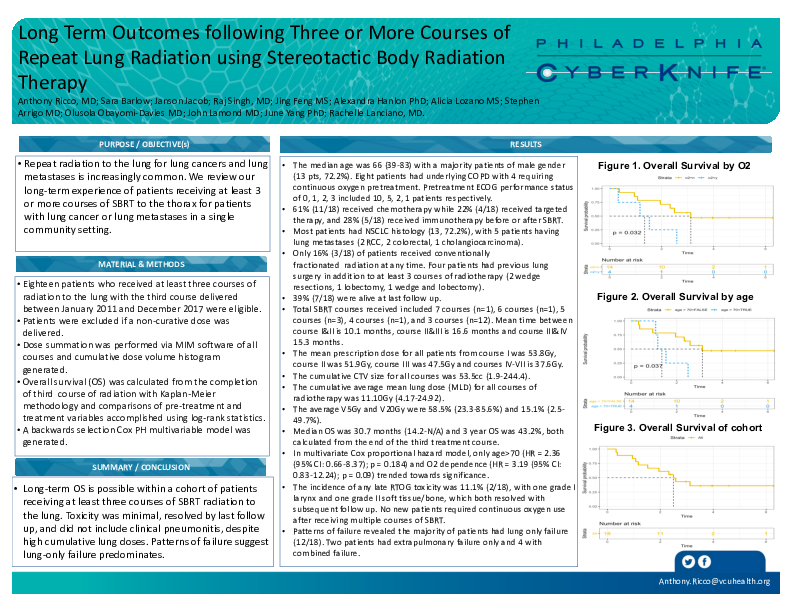
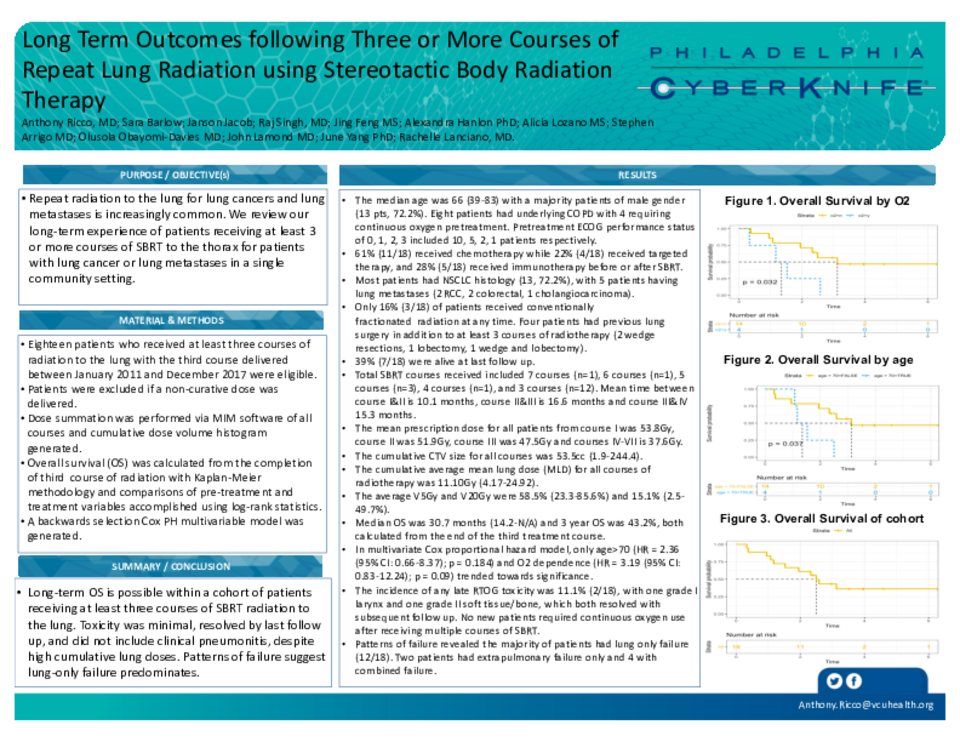
Results: The median age of the cohort was 66 (39-83) with a majority patients of male gender (13 pts, 72.2%). Eight patients had underlying COPD with 4 requiring continuous oxygen pretreatment. Pretreatment ECOG performance status of 0, 1, 2, 3 included 10, 5, 2, 1 patients respectively. 61% (11/18) received chemotherapy while 22% (4/18) received targeted therapy, and 28% (5/18) received immunotherapy before or after SBRT. Most patients had NSCLC histology (13, 72.2%), with 5 patients having lung metastases (2 RCC, 2 colorectal, 1 cholangiocarcinoma). Only 16% (3/18) of patients received conventionally fractionated radiation at any time. Four patients had previous lung surgery in addition to at least 3 courses of radiotherapy (2 wedge resections, 1 lobectomy, 1 wedge and lobectomy). 39% (7/18) were alive at last follow up.
Total SBRT courses received included 7 courses (n=1), 6 courses (n=1), 5 courses (n=3), 4 courses (n=1), and 3 courses (n=12). Mean time between course I&II is 10.1 months, course II&III is 16.6 months and course III&IV 15.3 months. The mean prescription dose for all patients from course I was 53.8Gy, course II was 51.9Gy, course III was 47.5Gy and courses IV-VII is 37.6Gy. Median margin is 5mm. Average number of radiation beams was 126.4. The cumulative CTV size for all courses was 53.5cc (1.9-244.4). The cumulative average mean lung dose (MLD) for all courses of radiotherapy was 11.10Gy (4.17-24.92). The average V5Gy and V20Gy were 58.5% (23.3-85.6%) and 15.1% (2.5-49.7%).
Median OS was 30.7 months (14.2-N/A) and 3 year OS was 43.2%, both calculated from the end of the third treatment course. In multivariate Cox proportional hazard model, only age>70 (HR = 2.36 (95% CI: 0.66-8.37); p = 0.184) and O2 dependence (HR = 3.19 (95% CI: 0.83-12.24); p = 0.09) trended towards significance. The incidence of any late RTOG toxicity was 11.1% (2/18), with one grade I larynx and one grade II soft tissue/bone, which both resolved with subsequent follow up. No new patients required continuous oxygen use after receiving multiple courses of SBRT. Patterns of failure revealed the majority of patients had lung only failure (12/18). Two patients had extrapulmonary failure only and 4 with combined failure.
Conclusions: Long-term OS is possible within a cohort of patients receiving at least three courses of SBRT radiation to the lung. Toxicity was minimal, resolved by last follow up, and did not include clinical pneumonitis, despite high cumulative lung doses. Patterns of failure suggest lung-only failure predominates.