
Abstract
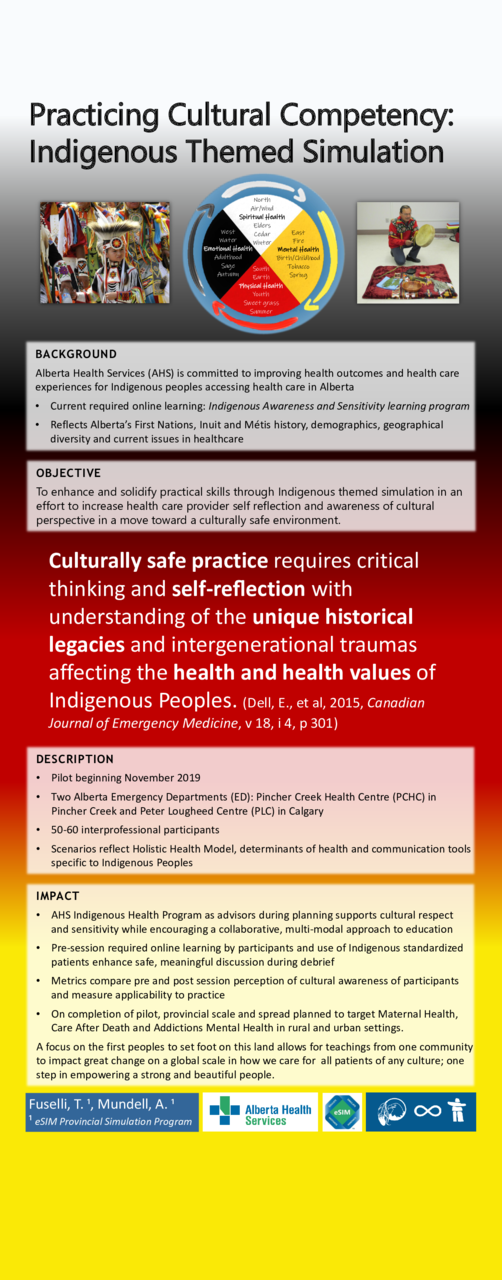
Alberta Health Services (AHS) is committed to improving health outcomes and the health care experiences for Indigenous peoples in Alberta through the appropriate allocation of resources and support, and a culturally competent, diverse and inclusive workforce. An Indigenous Awareness and Sensitivity learning program was developed and provided by AHS as required learning for all staff which reflects Alberta’s First Nations, Inuit and Metis history, demographics, geographical diversity and current issues when it comes to healthcare. Increased understanding and sensitivity to this unique population are necessary steps for improved outcomes and an inclusive environment when faced with illness.
The modality of simulation as a teaching approach enables application of learned knowledge to enhance and solidify practical skills of communication in an indigenous frame, increasing sensitivity in the provision of health care and building cultural competence. The eSIM Indigenous Integration Simulation Package includes a guideline for use, allowing faculty to deliver a rich simulation experience to diverse, interprofessional teams and areas across Alberta, with careful direction and informed guidance.
Indigenous experts as stakeholders provide an invaluable role as advisors and as participants in the debrief forum to open meaningful conversations and ensure the traditions and values of our Indigenous population are maintained within a safe simulation environment.
A Customizable Scenario Suite includes indigenous concepts focusing on the importance of extended family as a support system, impact of traumatic indigenous history on current beliefs, indigenous vs western health care practices, and alignment of communication differences. Scenarios are easily adapted to reach all urban and rural settings, diverse areas of care and professions in health care in a multicultural population.
Case examples include:
• Indigenous mother, suspected victim of domestic violence, presents to labor and delivery
• attempted suicide patient presents to Mental Health unit/clinic/Emergency Department
• Care of Indigenous patient After Death
• Indigenous patient, reluctant to accept western medicine care, presents to hospital or rural clinic.
The application of indigenous themes to practical education through experiential simulation will develop culturally competent practice with our unique indigenous population, while supporting cultural safety and intercultural interactions in the health care environment.




