Abstract
Background
Simulation-based education is part of modern education and in-situ based training of clinicians and teams may offer additional benefits.
Question
Does in-situ simulation-based training improve patient outcomes?
Answer
Systematic literature review.
Method
Search PUBMED, OVID, WEB OF SCIENCE, CINAHL, SCOPUS, and EMBASE for a combination of keywords: in situ, and simulation and patient outcomes. Due to the potential variable study designs and methodologies (heterogeneity), instead of a quantitative meta-analysis we performed a narrative synthesis.
Inclusion criteria:
- Conducted simulations were explicitly in situ
- Subjects of the studies must have included healthcare providers or trainees
- Studies used direct patient outcomes such as morbidity or mortality as a metric of analysis (result in Kirkpatrick level 4 or improvement in 7I framework)
- In English
- Peer-reviewed
Exclusion criteria:
- Secondary research; studies such as review articles or systematic reviews
- Not meeting inclusion criteria
Quality assessment
Risk of bias was assessed independently by two reviewers. Risk of bias was determined as a consensus.
Data extraction
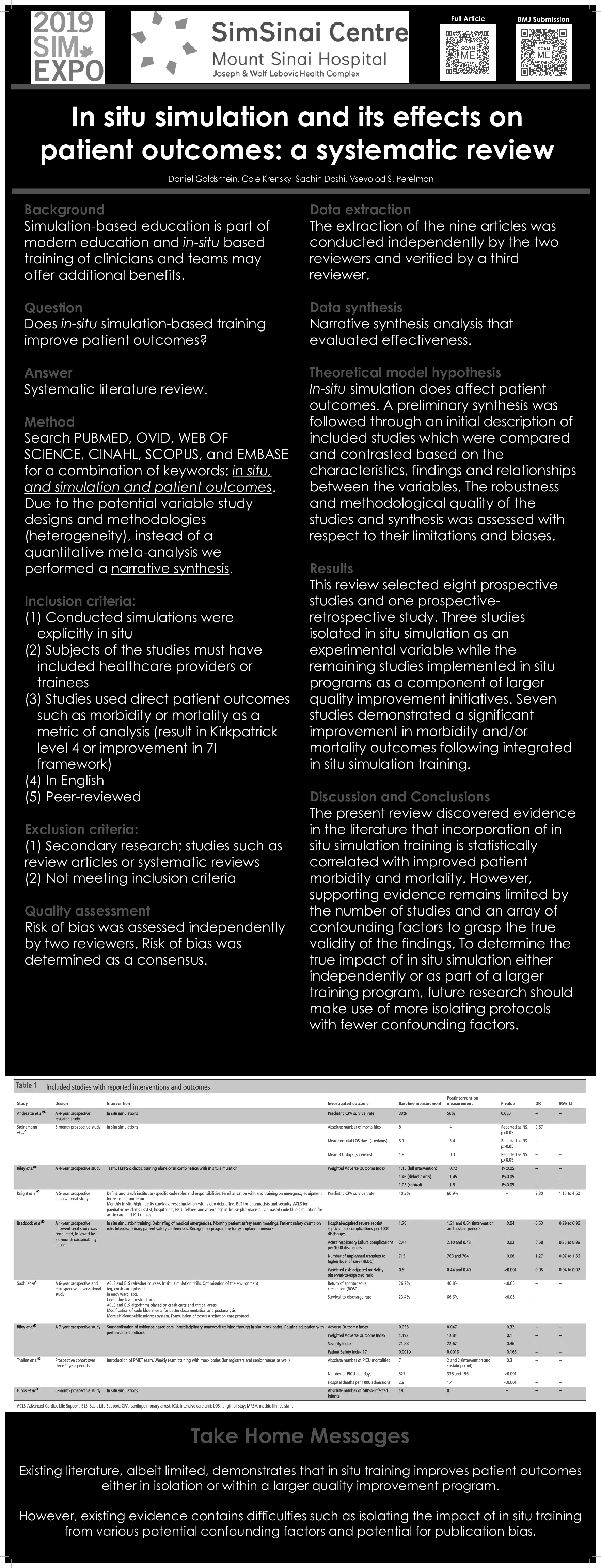
The extraction of the nine articles was conducted independently by the two reviewers and verified by a third reviewer.
Data synthesis
Narrative synthesis analysis that evaluated effectiveness.
Theoretical model hypothesis
In-situ simulation does affect patient outcomes. A preliminary synthesis was followed through an initial description of included studies which were compared and contrasted based on the characteristics, findings and relationships between the variables. The robustness and methodological quality of the studies and synthesis was assessed with respect to their limitations and biases.
Results
This review selected eight prospective studies and one prospectiveretrospective study. Three studies isolated in situ simulation as an experimental variable while the remaining studies implemented in situ programs as a component of larger quality improvement initiatives. Seven studies demonstrated a significant improvement in morbidity and/or mortality outcomes following integrated in situ simulation training.
Discussion and Conclusions
The present review discovered evidence in the literature that incorporation of in situ simulation training is statistically correlated with improved patient morbidity and mortality. However, supporting evidence remains limited by the number of studies and an array of confounding factors to grasp the true validity of the findings. To determine the true impact of in situ simulation either independently or as part of a larger training program, future research should make use of more isolating protocols with fewer confounding factors.
Take Home Messages
Existing literature, albeit limited, demonstrates that in situ training improves patient outcomes either in isolation or within a larger quality improvement program.
However, existing evidence contains difficulties such as isolating the impact of in situ training from various potential confounding factors and potential for publication bias.