Abstract
BACKGROUND
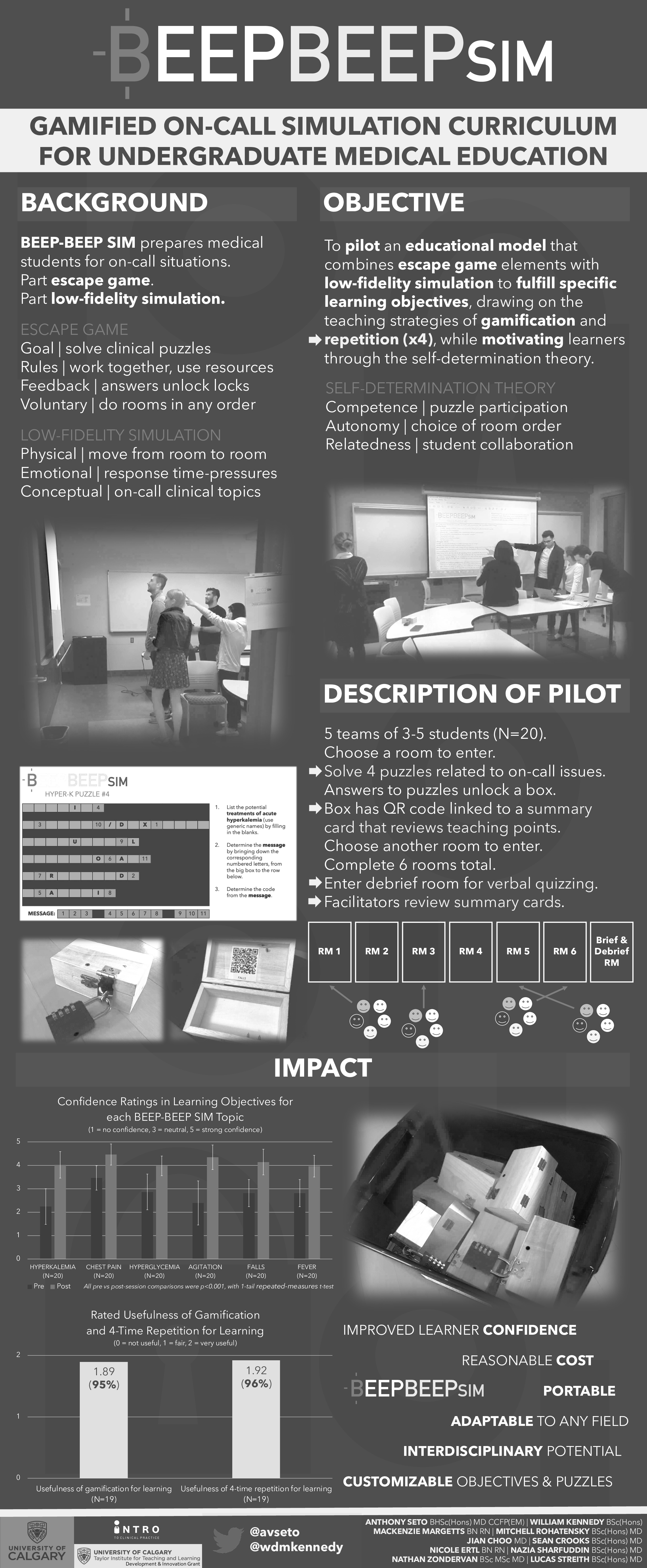
“BEEP-BEEP SIM” prepares medical students to be paged for on-call situations. The innovation is a hybrid between an escape game and low-fidelity simulation.
An escape game is a team-based activity where a group works together to solve a series of puzzles in order to escape a room, under a time limit. In “BEEP-BEEP SIM", students are tasked with solving puzzles in 6 different rooms to successfully pass/complete those rooms. A game can be considered to have four aspects: goal, rules, feedback system, and voluntary component. In “BEEP-BEEP SIM”, the goal is to solve clinical puzzles. The rule is for students to work on puzzles together, using resources as required. The feedback is built-in by having answers unlock locks. The voluntary component is that the 6 rooms can be completed in any order.
A low-fidelity approach to simulation involves using lower-tech strategies to simulate physical, emotional, and conceptual realism. “BEEP-BEEP SIM” uses inexpensive locks and boxes to facilitate the activity and a digital projector to display puzzles. Physically, learners move room-to-room to simulate being on-call. Emotionally, students face time-pressures when solving clinical issues. Conceptually, students review on-call topics.
“BEEP-BEEP SIM” is grounded in the self-determination theory, which posits that learner motivation requires the needs of competence, autonomy, and relatedness met. Competence is achieved through puzzle participation, choice in the order to complete rooms embraces autonomy, and student collaboration promotes relatedness.
OBJECTIVE
To pilot an educational model that combines escape game elements with low-fidelity simulation to fulfill specific learning objectives, drawing on strategies of gamification and repetition, while motivating learners through the self-determination theory.
DESCRIPTION OF THE INNOVATION
5 teams of 3-5 students (n=20) piloted “BEEP-BEEP SIM”. Teams completed 6 rooms in any order. Each room contained 4 puzzles related to a single on-call clinical topic. If teams exceeded 10-minutes for a room, a facilitator assisted. Solving 4 puzzles (exposure #1 to curricular content) enabled unlocking of a room’s box. Each box contained a summary card of teaching points for that room, which students reviewed (exposure #2). Once all 6 rooms were completed, students were debriefed in the debrief room; this included a verbal quiz to promote retrieval of learned content (exposure #3) and an instructor-facilitated summary to reiterate learning points (exposure #4).
IMPACT
The average learner-reported confidence (n=20) in learning objectives for Hyperkalemia (2.24 to 4.02), Chest Pain (3.46 to 4.46), Hyperglycemia (2.86 to 3.98), Agitation (2.39 to 4.34), Fall (2.81 to 4.14), and Fever (2.81 to 3.96) significantly increased pre- vs post-session (all p<0.001, 1-tail repeated-measures t-test). “BEEP-BEEP SIM” was reported as “fun”, “interactive”, “engaging”, “low stakes”, and “high-yield”. On a scale of “not useful” (0) to “very useful” (2), students (n=19) rated gamification 1.89/2.00 and the 4-time exposure repetition design 1.92/2.00.
“BEEP-BEEP SIM” improves learner confidence, with advantages of being relatively low-cost and portable. This educational model may be adapted for training in any field, and has interdisciplinary potential, as objectives and associated puzzles are easily customizable.