Abstract
Objective: To describe the current use of dryland training in swimmers by age category.
Design: Randomized Sampling Questionnaire
Setting: Web-based survey
Participants: Ninety-Seven Coaches from swim clubs throughout the United States
Main Outcome Measures: Dryland training use, frequency, duration, mode of exercise, and exercise by body region in the following groups: ≤10 yrs, 11-14 yrs, 15-18 yrs, Collegiate, and Masters swimmers
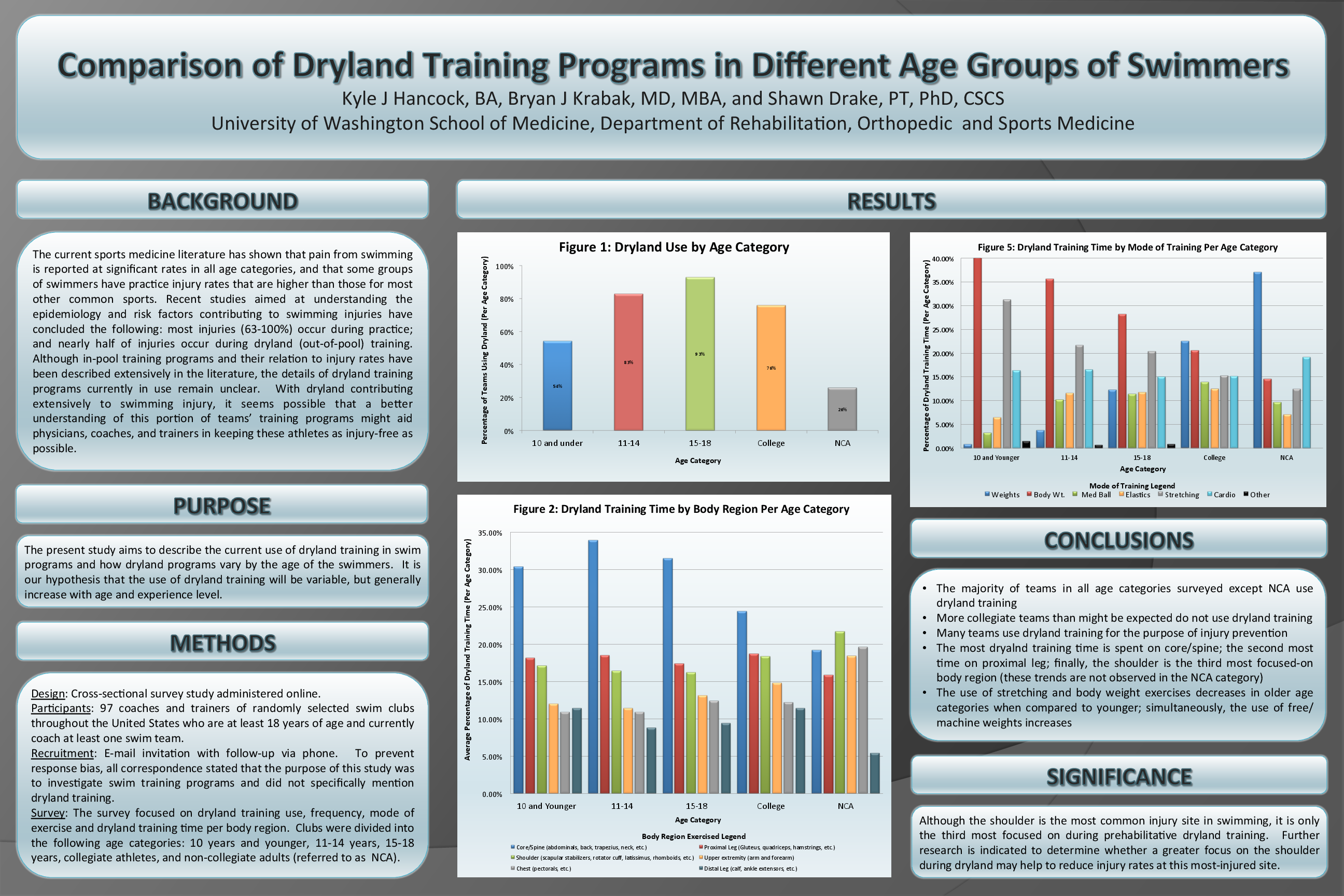
Results: Among the surveyed coaches (n=97), dryland training use varied by swimmers’ age (≤10 yrs [54%], 11-14 yrs [83%], 15-18-yrs [93%], Collegiate [86%], Masters [26%]) as did training modality (age ≤18 yrs [body weight exercises, stretching]; Collegiate [free/machine weights and body weight exercises]; Masters [weight and cardiovascular training]). The most common body region exercised for all categories except Masters was the spine/core, followed by the proximal leg and then the shoulder. Masters swimmers focused on the shoulder region followed by the spine. The primary reason for participation in dryland training was injury prevention for all categories except Masters. Limited practice time was the most common reason for not using dryland training.
Conclusions: 50-93% percent of swim coaches surveyed for all groups except Masters incorporated some form of dryland training, utilizing body weight exercises in younger swimmers. The focus of dryland training among swimmers ≤18 years and collegiate swimmers was the spine/core. These findings may be utilized to develop future studies on how dryland training contributes to performance or injuries, especially in the younger swimmer.