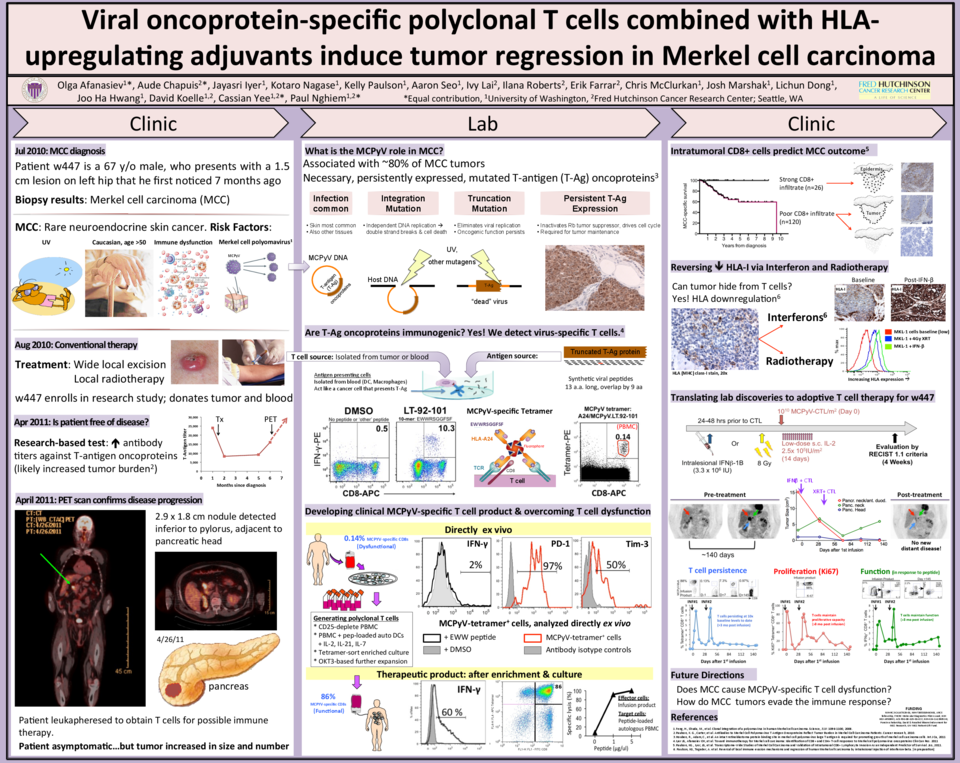
Viral Oncoprotein-Specific Polyclonal T Cells Combined with HLA-Upregulating Adjuvants Induce Tumor Regression in Merkel Cell Carcinoma
Abstract
Persistent expression of Merkel cell polyomavirus (MCPyV) T antigen oncoproteins is required for the growth of most Merkel cell carcinomas (MCCs). MCPyV oncoproteins are thus an attractive target for adoptive T-cell therapy. Although most MCCs evade CD8 T cells by down-regulating class I HLA expression, we report that a single dose of either radiotherapy (2-8 Gy) or interferon reverses HLA-I downregulation in MCCs and can be used as adjuvants in combination with T cell immumotherapy.
Patient w447 had a primary MCC on the hip that expressed low levels of HLA-I, high levels of MCPyV oncoprotein, and contained MCPyV-specific CD8 T cells. Based on rising antibody titers to MCPyV T-antigen, he was later found to have a peri-pancreatic metastasis. Blood-derived virus-specific T cells failed to respond to peptide challenge and expressed high levels of T cell exhaustion markers PD-1 and Tim-3. To generate therapeutic T cells, his lymphocytes were cultured for a week with peptide-loaded autologous dendritic cells, IL-2, IL-7, and IL-21. MCPyV-specific cells were then sorted using an HLA-I/peptide tetramer and further expanded. 86% of these polyclonal CD8+ T cells were virus-specific and killed appropriate target cells. 24h after injecting interferon-beta into a pancreatic metastasis, the patient received 10^10 T cells/m2. Four weeks later, a second T cell infusion was given 24h after an 8 Gy dose of radiation to the tumor area. Treatment was well tolerated. After 2 treatments, all 3 metastatic lesions had markedly responded (>60% shrinkage by RECIST). No new distant disease has been detected at 456 days after the first metastasis (median time to distant progression is 200 days among 49 stage-matched MCC patients). At >140 days after initiation of therapy, each of the following parameters remained markedly increased among virus-specific T cells in the blood: frequency, Ki-67 positivity (proliferation) and antigen-induced interferon-gamma production. TCR sequence analysis was used to track the prevalence and tumor infiltration of infused T cell clonotypes. After treatment, an increased fraction of virus-specific T cells was observed in the metastasis compared to a pre-treatment biopsy of the primary tumor. The use of polyclonal T cells may have been important because only one of several infused virus-specific clones effectively infiltrated the sampled metastasis. This study represents a first-in-man treatment of a carcinoma using T cells targeting an oncogenic viral antigen.
Related articles