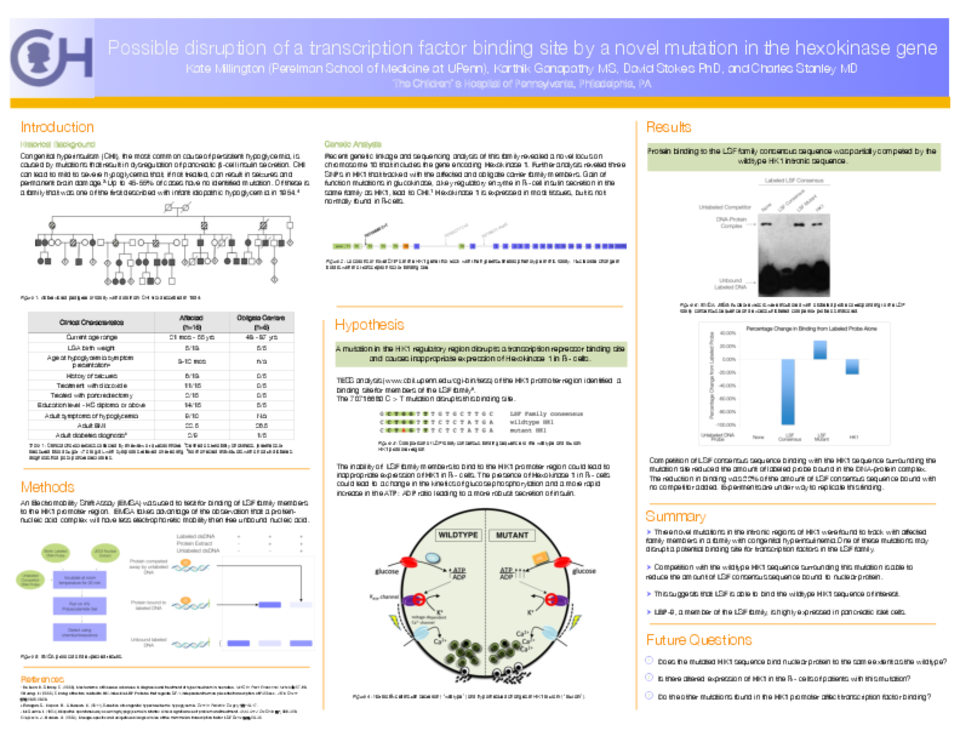
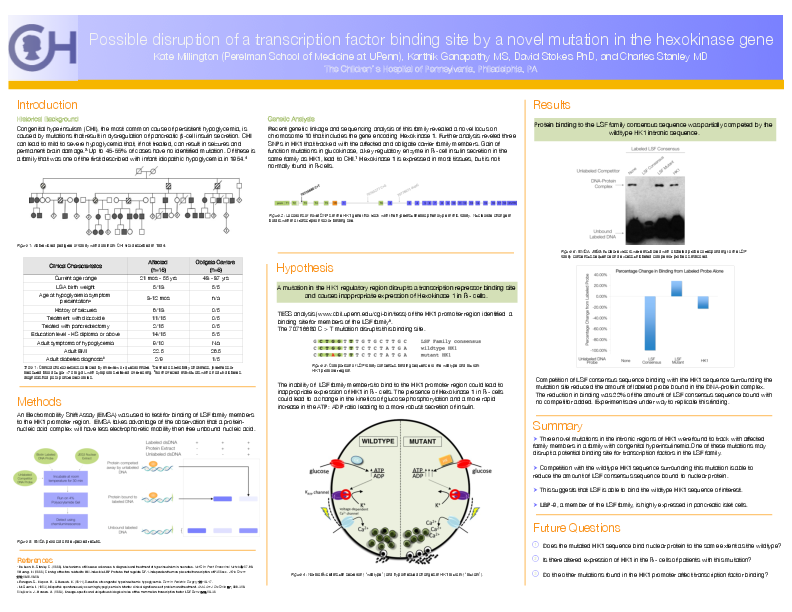
Possible Disruption Of A Transcription Factor Binding Site By A Novel Mutation In The Hexokinase Gene
Abstract
Congenital Hyperinsulinemia is associated with mutations in genes whose products are involved in regulation of β-cell insulin secretion. Genetic analysis of a family with an autosomal dominantly inherited hyperinsulinemia phenotype revealed several mutations in the hexokinase 1 gene (HK1) intronic regions. HK1 is expressed in most tissues, but not in pancreatic β-cells where phosphorylation of glucose is performed by glucokinase. Based on sequence similarity of one mutation site with the consensus binding site of transcription factors in the LSF (Late SV40 Factor) family, which exhibit both activator and repressor function, we hypothesized that disruption of repressor binding may lead to inappropriate expression of HK1 in β cells. Inappropriate expression of hexokinase in β cells could result in altered glucose phosphorylation kinetics leading to a dysregulated release of insulin. To assess possible transcription factor binding to the HK1 intronic sequence an Electromobility Shift Assay (EMSA) using nuclear protein extracts of JEG3 cells known to have high expression of LSF family members was performed. Nuclear protein binding was detected to the LSF consensus sequence. These DNA-protein complexes were fully competed away by excess unlabeled LSF consensus sequence, and partially competed by excess unlabeled HK1 promoter sequence. This indicates that LSF family members may bind the HK1 intronic sequence, and thus, may play a role in the regulation of HK1 expression.
Related articles