Abstract
Background/rationale/context: In 2011, physiotherapists were granted the ability to perform controlled acts, due to changes to the Physiotherapy Act. As a result, the College of Physiotherapists of Ontario (CPO) required that all physiotherapists roster for each controlled act they perform in practice.
Rostering requirements include indicating: “the year training was completed/ how you received your training, describe the theory/ practical portions, how you were assessed and indicate whether you have performed the activity or completed training over the last two years” (College of Physiotherapists of Ontario, 2017).
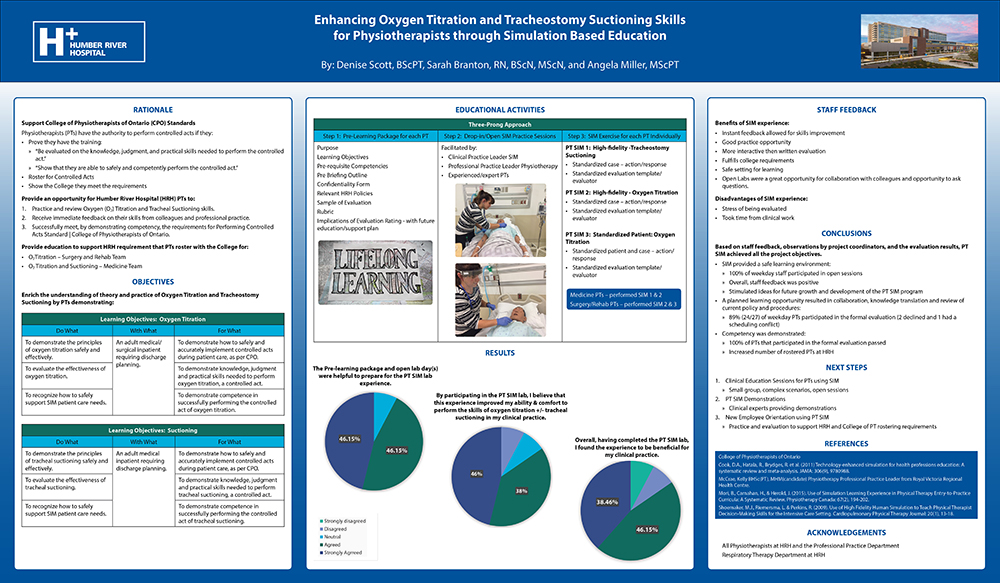
To enhance the method of assessment and ensure quality assurance practices of the required controlled acts, a combination of different simulation modalities were explored.
Objective: To enrich staff’s understanding of the theory/practical application of controlled acts which Humber River Hospital physiotherapists are required to perform during patient care. Each physiotherapist, was expected to: 1) To demonstrate how to safely/accurately implement a controlled act; 2) To demonstrate the knowledge, judgment and practical skills needed to perform controlled acts; and 3) To demonstrate competence in successfully performing the identified controlled act.
Description of the innovation: Three simulations, including two high-fidelity, where developed inter-professionally to assist with the standardized approach of evaluating the staff’s skills in performing each controlled act. All physiotherapy staff were invited to attend lunch and learn sessions in the simulation lab to practice and review the practical skills for each controlled act.
Impact: Participation was voluntary and 89% of staff completed the simulation. Debriefing enabled the evaluator to provide immediate feedback to the participant. Feedback enabled relevant reflections on different techniques, order of operation, the impact of medical diagnosis on clinical decision making and initiated discussions related to critical thinking of clinical application versus policy and guidelines.
The post simulation survey showed 82% agreed/strongly agreed that completing the simulations were beneficial for their practice. For 91% of respondents they agreed/strongly agreed that the drop-in sessions and pre-learning packages increased their knowledge of policies and were helpful to prepare for the simulations. The simulations improved 82% of respondent’s comfort/ability to perform the controlled acts. For 73% of respondents, they agreed/strongly agreed they were more confident to meet the CPO requirements.